



|
Getting your Trinity Audio player ready...
|
By: Ariella Haviv
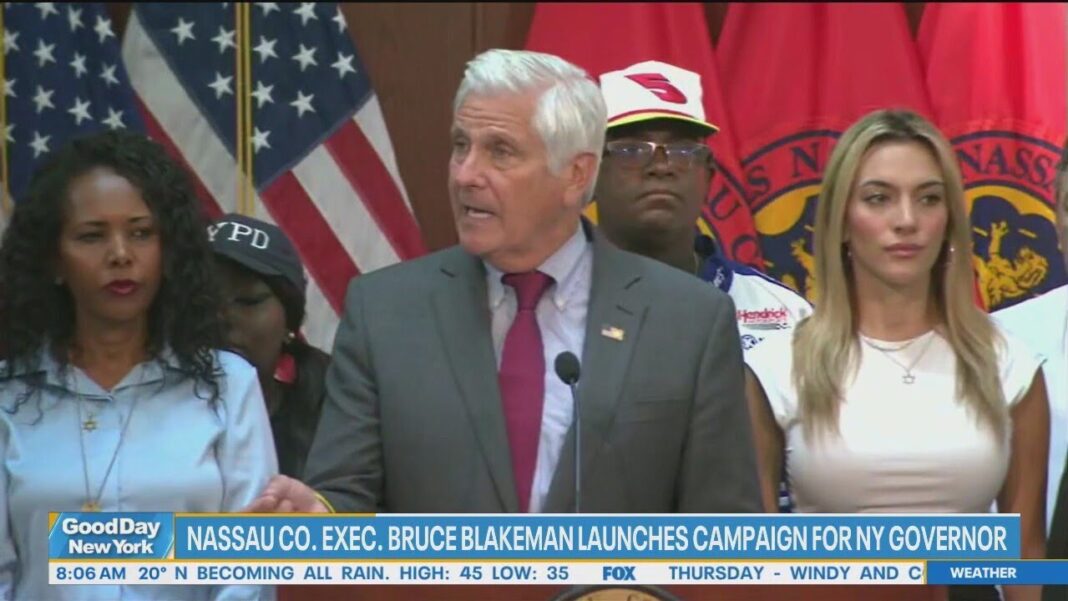
In an announcement on Tuesday that instantly reshaped New York’s 2026 political landscape, Nassau County Executive Bruce Blakeman declared on Fox & Friends that he is officially seeking the Republican nomination for governor, positioning himself as a candidate who will, in his own words to Fox News Digital, “put New York first” and restore safety, affordability, and optimism across a state he argues has been battered by mismanagement and ideological extremism under Democratic leadership.
Blakeman’s entrance into the race—broadcast live to a national audience—immediately ignited a fierce political firestorm. It drew swift denunciations from Gov. Kathy Hochul’s campaign, triggered a sharply worded response from the camp of Blakeman’s most formidable primary rival, Rep. Elise Stefanik, and prompted renewed scrutiny of the Republican Party’s internal dynamics as it prepares for what could be its most consequential gubernatorial contest in decades.
Within hours of Blakeman’s appearance on Fox & Friends, Gov. Hochul’s campaign issued a blistering attack, branding the Nassau County executive a “MAGA fanboy” and mocking his electoral track record.
Hochul campaign communications director Sarafina Chitika unleashed an unusually personal volley, telling Fox News Digital and other outlets that Blakeman “has lost just about every race he’s touched,” ticking off failed bids for county legislator, comptroller, Congress, and even U.S. Senate.
“Just like Donald Trump,” Chitika charged, “he takes money out of New Yorkers’ pockets and squeezes working families at every turn.”
She accused Blakeman of flying to Washington to applaud tariffs that “raised costs,” and of praising Trump for “gutting Medicaid” and “jacking up costs.” Her statement culminated in a dramatic flourish: “We’re not about to let him turn the governor’s mansion into Mar-a-Lago North.”
The unusually caustic tone from the Hochul campaign—highlighted across Fox News Digital coverage—underscored how seriously Democrats are taking the early stages of the race, even as Republicans remain divided on whom to nominate.
Blakeman’s response, delivered again through Fox News Digital, was equally sharp. He said that Hochul “has been a failure by every imaginable metric.”
“I made Nassau County the safest county in America,” he told Fox’s Brian Kilmeade. “We’re one of the most prosperous counties in America. I cut taxes—I haven’t raised taxes a penny in four years. We’ve created economic prosperity. Our poverty rate is one-third of the poverty rate of the state of New York.”
Blakeman insisted that his track record shows “what real leadership looks like,” and argued that he would replicate Nassau County’s success on a statewide scale.
He framed his campaign around three themes that he repeatedly emphasized during the interview: prosperity, safety, and happiness.
“I’m running to make people more prosperous, to make them safer, and to make New Yorkers happy again,” he said—echoing language he has frequently used on Fox News Digital, where he has cultivated a national conservative audience.
Complicating Blakeman’s path is the presence of a heavyweight contender: Rep. Elise Stefanik, the House Republican Conference Chair, who entered the gubernatorial race with overwhelming institutional support from the GOP and Conservative Party.
When asked by reporters about the prospect of two of his political allies competing, President Trump offered warm words for both.
“He’s great and she’s great,” Trump said—remarks highlighted prominently by Fox News Digital. “They’re both great people.”
For Blakeman, Trump’s neutrality is a political lifeline. For Stefanik, it is an expected opening bid in what could become the most intensely watched Republican primary in the state since George Pataki’s run in the 1990s.
If the Hochul camp’s reaction was blistering, Stefanik’s response was devastating.
In a detailed statement, Stefanik’s campaign argued that Blakeman is not merely a weaker candidate but a dangerous liability for the party’s chances in November.
“Public polling has repeatedly shown Elise Stefanik leads Blakeman by 70% in a primary,” the statement said, “including beating him soundly on Long Island.”
The campaign emphasized Stefanik’s unmatched electoral record: She has outrun Donald Trump on the ballot by wider margins than any other Republican in New York. She flipped a congressional seat that had eluded Republicans for years. She commands a broad coalition of Republicans, independents, and even Democrats. She has raised tens of millions of dollars to support GOP candidates across the state and the country.
The harshest critique centered on Blakeman’s ideological controversies.
“Bruce Blakeman is anti-2A,” the statement said, calling this “the kiss of death Upstate.”
It accused him of donating to “Far Left Democrats” and of “losing numerous statewide, federal, and local races in smashing fashion.”
The conclusion was unambiguous: “Bruce Blakeman is an early Christmas present to Kathy Hochul.”
It was a message calibrated not only to undermine Blakeman’s candidacy, but to suggest that nominating him would effectively hand Hochul a second full term.
When pressed on whether he expects Trump to choose between himself and Stefanik, Blakeman took a restrained approach.
“I don’t think the president has to make a decision now,” he told Fox & Friends. “Let’s see how it plays out.”
He then pivoted to robust praise of Trump’s presidency.
“He’s done more for America in the last 11 months than any president in my lifetime,” Blakeman said. “He’s done a great job with the economy. He’s going to Pennsylvania today to talk about economic development and prosperity. Those are the same things I want to do for New York State.”
The praise appeared carefully calibrated: strong enough to resonate with pro-Trump GOP voters, but cautious enough to avoid alienating moderates or forcing Trump’s hand prematurely.
Blakeman’s pitch leans heavily on his tenure in Nassau County, where crime rates are low, taxes have remained flat, and household wealth is among the highest in the state.
He frequently cites a four-year tax freeze, designation as the safest county in America, a poverty rate significantly below the state average.
These metrics, repeatedly highlighted in his Fox News appearances, form the spine of his argument that he can “fix” New York.
Blakeman also framed his governorship as a cultural correction, saying he wants to “make New Yorkers happy again”—a sentiment that merges economic messaging with a broader sense of nostalgia for stability and civic pride.
Despite the early energy behind his campaign, Blakeman faces structural challenges.
Fox News Digital has noted repeatedly that Stefanik entered the race with instant endorsements from Republican and Conservative Party leadership, superior statewide name recognition, a decisive polling advantage and a massive national fundraising network.
For Blakeman to compete, he must rely on his strong political base in Long Island, his identity as a hands-on executive rather than a Washington figure, his deep ties to New York’s law enforcement community, and his rapport with Fox News audiences, But the central dynamic remains unavoidable: Stefanik is the presumptive Republican frontrunner, and Blakeman is challenging the party’s hierarchy at a moment when Republicans see an unusually high potential for defeating a vulnerable Democratic incumbent.
One reason the gubernatorial race is drawing national attention—particularly in Fox News Digital coverage—is the perception that Gov. Hochul is unusually vulnerable.
Her political liabilities include rising crime concerns, a housing affordability crisis, deep fractures within the Democratic Party, ongoing tension with the Biden administration over migrant policy, fierce public criticism from Jewish community leaders after protests outside synagogues and a turbulence-filled first term marked by low approval ratings.
Republicans believe Hochul’s vulnerabilities could lead to the first GOP governorship in New York since Pataki’s final term ended in 2006.
But Stefanik’s allies argue that nominating Blakeman would squander the opportunity.
If Stefanik presents herself as the national figure capable of galvanizing a new statewide coalition, Blakeman positions himself as a local problem-solver who has already demonstrated executive competence.
The 2026 Republican primary will thus test two competing theories of political power: The Washington-rooted, high-profile, nationalized campaign model — embodied by Stefanik and the hyper-local, executive-success-based model — embodied by Blakeman. Both are credible. Both have strengths. And both have vulnerabilities.
With nearly a year until the Republican primary, the race is poised to become one of the most contentious and closely watched contests in New York politics.
Blakeman is betting that voters want a governor who has already delivered measurable results at the county level.
Stefanik is betting that voters want a nationally recognized Republican warrior capable of uniting the right and defeating Hochul.
Trump, for now, is maintaining a studied neutrality—though Fox News Digital reporting suggests his eventual endorsement could reshape the field instantly.
What is certain is that Blakeman’s announcement has already transformed the race, prompting sharp exchanges, ideological clashes, and competing visions for New York’s future.
As Blakeman told Fox & Friends, “Let’s see how it plays out.”
In a state hungry for change and reeling from years of political turbulence, voters will soon decide which Republican—if any—can capitalize on the moment.
I see no reason for Blakeman to muddy the waters for Stefanik. She is a strong candidate and why ruin things by making her spend her dollars in a primary campaign. Blakeman should bite the bullet and run against Schumer and he might stand the best chance there.
I would never forgive him if Stefanik did not win because of his interference.