



|
Getting your Trinity Audio player ready...
|
By: Abe Wertenheim
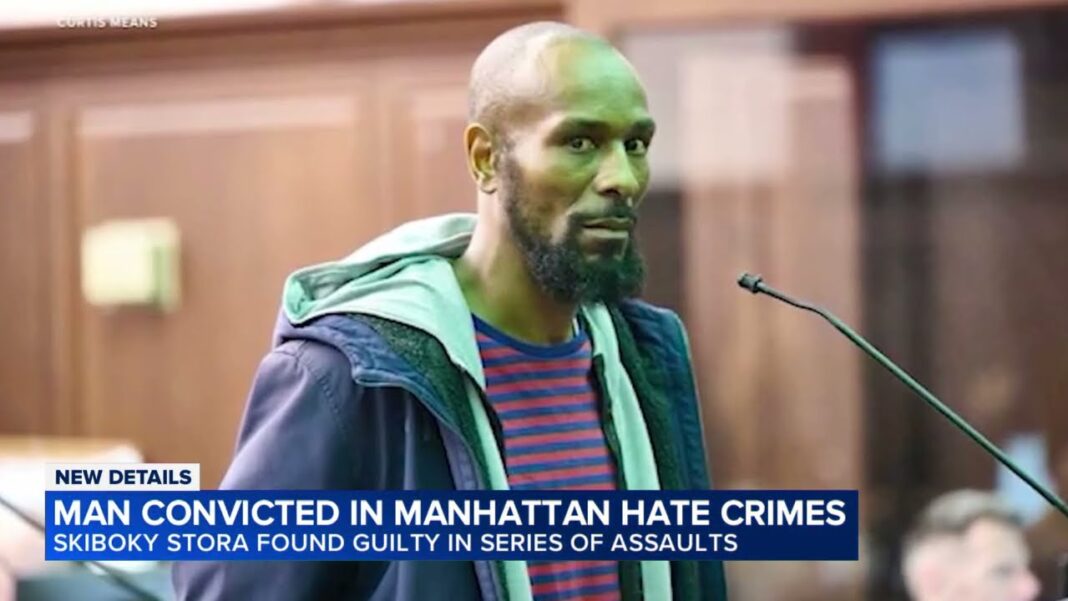
A New York State Supreme Court judge has convicted a Brooklyn man of carrying out a disturbing series of bias-driven attacks across Lower Manhattan, including an antisemitic assault on a Jewish couple in Union Square that shocked residents and intensified concerns about rising hate crimes in the city. The conviction, announced by Manhattan District Attorney Alvin L. Bragg Jr., marks a significant legal rebuke of what prosecutors described as a sustained campaign of racially and religiously motivated violence.
As reported on Thursday by VIN News, Skiboky Stora, 42, was found guilty Wednesday by Justice Josh Hanshaft on multiple counts, including two counts of assault in the third degree as hate crimes, stalking in the third degree as a hate crime, aggravated harassment in the second degree, and attempted assault in the third degree as a hate crime. The verdict followed months of testimony detailing a pattern of assaults and harassment between September 2023 and March 2024, many of which targeted individuals perceived by the defendant to be white or Jewish.
The case represents one of the more high-profile hate crime prosecutions in Manhattan in recent months, reflecting both the persistence of antisemitic incidents in New York City and the determination of prosecutors to pursue bias-driven offenses vigorously.
The most widely publicized episode occurred on November 18, 2023, in Union Square. Court documents and trial testimony, as summarized in the VIN News report, established that Stora was observed tearing down posters bearing the faces of Israeli hostages who had been kidnapped during the Hamas attacks of October 7, 2023. When a Jewish woman photographed him as he removed the posters, Stora allegedly followed her and her husband, shouting obscenities and antisemitic slurs, including “Die, Jews, Die!”
The situation escalated rapidly. According to the information provided in the VIN News report, the couple attempted to retreat to safety as Stora pursued them. A Good Samaritan intervened and assisted the pair into a nearby building, yet Stora allegedly followed them into the lobby, continuing his verbal assault. The episode left the victims shaken and highlighted the volatility that can accompany acts of public intimidation rooted in hatred.
The Union Square incident did not occur in isolation. The prosecution presented evidence of three additional attacks in the months preceding and following the antisemitic assault.
On September 20, 2023, in the Chelsea neighborhood, Stora approached a 17-year-old white male student and allegedly elbowed him in the neck while uttering, “You people think you can do whatever the f— you want.” The suddenness of the attack and the explicitly racialized language, as detailed in court records called attention to the prosecution’s contention that Stora was motivated by animus toward perceived racial or ethnic groups.
Just over a month later, on October 26, 2023, Stora allegedly struck a 37-year-old fair-skinned woman in Chelsea, causing bruising and pain. The woman had no prior interaction with Stora and was assaulted without provocation. The prosecution argued that the incident fit a broader pattern of targeting individuals based on perceived identity.
The final episode in the string occurred on March 25, 2024, again in Chelsea, when Stora allegedly struck a 23-year-old white woman in the head, causing her to fall and suffer visible swelling. According to the information contained in the VIN News report, the attack was abrupt and unanticipated, reinforcing the prosecution’s depiction of a defendant acting out of prejudice rather than personal dispute.
Assistant District Attorneys Edward Smith and Davida Hawkes prosecuted the case under the supervision of Deputy Chief Constantine Coritsidis, Chief Hannah Yu, and Executive Assistant District Attorney Lisa DelPizzo. The NYPD’s Hate Crimes Task Force, including Detectives Redmond Halpern, Jorge Pedroza, and Gene Ruda, conducted the investigation that ultimately led to Stora’s arrest and prosecution. The VIN News report highlighted the collaborative effort between prosecutors and law enforcement as central to securing the conviction.
In announcing the verdict, Manhattan District Attorney Alvin L. Bragg Jr. emphasized the gravity of bias-driven violence. “A judge has convicted Skiboky Stora for a disturbing series of bias-driven attacks on unsuspecting New Yorkers,” Bragg said. “The victims were met with both violence and harassment simply because of who they are. Hate crimes strike at the core of our city’s values and sense of safety, and I thank the hardworking prosecutors of our Hate Crimes Unit for presenting a rigorous case and securing this conviction.”
The district attorney’s remarks reflect a broader recognition that hate crimes inflict harm beyond individual victims. By targeting people based on identity, such offenses reverberate through entire communities, instilling fear and undermining the pluralistic ethos that defines New York City. VIN News has frequently reported on the surge of antisemitic incidents in the city since the outbreak of the Israel-Hamas conflict, noting that Jewish residents have expressed heightened concern about their safety in public spaces.
The Union Square attack, in particular, resonated widely. The act of tearing down hostage posters had already become a flashpoint in public discourse, with some viewing it as a political statement and others as an act of callous disregard for human suffering. The addition of violent threats and antisemitic invective transformed the episode into an unequivocal hate crime, prosecutors argued. Community leaders and advocacy groups cited the case as emblematic of a troubling normalization of antisemitic rhetoric in certain corners of public life.
Justice Hanshaft’s conviction sends a message that such behavior will not be tolerated under New York’s hate crime statutes. By elevating certain offenses to hate crimes when motivated by bias, the law recognizes the enhanced societal harm they cause. The VIN News report noted that Stora’s convictions on hate crime counts could significantly increase potential penalties at sentencing.
For the victims, the verdict represents a measure of accountability after months of legal proceedings. Prosecutors presented detailed testimony and evidence demonstrating the defendant’s repeated pattern of targeting individuals based on race or religion. The court found that the assaults were not isolated altercations but part of a sustained course of conduct reflecting discriminatory intent.
The case also shines a proverbial spotlight on the critical role of bystanders and community members in responding to hate incidents. In the Union Square episode, the intervention of a Good Samaritan enabled the targeted couple to reach temporary safety. The VIN News report highlighted the importance of such acts of solidarity in countering hate-driven aggression.
As the city continues to grapple with the challenge of bias crimes, officials have reiterated their commitment to robust enforcement and public education. Prosecutors have emphasized that swift reporting and cooperation with law enforcement are essential to ensuring that perpetrators are brought to justice.
Sentencing in the case is expected at a later date. In the interim, the conviction stands as a reaffirmation of the legal system’s capacity to confront hate-fueled violence decisively. For many New Yorkers, particularly within the Jewish community, the verdict offers reassurance that acts of antisemitic intimidation and assault will be prosecuted with seriousness and resolve.
The broader implications of the case extend beyond Lower Manhattan. As the VIN News report observed, antisemitic and racially motivated attacks have emerged as a pressing concern nationwide. The successful prosecution of Stora demonstrates that hate crimes statutes remain a vital tool in safeguarding diverse communities and upholding the rule of law.
Ultimately, the conviction underscores a fundamental principle: violence and harassment rooted in prejudice strike at the very foundations of a pluralistic society. By holding perpetrators accountable, the justice system affirms that New York’s streets belong to all its residents, regardless of race, religion, or ethnicity.
