



|
Getting your Trinity Audio player ready...
|
By: Tzirel Rosenblatt
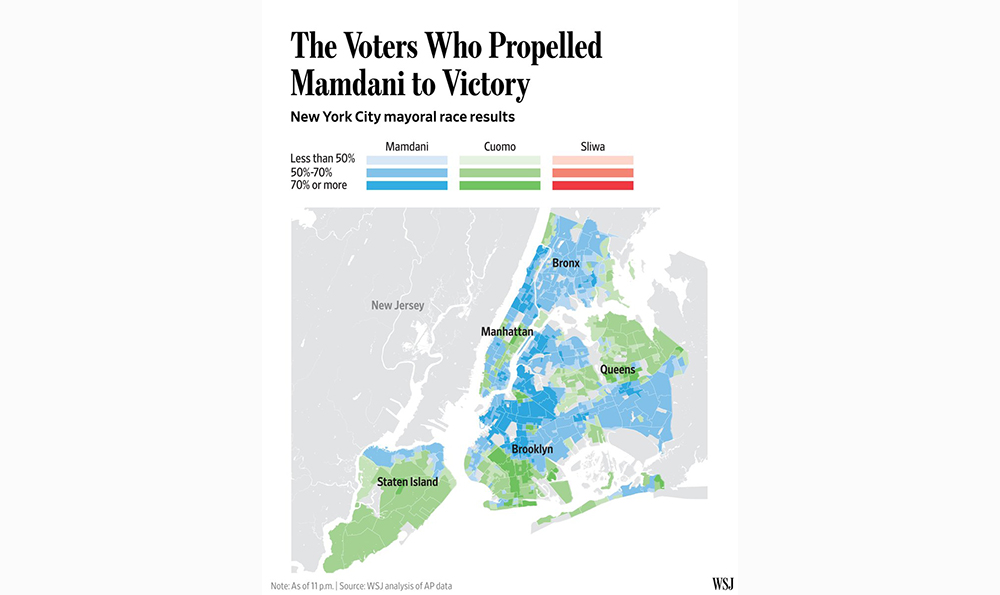
In the aftermath of the November 2025 New York City mayoral election, a meticulous breakdown of voting data from Brooklyn has revealed deep ideological divisions within the borough’s Jewish electorate. Across neighborhoods as diverse as Satmar Williamsburg, Park Slope, and Midwood, voters with Jewish-sounding surnames displayed dramatically contrasting political loyalties — exposing a widening rift between the borough’s progressive enclaves and its traditional bastions of Orthodox and Zionist identity.
The figures, analyzed from precinct-level returns, show that while Andrew Cuomo, running as an independent, retained overwhelming support from Orthodox and traditional Jewish communities, Zohran Mamdani — the self-proclaimed democratic socialist whose anti-Israel rhetoric has made him a polarizing figure — captured a strikingly high share of Jewish votes in Brooklyn’s liberal neighborhoods. The data, experts say, reflects a historic transformation in the Jewish political landscape — one that pits religious continuity and communal security against a younger generation’s embrace of radical ideology.
The Progressive Strongholds: Park Slope, Brooklyn Heights, and Beyond
Perhaps nowhere was Mamdani’s strength more visible than in Park Slope, the epicenter of Brooklyn’s progressive Jewish intelligentsia. Of the 17,085 voters with Jewish-sounding surnames in the neighborhood, an astonishing 12,890 — or roughly 75% — cast their ballots for Mamdani, leaving Cuomo with just 3,695 votes. The result underscores how Park Slope’s political and cultural milieu has evolved into a hub of socialist-leaning activism where support for Israel — once a defining feature of Jewish political identity — has become secondary, if not obsolete.
A similar pattern emerged in Brooklyn Heights, where of 6,652 Jewish-surnamed voters, 4,026 favored Mamdani compared to 2,366 for Cuomo. In Cobble Hill, 2,980 out of 4,515 Jewish-named voters went for Mamdani, while 1,421 chose Cuomo. These neighborhoods — populated largely by professionals, academics, and interfaith families — form the ideological core of the city’s Jewish progressive movement.
The pattern extended into nearby Carroll Gardens, Boerum Hill, and Windsor Terrace, where Mamdani consistently drew two-thirds or more of the Jewish-identified vote. In Carroll Gardens, for instance, 2,184 out of 3,136 such voters supported him, while Boerum Hill recorded 459 of 633 Jewish-surnamed voters in Mamdani’s column. In Windsor Terrace, a once middle-class Irish and Jewish enclave now populated by young families, 1,847 of 2,532 Jewish voters backed Mamdani — a testament to the neighborhood’s ideological realignment toward far-left politics.
Even in Prospect Heights, long a symbol of Brooklyn’s liberal Jewish activism, Mamdani commanded 2,782 votes out of 3,424 among Jewish-named voters — dwarfing Cuomo’s 545. Political analysts point to the same explanation: these neighborhoods’ educated and younger Jewish residents have embraced an ethos of “social justice” politics that increasingly regards Israel as an oppressor state and socialism as moral progress.
The Traditional Core: Midwood, Borough Park, and Crown Heights
In contrast, Orthodox and Hasidic communities across Brooklyn overwhelmingly rejected Mamdani’s candidacy, delivering decisive margins for Cuomo. In Borough Park, home to one of the largest concentrations of Hasidic Jews outside Israel, 19,056 out of 21,610 Jewish-named voters supported Cuomo, while just 1,428 chose Mamdani. The numbers in Midwood tell a similar story: of 32,539 Jewish-surnamed voters, Cuomo received 25,848 votes — more than five times Mamdani’s 4,785.
In Crown Heights, a historically complex neighborhood split between Lubavitcher Hasidim and secular progressives, the Jewish vote fractured along predictable lines. Among 3,824 voters with Jewish surnames in Crown Heights proper, 2,024 backed Mamdani while 1,647 sided with Cuomo — reflecting the area’s growing progressive contingent. Yet in Lubavitcher Crown Heights, where religious observance and Zionism remain deeply rooted, the numbers inverted: of 3,549 Jewish voters, only 812 supported Mamdani while 2,639 voted for Cuomo.
Satmar Williamsburg mirrored that resistance. Of 9,175 Jewish-identified voters in the enclave, 6,256 — roughly 68% — voted for Cuomo, compared to 2,330 for Mamdani. While Satmar Hasidim are traditionally non-Zionist, their skepticism of radical secular politics and hostility toward socialist ideology aligned them solidly against Mamdani.
The same conservative pattern was evident in southern Brooklyn. In Gravesend, 5,728 of 6,666 Jewish-named voters chose Cuomo, and in Coney Island, Cuomo drew 3,391 votes out of 4,106, with Mamdani receiving just 360. In Manhattan Beach, a community known for its strong Russian-Jewish population and staunch support for Israel, Cuomo captured 1,311 of 1,499 Jewish-identified votes — a staggering 87% margin.
In Marine Park, a largely middle-class and Modern Orthodox area, Cuomo won 3,891 of 5,975 Jewish votes, while Mamdani earned 1,018. In Dyker Heights and Bensonhurst, the divide was even more lopsided: Cuomo drew 2,828 of 3,360 Jewish votes, with Mamdani managing only 301.
Swing Districts and the Battle for the Middle
Between Brooklyn’s extremes lies a swath of neighborhoods reflecting the internal conflict within Jewish political identity — particularly in Flatbush, Kensington, and Crown Heights’ non-Hasidic zones. In Flatbush, the Jewish vote was split: Cuomo took 2,773 votes to Mamdani’s 2,077, while Kensington saw Mamdani edge ahead with 5,564 votes against Cuomo’s 4,338.
These neighborhoods, demographically diverse and religiously mixed, illustrate how the generational divide now transcends theology. In the Orthodox corridors of Flatbush, rabbis warned congregants against the dangers of Mamdani’s openly anti-Israel stance. Yet in Kensington, young Jewish professionals — many unaffiliated with synagogues — flocked to his campaign rallies, convinced that his socialist agenda represented moral renewal.
In Prospect Park South and Prospect Lefferts Gardens, both gentrifying areas with mixed Jewish populations, Mamdani also enjoyed narrow leads: 1,533 of 2,518 in Prospect Park South and 1,375 of 2,709 in Prospect Lefferts voted for him. Cuomo trailed by slim margins, underscoring how even neighborhoods with traditional Jewish roots are experiencing ideological drift.
The Cultural Geography of Division
The data paints an unmistakable picture: Mamdani dominated the progressive, secular, and intermarried Jewish vote, particularly among those under 40, while Cuomo triumphed among the religious, Zionist, and immigrant communities who remain deeply tied to Jewish continuity and Israel’s security.
In neighborhoods like Bedford-Stuyvesant, Fort Greene, and Dumbo, smaller Jewish populations showed surprising support for Mamdani — 55% or higher — reflecting the influence of cultural elites and activists. In contrast, Orthodox areas like Boro Park, Gravesend, and Midwood stood as bulwarks of resistance against what many community leaders described as “a betrayal of Jewish values.”
Rabbi Eliezer Stern of Midwood told reporters after the election that “to vote for a man who refuses to condemn Hamas and denies the right of Israel to exist is not progressivism — it is moral blindness.” Others echoed his alarm, warning that the normalization of anti-Israel rhetoric within Jewish progressive circles could erode communal unity and embolden antisemitism under the guise of activism.
Brooklyn’s Jewish electorate, once a powerful and cohesive political bloc, is now fractured along lines of ideology, age, and faith. Where once the shared memory of persecution and the defense of Israel unified Jewish voters across denominations, the 2025 data reveal a deep rift — between a traditional Judaism grounded in survival and a secular progressivism enthralled by revolution.
As Brooklyn emerges from this election, the borough stands as a microcosm of a broader crisis within American Jewry: a struggle between those who see the defense of Israel as essential to Jewish identity and those who have replaced that commitment with a universalist creed detached from Jewish particularism.
The question for New York’s Jewish community — and perhaps for American Jewry itself — is which vision will define its future.
