



|
Getting your Trinity Audio player ready...
|
Brawls, Boos, and Boiling Tensions: Coney Island’s Casino Battle Reaches a Fever Pitch
By: Jerome Brookshire
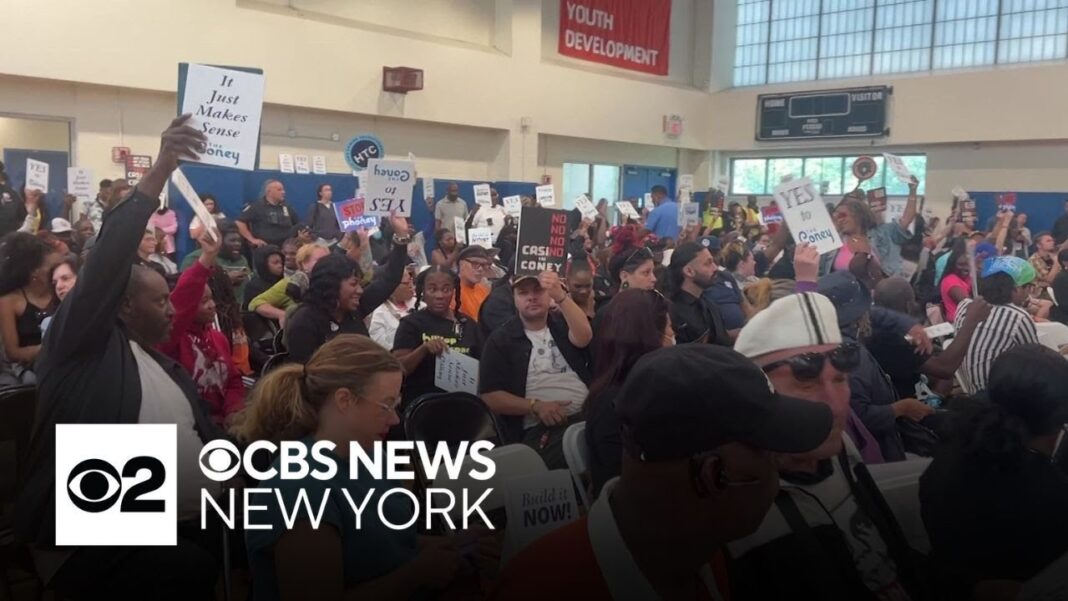
The pitched battle over the proposed Coney Island casino reached a dramatic climax on Wednesday night inside the crowded gymnasium of the Coney Island YMCA, where tempers boiled over, fists flew, and police officers twice had to intervene to restore order. According to a report that appeared on Friday in Brooklyn Paper, the explosive hearing last Wednesday, called attention to the ferocity of the debate surrounding “The Coney,” a $7 billion casino and entertainment complex that, for months, has divided the peninsula’s residents, developers, and elected officials.
Just over 100 people squeezed into the YMCA auditorium for what was billed as the second and final public meeting of the Community Advisory Committee (CAC), the six-member panel tasked with gauging public support and voting on whether the proposal should advance to the state Gaming Facility Location Board. Dozens more were left waiting outside, unable to enter once the room hit capacity, Brooklyn Paper reported.
Over the course of the four-hour session, about 110 speakers signed up to testify. Roughly 85 spoke in opposition to the casino, while about 25 offered their support. As one longtime observer told Brooklyn Paper, the split reflected the same bitter divide that has defined the project since it was first floated: a clash between promises of jobs and investment, and fears of crime, gentrification, and a neighborhood lost to gambling.
The meeting, described by Brooklyn Paper as “chaotic and at times combustible,” quickly escalated beyond sharp words. Police were called in at least twice to break up skirmishes in the audience, escorting attendees from the room.
“This should have ended for you the moment that violence erupted,” one resident shouted toward the development team. “Because that’s what you’re bringing. You’re bringing anger. You’re bringing people so thirsty for jobs they’re getting violent with people.”
That remark captured the mood of many opponents who argued that the very spectacle of the night — shouting matches, scuffles, and an overstuffed hall — served as proof of the divisive force the project had already unleashed on the community.
The developers, led by Thor Equities, have pitched The Coney as a 1.6-million-square-foot mega-complex featuring a casino, hotel, convention center, restaurants, and retail. According to the information provided in the report in Brooklyn Paper, the project’s backers insist it would generate thousands of jobs, inject year-round economic activity into a neighborhood long dependent on seasonal tourism, and establish a $200 million community trust for local investment.
In recent weeks, the developers sweetened their pitch with additional pledges: a program allowing Coney Island residents to purchase ownership shares, and a $10 million contribution toward a long-sought ferry station.
Still, as the report in Brooklyn Paper noted, skepticism remains rampant. The City Council approved a rezoning in June that would permit taller towers if the project proceeds, but Community Board 13 overwhelmingly opposed it — a clear sign of grassroots resistance.
The CAC, composed of six members appointed by state and city officials, now holds the project’s fate in its hands. Under state rules, two-thirds of the panel must vote in favor for the application to move to the Gaming Facility Location Board. Their decision is due by Sept. 30.
According to the information contained in the report at Brooklyn Paper, Wednesday’s hearing was the community’s last chance to directly address the CAC before the pivotal vote. That urgency infused every testimony with heightened intensity, as both sides sought to sway the committee in their favor.
The developers’ central argument rests on job creation. They project 4,500 construction jobs and 4,000 permanent jobs, 2,300 of which would be full-time. Twenty-five percent of those jobs, they promised, would go to Coney Islanders.
But, as Brooklyn Paper reported, their official casino license application pegs local hiring much lower, with only 9% of employees expected to come from Coney Island and neighboring Gravesend.
That discrepancy fueled doubts from many residents.
“The jobs won’t save you,” said artist and longtime resident Sheila Maldonado. “We already know those numbers are not real. This is about lining the pockets of billionaires, serving as a tax shelter, and leaving the rest of us hoodwinked and bamboozled.”
Former Council Member Ari Kagan echoed that skepticism. “The only thing a casino will bring to Coney Island is congestion, crime, muggings against seniors, mental illness, bankruptcies. Go to Atlantic City and see what jobs were created there,” Kagan told the crowd.
Others, however, insisted the jobs were desperately needed. Sean Campbell, of the NYC District Council of Carpenters, said workers in Coney Island have been plagued by exploitative contractors for years. “Construction workers at The Coney would be compensated with fair wages, benefits, and dignity,” Campbell argued.
Perhaps the most surprising support came from Dick Zigun, known as the “unelected mayor” of Coney Island. Founder of the Mermaid Parade and Coney Island USA, Zigun broke with his arts organization’s anti-casino stance to support the project.
“I’m a realist and a businessperson,” Zigun said. “I want it all here. I’m afraid, honestly afraid, about what happens if we don’t get this once-in-a-lifetime investment.”
Others echoed his view, portraying the casino as an opportunity for revival after decades of disinvestment. “What I see in this vision of The Coney is giving back money to renovate our Coney Island,” said Sheila Smalls, president of the O’Dwyer Gardens tenant association. “Investing in this community means a brighter future for our children.”
Yet the pro-casino side faced damaging accusations during the hearing. Malik Hassan, of MAS Brooklyn, alleged that some speakers were being paid to voice support. “Eighty dollars. That’s what they’re being paid,” Hassan said, claiming supporters told him directly.
Patrick Wall, executive director of Coney Island USA, reinforced that suspicion. “We know people are paid to say good things about this casino. We know ex-public officials are paid to say good things. We know politicians have had donations from this casino. How good can this be for the community under those terms?”
As Brooklyn Paper reported, the charges of astroturfing further inflamed distrust in a community already wary of developers’ promises.
The controversy also revived old grievances against Thor Equities founder Joe Sitt, who purchased large swaths of Coney Island in the 2000s, later selling 6.9 acres to the city during the 2009 rezoning. Critics have long accused Sitt of letting properties languish in blight, filled with trash and illegal businesses.
“Our exhibit center is surrounded by several Thor properties filled with garbage and rats,” said Charles Denson of the Coney Island History Project. “Only Joe Sitt, the foreclosure king, could come up with a casino scam that would make things worse.”
Brooklyn Paper reminded readers that just this month, Thor Equities faced news of a possible foreclosure on one of its Manhattan holdings — further fueling doubts about the developer’s credibility.
Beyond economics, many opponents emphasized the intangible costs: the potential loss of Coney Island’s character.
“This proposal exploits every crack in our already vulnerable infrastructure,” said Brighton Beach resident Christian Molieri. “It will deepen poverty, overburden schools, strain healthcare, and worsen the housing crisis.”
Small business owners worried that a casino with restaurants and entertainment under one roof would keep visitors inside, leaving little spillover for neighborhood shops. “It gives people no reason to step outside,” said Wall.
For others, the casino represented an existential threat. “The People’s Playground will become a gambling playground,” one opponent told Brooklyn Paper.
In a statement after the hearing, The Coney’s spokesperson Robert Busweiler struck an optimistic tone, emphasizing that the project team had heard the community’s concerns.
“We have heard time and time again the need for jobs, economic development, workforce training, and community support,” Busweiler said. “The Coney looks forward to continued engagement with the Coney Island community.”
As Brooklyn Paper detailed, Wednesday’s fireworks are only one chapter in a larger political drama. Assembly Member Tony Simone, whose appointee sat on the CAC, has been a vocal critic of casinos, as have Senators Brad Hoylman-Sigal and Liz Krueger. Council Member Erik Bottcher and Manhattan Borough President Mark Levine also opposed casino projects elsewhere in Manhattan, shaping a broader political climate hostile to gambling proposals.
By Sept. 30, the CAC must vote. If four of the six members approve, The Coney’s license application will advance to the state Gaming Facility Location Board, which will make final decisions by year’s end. Eight proposals across the state are competing for just three licenses. Two frontrunners — Empire City in Yonkers and Resorts World in Queens — are already operating limited casinos and would simply expand with full licenses.
As the report in Brooklyn Paper noted, that math leaves projects like The Coney facing an uphill battle, even if they survive the CAC stage.
Wednesday night’s melee at the YMCA encapsulated the Coney Island casino saga: passionate, divided, and deeply uncertain. To supporters, the project represents long-overdue investment and opportunity. To opponents, it is a reckless gamble that threatens the community’s identity, safety, and stability.
As the CAC prepares for its crucial vote, the stakes extend far beyond a single development. What hangs in the balance is nothing less than the future of Coney Island itself — whether it remains a historic seaside playground defined by rides, parades, and grit, or transforms into a high-stakes experiment in urban casino economics.
For now, one thing is certain: the battle for Coney Island has only just begun.
