



|
Getting your Trinity Audio player ready...
|
By: Fern Sidman – Jewish Voice News
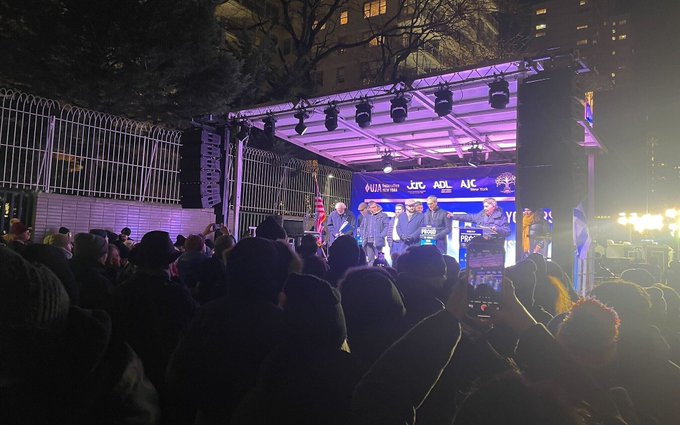
More than a thousand New Yorkers gathered on a frigid Thursday night outside Manhattan’s Park East Synagogue, transforming a stretch of the Upper East Side into a powerful tableau of Jewish unity, civic alarm, and communal resolve. According to a report on Friday at The Times of Israel, which closely followed the event, the rally was organized in direct response to the vitriolic anti-Zionist protest that erupted outside the same synagogue late last month—a demonstration whose violent chants and strategic targeting of a Jewish house of worship sent shockwaves through New York’s Jewish community.
The Thursday evening rally, convened under the banner of solidarity and resilience, marked a decisive counter-narrative to the intimidation many felt in the wake of last month’s incident. That earlier protest, staged at the entrance of Park East’s school building, targeted an informational event for Jewish immigration to Israel. Protesters reportedly shouted threats and epithets at families entering the synagogue, prompting some Jewish New Yorkers—many of whom spoke to The Times of Israel—to describe the atmosphere as reminiscent of the darkest chapters in Jewish history.
HAPPENING NOW OUTSIDE PARK EAST SYNAGOGUE
2 weeks ago the Anti-Zionist mob stood outside Park East Synagogue with a horrific display of hate and racism.
Tonight, New York’s Jewish community responded to the hate with love.
They chant for death, intifada, and destruction–we… pic.twitter.com/PMMXksGWIt
— Rabbi Poupko (@RabbiPoupko) December 4, 2025
“We are not afraid. United we prevail, divided we fail,” Rabbi Arthur Schneier declared to the crowd, his voice resonant with both pain and conviction. Schneier, Park East’s longtime spiritual leader and a Holocaust survivor, drew a direct line between the violent rhetoric hurled at his synagogue and the anti-Jewish mob assaults he witnessed as a child in wartime Europe. The Times of Israel report emphasized the gravity of Schneier’s remarks, noting that the 93-year-old rabbi rarely invokes his Holocaust experience publicly unless he believes a moment demands historical clarity.
“What Park East has experienced—I am so shaken,” Schneier said, warning that the messages broadcast outside the building last month were not mere political slogans but intimidation tactics designed explicitly to instill fear in Jewish civilians.
The rally itself was a meticulously coordinated effort involving an extraordinary coalition of Jewish institutions—more than 70 in total—spanning Orthodox, Conservative, Reform, and communal organizations. The Times of Israel noted the remarkable breadth of support, from Yeshiva University and SAR High School to major community centers, synagogues across the denominational spectrum, and flagship organizations such as the UJA-Federation of New York, which led the event.
Though framed as a response to a single protest, Thursday’s gathering tapped into more than a year of rising antisemitism and anti-Zionist demonstrations nationwide. The Times of Israel has chronicled parallel events across cities and campuses since October 7, highlighting how Jewish institutions—schools, synagogues, community centers—have increasingly been singled out.
Perhaps that is why even in the biting cold, the turnout exceeded 1,100 people, according to an NYPD headcount cited in The Times of Israel report. Jewish community security teams staffed checkpoints at the rally entrance, and rows of uniformed NYPD officers lined the perimeter. When officers were thanked from the podium, the crowd erupted in applause.
One striking feature of the rally, as The Times of Israel report noted, was the assertive language used on signs carried by participants. Gone were euphemisms and abstract calls for tolerance. Instead, demonstrators held placards reading: “Proud New Yorkers, Jews, Zionists,” “Proudly Park East,” “Anti-Zionists spread libels to mark Jews for violence,” and “If you don’t teach your kids about anti-Zionism, someone else will.”
These messages reflected a growing trend within mainstream Jewish circles to identify anti-Zionism explicitly as a form of anti-Jewish animus. As The Times of Israel has reported, this shift parallels broader community efforts since October 7 to confront rhetoric that, while cloaked in political critique, often bleeds into essentialist attacks on Jews or Jewish identity.
The demonstration last month outside Park East was not the first anti-Israel protest in New York City, but Jewish leaders described it as fundamentally different in tone and intent. According to the information provided in The Times of Israel report, one of the protest organizers declared through a bullhorn: “We need to make them scared”—a line that City Comptroller-elect Mark Levine later quoted verbatim during the rally.
“This was unambiguously an effort to intimidate and threaten Jewish New Yorkers going into a synagogue,” Levine told the crowd, insisting that the incident demanded a robust community and governmental response.
His remarks drew attention to a critical point: the protest did not take place outside a consulate, corporation, or government office but at the doors of a Jewish religious institution hosting a program about moving to Israel. For many, that choice of venue signaled an unmistakable attempt to target Jews as Jews.
Though no speaker mentioned Mayor-elect Zohran Mamdani by name, his presence hung over the rally like an unspoken tension. As The Times of Israel reported, many in the mainstream Jewish community remain deeply uneasy about Mamdani’s election, given his history of anti-Israel activism, his description of Israeli policy as “genocide,” and his refusal to condemn the chant “Globalize the intifada.”
Following last month’s protest, Mamdani issued a statement criticizing both the protesters and the synagogue—an equivalence that infuriated Jewish leaders. He asserted that “sacred spaces should not be used to promote activities in violation of international law,” a reference to Israeli settlements. But as The Times of Israel pointed out, the group hosting the Park East event, Nefesh B’Nefesh, does not direct immigrants to Israeli settlements.
Jewish organizations viewed Mamdani’s comments as a justification for harassment, and his silence on the protesters’ explicit threats was widely condemned. While rally speakers avoided naming him—likely a strategic decision to keep the focus on communal unity—the anxiety over the incoming mayor was palpable.
For many attendees, the rally was about reclaiming a sense of safety and belonging. Sisters Alison and Jolie Widawsky traveled from Long Island and the Upper West Side, respectively. “Our grandparents were Holocaust survivors,” Jolie told The Times of Israel. “We know what happens when people don’t stand up.”
She added that on college campuses, young Jews often feel alienated or shamed for expressing support for Israel. Thursday’s rally served as a reminder that they are not alone.
Between speeches, the crowd swayed to performances by Jewish reggae artist Matisyahu, who played his peace anthem “One Day” and the spiritual classic “Jerusalem.” As The Times of Israel report described, his presence turned the rally into a moment of shared resilience, an artistic expression of collective identity and hope.
The evening closed with the Park East children’s choir singing both “The Star-Spangled Banner” and Israel’s national anthem, “Hatikvah.” Attendees described the moment as deeply emotional—symbolizing the dual commitments of American Jewry: loyalty to their country and solidarity with their ancestral homeland.
Beyond the emotional resonance, the rally was also a call to political action. Rabbi Schneier urged attendees to support legislation barring protests at houses of worship—proposals already under consideration by city lawmakers. Mayor Eric Adams has instructed the NYPD to evaluate such measures, a point noted by The Times of Israel.
Several rally speakers emphasized that freedom of speech does not include the right to terrorize families entering religious institutions. In a city where synagogues have been firebombed, shot at, vandalized, and besieged, the Park East protest hit a particularly sensitive nerve.
In its coverage, The Times of Israel framed the rally as part of a larger reckoning: between the Jewish community and a growing movement that seeks to normalize anti-Zionism as a socially acceptable form of anti-Jewish hostility; between citizens and a city government entering uncharted political territory; and between fear and defiance.
Jewish institutions have long dealt with threats, but Thursday’s rally signaled something new—a broad, grassroots refusal to accept intimidation as a norm of civic life.
“We are fighting for a New York where all of us feel safe,” Comptroller-elect Levine said. “This is the New York we are fighting for.”
As the crowd dispersed through police barricades, and the Park East children returned inside the synagogue, the brisk air seemed to carry a shared realization: the struggle ahead will be difficult, but the community will not face it alone.
The night had been cold, but the message was unmistakably resolute: New York’s Jewish community will not be cowed into silence—not by protesters at synagogue doors, not by rising antisemitism, and not by political ambiguity at City Hall.