



|
Getting your Trinity Audio player ready...
|
By: Fern Sidman
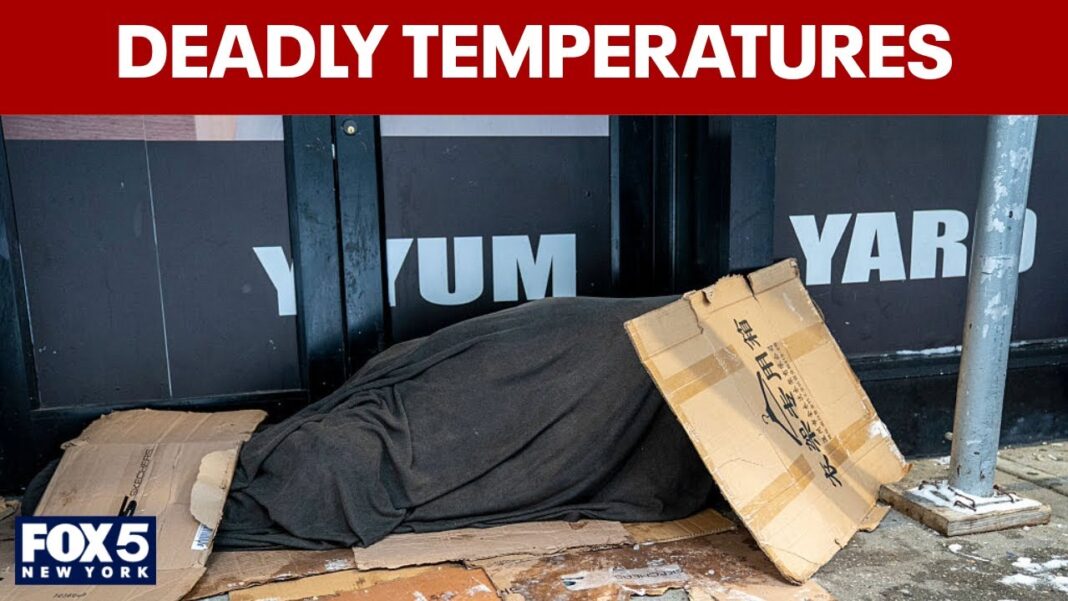
The city that never sleeps found itself gripped in a lethal stillness this week, as brutal cold and relentless snowfall transformed New York’s streets into a landscape of quiet tragedy. According to city officials, at least ten New Yorkers were found dead outdoors over the weekend as sub-freezing temperatures and the ferocity of Winter Storm Fern bore down on the five boroughs. The grim toll, revealed by Mayor Zohran Mamdani at a Tuesday press conference, has shaken the city and intensified an already fraught debate over homelessness, public safety, and the limits of compassion in moments of crisis.
As The New York Post reported on Tuesday, the deaths occurred during one of the most punishing weather events the city has experienced in recent years, with more than a foot of snow falling in parts of the metropolitan area and temperatures plunging well below freezing. While the precise causes of death remain under investigation, city officials acknowledge that the conditions created a deadly environment for anyone exposed to the elements for prolonged periods.
“The cold is this deadly,” Mamdani said solemnly. “We need to meet the moment and leave no stone unturned. And we are mobilizing every resource at our disposal to ensure that New Yorkers are brought indoors during this potentially lethal weather event.”
The stark language reflects the gravity of the crisis. As The New York Post report detailed, the storm’s impact has extended far beyond inconvenience or disruption, evolving into a humanitarian emergency that has tested the city’s infrastructure, social services, and political leadership. The deaths, whether directly attributed to hypothermia or not, underscore a deeper vulnerability that runs through New York’s streets—one that becomes most visible in moments of extreme weather.
The New York Police Department, in figures cited by The New York Post, listed nine confirmed outdoor deaths as of early Tuesday, while the mayor reported a total of ten fatalities since Saturday. The distribution of those deaths paints a sobering portrait of the crisis’s reach: three in Queens, three in Brooklyn, two in Manhattan, and one in the Bronx. The geographic spread suggests not an isolated tragedy, but a citywide phenomenon.
Department of Social Services Commissioner Molly Wasow Park added a crucial dimension to the narrative, revealing that a number of the victims had previously used the city’s shelter system. This detail, highlighted in The New York Post’s coverage, complicates any simplistic framing of the deaths as solely the result of people refusing help. Instead, it points to a more complex reality—one in which individuals move in and out of the shelter system, navigating a precarious existence shaped by mental health challenges, addiction, distrust of institutions, and systemic failures that no single storm can fully explain.
In response to the unfolding crisis, Mayor Mamdani announced a series of emergency measures aimed at preventing further loss of life. City shelters have loosened intake protocols to accelerate access, hospitals have been asked to limit overnight discharges, and ten additional warming shelters have been opened across the city. Outreach efforts, coordinated between city agencies and nonprofit organizations, have been dramatically intensified.
As The New York Post reported, these measures represent one of the largest coordinated winter emergency responses in recent memory. Yet they also expose the structural limitations of New York’s social safety net. Even with expanded capacity, outreach teams face the difficult reality that not every vulnerable person can be reached in time, and not every person reached will accept help.
This tension lies at the heart of the political and moral debate now unfolding in City Hall. Mamdani, who has broken with his predecessor, former Mayor Eric Adams, on the issue of involuntary shelter placement, has emphasized persuasion over coercion. His administration has been markedly more reluctant to compel homeless individuals to leave the streets, framing such actions as a last resort rather than a default policy.
When pressed on whether the city would force people into shelters during the extreme cold, Mamdani responded with careful restraint. “If a New Yorker is a danger to themselves or to others then that’s the driving force of that decision,” he said. “This is a last resort. Our first method of outreach is to communicate to homeless New Yorkers across the five boroughs as to the options that they have. We however are not going to leave someone out in the cold if they’re a danger to themselves or to others.”
The language reflects a philosophical approach rooted in autonomy and dignity, principles that have defined Mamdani’s political identity. But as The New York Post has repeatedly noted, such principles come into painful tension with the realities of extreme weather. When temperatures fall into life-threatening ranges, the line between respecting autonomy and preventing death becomes dangerously thin.
Winter Storm Fern has not merely been a meteorological event; it has functioned as a stress test for the city’s moral and administrative frameworks. The storm has forced New York to confront uncomfortable questions about responsibility, intervention, and the limits of individual choice in the face of mortal danger.
The broader context, documented extensively by The New York Post, reveals that this crisis is unfolding against a backdrop of prolonged cold. While snowfall is expected to ease temporarily, forecasts predict that freezing temperatures will persist well into February. This extended cold snap raises the specter of additional fatalities if systemic vulnerabilities are not addressed with urgency and scale.
What makes this moment particularly significant is the intersection of policy, ideology, and emergency response. Mamdani’s approach represents a deliberate departure from more forceful strategies employed in the past, reflecting a broader shift in progressive urban governance toward non-coercive social policy. Yet the deaths have intensified scrutiny of whether such an approach is viable in moments of acute crisis.
Critics, quoted in The New York Post report, argue that ideological commitments should not override the imperative to save lives. Supporters counter that coercion risks criminalizing poverty and homelessness, deepening mistrust and driving vulnerable populations further from services.
This debate is not new, but Winter Storm Fern has given it tragic immediacy. The images of snow-covered streets, emergency warming centers, and police tape around lifeless bodies have transformed abstract policy arguments into visceral realities.
The crisis has also highlighted the fragile interdependence between public institutions and nonprofit organizations. Outreach workers, shelter staff, healthcare providers, and volunteers have become the city’s frontline defense against the cold. Their work, often invisible in normal times, has become indispensable. As The New York Post has reported, these networks are operating under immense strain, balancing compassion with exhaustion, urgency with limited resources.
The role of hospitals in the emergency response underscores another dimension of the crisis. By requesting that hospitals limit overnight discharges, the city is acknowledging the lethal risks posed by releasing vulnerable patients into extreme cold. This measure, while necessary, reveals how interconnected the city’s systems truly are: healthcare policy, housing policy, and emergency management converge in moments like this.
The deaths have also reignited conversations about long-term solutions. Emergency shelters and warming centers are essential, but they are temporary interventions. The underlying drivers of homelessness—affordable housing shortages, mental health care gaps, addiction services, economic inequality—remain unresolved. Winter Storm Fern has merely exposed these structural failures in their most brutal form.
As The New York Post report emphasized, the storm has transformed the city into a stark tableau of contrasts: heated apartments and frozen sidewalks, stocked pantries and empty hands, safety behind doors and vulnerability in the open air. It is a portrait of urban inequality rendered in ice and snow.
Mayor Mamdani’s call to “meet the moment” resonates not only as an emergency directive, but as a moral challenge. The phrase suggests that this crisis is not merely about weather, but about collective responsibility. It asks whether a city of immense wealth and resources can tolerate deaths from exposure in its streets—and if not, what structural changes are required to prevent them.
The numbers themselves are haunting. Ten deaths in a single weekend. Lives reduced to statistics. Stories untold. Families notified. Communities shaken. As The New York Post has reported, each of these deaths represents not just an individual tragedy, but a failure of systems meant to protect the most vulnerable.
And yet, the city moves forward, even as it mourns. Warming shelters remain open. Outreach teams continue their work. City officials hold briefings. Policies are debated. Forecasts are monitored. Snow is cleared. Life resumes.
But beneath that motion lies a deeper stillness—a recognition that Winter Storm Fern has revealed something fundamental about New York: its resilience, its contradictions, and its unresolved moral dilemmas.
The storm will pass. The snow will melt. The temperatures will rise. But the questions it has raised will linger long after the streets are clear.
As The New York Post report observed, one truth stands out with chilling clarity: in a city defined by ambition, energy, and power, the most vulnerable lives remain the most fragile. And in moments of extreme cold, the distance between policy and mortality is measured not in miles, but in degrees.
Winter Storm Fern has not only frozen the city—it has forced it to look inward, to confront the human cost of structural failure, and to reckon with what it truly means to protect every New Yorker when survival itself becomes uncertain.
