



|
Getting your Trinity Audio player ready...
|
By: Fern Sidman – Jewish Voice News
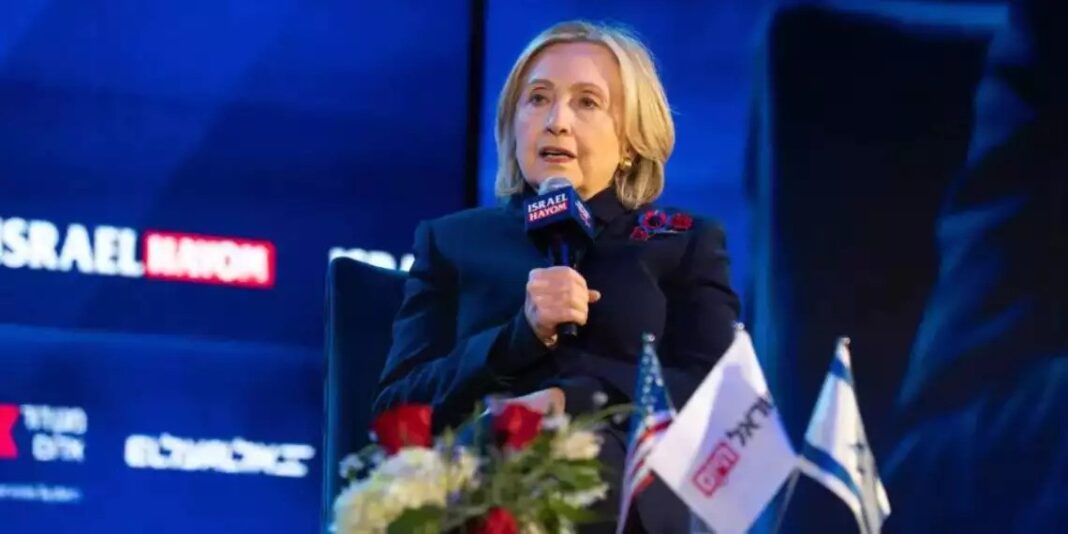
At a moment of profound geopolitical uncertainty and cultural transformation, former U.S. Secretary of State Hillary Clinton issued a stark and unvarnished warning: Israel is facing a historic public-relations crisis among young Americans, one that she believes is eroding foundational support for the Jewish state in ways that could shape U.S.–Israel relations for decades. Speaking on Tuesday afternoon at the Israel Hayom Conference in New York—a gathering that brought together diplomats, policymakers, media leaders, and Jewish community figures—Clinton delivered a sobering assessment of how Israel’s narrative has faltered, especially in the digital arenas where younger generations form their worldview.
As Israel National News reported from the conference, Clinton told interviewer Yoav Limor that “Israel has the worst PR of any group I have ever known.” A striking statement coming from a former secretary of state with unparalleled exposure to global diplomacy and the information wars waged around it. Her message was blunt: Israel’s story is not being told effectively, and the consequences are becoming increasingly visible across American campuses, political movements, and electoral outcomes.
Clinton—who taught at Columbia University in the months following the October 7 Hamas massacre—said she witnessed firsthand the extent of the information distortion among the young. Many of her students, she emphasized, came to class having absorbed deeply inaccurate accounts of what occurred on October 7.
“We saw an almost organized effort to turn what happened into something unrecognizable,” she told the audience, according to the report at Israel National News. “We began to understand that our students—smart, educated, young—where are they getting their information? From social media, especially TikTok.”
Her point was as chilling as it was clear: the center of gravity in information consumption has shifted completely, and the traditional venues in which Israel once excelled—newspapers, television, elite institutions—no longer shape young Americans’ understanding of global events.
“More than 50% of young people in America get their news from social media,” she noted. “They see short videos, some of them completely fabricated, and that is where they get their information.”
This phenomenon, Clinton argued, is not merely a challenge for Israel—it is “a serious problem for democracy, whether in Israel or the United States.” The architecture of democratic discourse requires, at a minimum, a shared set of facts. Social media platforms—algorithmically designed to amplify emotional extremes and sensationalism—are increasingly undermining that foundation.
Clinton repeatedly stressed that this crisis is not a left–right divide, but rather a generational rupture.
“When you hear Tucker Carlson and Nick Fuentes speak, they are part of the right,” she said. “This isn’t Democrats versus Republicans; it is a generational issue.”
This point has been echoed extensively by Israel National News, which has charted the rapid shift of younger Americans—across political affiliations—toward a more hostile view of Israel. A recent survey cited by the outlet showed sharp declines in support among voters under 30, many of whom view the Middle East conflict through the simplified binaries of online activism.
Clinton’s invocation of Zohran Mamdani—New York’s recently elected mayor and one of the most vocal anti-Israel political figures in the city’s modern history—served as a real-world example of this generational shift.
“He was a social media candidate,” she said pointedly. “That is exactly my point. Young people were the engine… the social media campaign was extremely effective.”
To Clinton, Mamdani’s rise symbolizes a new political reality: the politicians most likely to shape America’s future are those fluent in the digital activism ecosystems where Israel has repeatedly lost ground.
Despite her candid critique, Clinton sounded notes of cautious optimism regarding Israel’s diplomatic horizons. She pointed to the resilience of the Abraham Accords—even after the trauma of October 7—which she described as “proof that there are more optimistic scenarios for Israel in the region.”
As Israel National News has frequently emphasized, the Accords survived shockwaves that would have once dismantled fragile regional ties. None of the signatory states retracted their relationships with Israel, and several have deepened cooperation with Jerusalem even amid the Gaza conflict.
Clinton reiterated her longstanding view that Israeli and American policymakers must work together to “keep Iran on the back foot.” She warned against reviving the kind of nuclear deals that she believes emboldened Tehran and enabled further destabilization across the Middle East.
In this context, she suggested that Israel’s diplomatic outreach—combined with its strategic partnerships through frameworks like the Accords—can form the basis of a stronger regional posture. But such gains, she insisted, will not matter if Israel continues losing the battle for public support among the next generation of Americans.
Clinton’s most emphatic message was a call for Israel to fully re-engage the narrative war, especially with young people who consume information almost exclusively through short-form digital platforms.
“You must engage in the narrative,” she urged. “You must do a better job telling Israel’s story—not only looking inward, but outward, and especially toward the younger generation.”
Her criticism aligns with years of reporting from Israel National News highlighting Israel’s chronic underinvestment in storytelling, strategic communication, and rapid response mechanisms on digital platforms. The outlet has repeatedly spotlighted the organized nature of anti-Israel activism online—sophisticated networks that deploy influencers, activists, NGOs, and coordinated messaging to shape global discourse in real time.
Clinton’s remarks amounted to a clarion call for Israel to fundamentally rethink its approach to public diplomacy. No longer can the country rely on traditional press briefings, long-form articles, or diplomatic speeches to compete with short, viral videos that circulate in seconds.
For all her critique, Clinton made a point of encouraging expanded dialogue, not retrenchment.
“I hope there will be more events like this one,” she told the summit. “It is important not to dismiss anyone before we have a chance for a conversation.”
In an era in which Israel’s critics often refuse to engage, Clinton underscored the importance of proactive dialogue, especially with younger Americans who have never heard Israel’s narrative articulated beyond the distorted lens of online activism.
Her message resonated throughout the Israel Hayom Conference, where speakers repeatedly emphasized that the struggle Israel faces is no longer confined to battlefields in Gaza, Lebanon, or the Golan Heights. It is also unfolding in classrooms, city councils, social media platforms, and voting booths across the United States.
As the Israel National News report framed it, Clinton’s intervention was not merely an analysis, but a warning: Israel must take ownership of its story—or risk losing the next generation of American support, with consequences that could reshape the alliance at the heart of Middle East stability.
In a year defined by upheaval, anti-Israel political victories in major American cities, and rapidly shifting cultural attitudes, Clinton’s message reverberated far beyond the summit hall. It was, in essence, a reminder that wars are no longer won by force alone—but also by narrative, clarity, and truth. And on that battlefield, Israel must urgently regroup, recalibrate, and re-engage.
You cannot reason with a Nazi, Democrat, or Muslim, and Clinton‘s and TJV‘s advice is the OPPOSITE of what Jews need to do now! There should be no “dialogue” or negotiation with these antisemite scum. Fight them in the media in the same manner as we need to physically fight them in the actual battlefields – call them out for the scum they are. And SEVER all social, political, religious, and personal and family ties!
The complete CORRUPTION of Hillary Clinton:
“Time Is Up for Hillary Clinton
(including the Jeffrey Epstein scandal)
https://youtu.be/ClbOp7HFfJU?si=I44yPas0k1vEvwBB