



|
Getting your Trinity Audio player ready...
|
By: Fern Sidman – Jewish Voice News
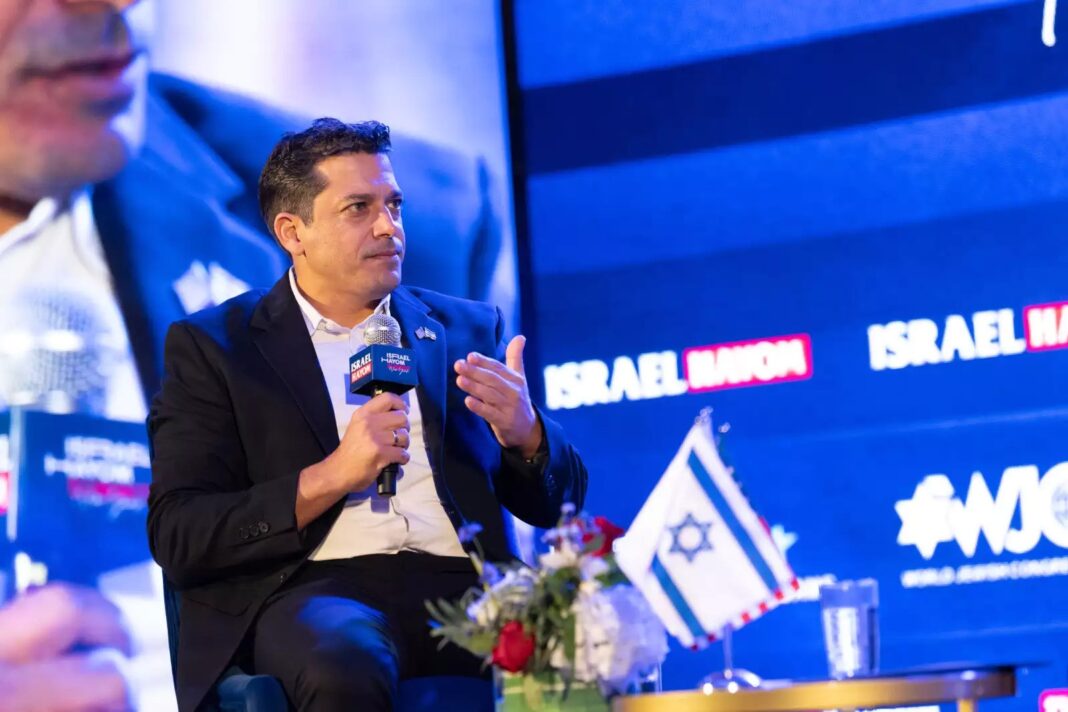
At a moment of profound geopolitical uncertainty and mounting ideological volatility across the Middle East, Israeli Minister of Diaspora Affairs Amichai Chikli used the stage of the Israel Hayom Summit on Tuesday to issue one of the most blunt and unvarnished assessments delivered by a senior Israeli official in recent years. Speaking before a packed audience in New York City, Chikli declared that Israel is confronting a “new axis of danger,” identifying Turkey and Syria—under its emergent leadership—as the gravest threat now facing the Jewish state. His address signaled a dramatic reorientation of Israel’s threat perception at a time when international actors, including Washington, appear ready to recalibrate their approach to Syria’s post-Assad landscape.
The minister’s remarks, delivered against a backdrop of diplomatic reconfiguration and political turbulence across the region, were at once a rejection of what he described as “Western illusions” about the intentions of Syria’s new leadership and a scathing critique of the ideological currents he sees embedding themselves simultaneously in the Middle East and the West.
According to a report on Tuesday at Israel Hayom, Chikli opened his remarks by disputing the increasingly common suggestion—voiced most notably by President Donald Trump—that Israel should avoid undermining Syria’s interim leadership under Ahmed al-Sharaa, better known as Abu Muhammad al-Julani. Chikli dismissed such proposals as dangerously naïve.
“There is no peace agreement with al-Julani,” he declared, describing the Syrian figure, a onetime al-Qaida affiliate, as a “jihadist who butchered thousands of Druze and Alawites” and a man whose ideological DNA is grafted to the global Muslim Brotherhood movement. “It is a mistake to give him credit,” Chikli insisted, countering the international framing of al-Julani as a stabilizing force capable of leading a post-Assad Syria.
In Israel Hayom’s account of the speech, Chikli expanded the threat matrix to Turkey, arguing that President Recep Tayyip Erdogan embodies a “hybrid ideology” composed equally of neo-Ottoman expansionism and Muslim Brotherhood-inspired Islamist revivalism.
“Julani is Muslim Brotherhood, Erdogan is Muslim Brotherhood,” Chikli said, drawing a direct line between the leaderships in Ankara and in Damascus. “Together, they represent a unified ideological front aimed at reshaping the region.”
He went further, labeling Erdogan’s long-term ambitions as “the new Iran,” suggesting that the Turkish president seeks not merely regional influence but a civilizational reassertion anchored in Islamist dominance. Chikli argued that Israel must therefore maintain a “hard-power posture” on its northern border—including a continued IDF presence on Mount Hermon and strategic depth in the Syrian buffer zone—because “the next October 7 is preventable only if Israel remains vigilant.”
Chikli’s comments directly challenge the recent American push to stabilize Syria through dialogue rather than confrontation. President Trump, as reported by Israel Hayom, has argued that Israel should ensure “nothing interferes with Syria’s evolution into a prosperous state.” Chikli rejected that framing entirely.
“Prosperity is not born of jihadist rule,” he said. “It is born of institutions and moderation—not of the people responsible for massacres.”
The divergence highlights a growing debate among Israeli, American, and regional policymakers about how best to manage the post-Assad vacuum. Chikli’s insistence on confronting al-Julani’s leadership stands in sharp contrast to the more conciliatory posture gaining traction in Western capitals.
In a shift from regional geopolitics to the American cultural and political arena, Chikli startled the summit audience—and subsequently journalists covering the event for Israel Hayom—with an incendiary critique of prominent conservative media figure Tucker Carlson.
“I believe Tucker is being paid to push forward Sharia Law,” Chikli said, a statement that drew an audible reaction from the crowd. When pressed by the interviewer about whether he was referring specifically to Qatari influence, Chikli replied, “I think he is being paid by Qatar, yes—though it is hard to prove.”
The suggestion ties Carlson not merely to foreign persuasion but to an ideological project fundamentally at odds with the values of Western liberalism. While controversial, Chikli claimed his view is based on what he described as Carlson’s “consistent alignment with Islamist narratives” and the “open embrace of figures promoting the Muslim Brotherhood’s worldview.”
His comments are likely to reverberate widely within American conservative circles, particularly given Carlson’s close association with parts of the MAGA movement and his influential online platform.
Beyond personalities, Chikli told the Israel Hayom audience that he has fundamentally changed his understanding of right-wing antisemitism in the United States. He admitted that he once believed such hatred was confined to “some lunatic in a basement,” but that recent developments have disabused him of that notion.
“In the last two years, I have seen a sharp rise in white supremacy, Nazi antisemitism, and conspiracies,” he said. “This is not fringe—these ideas are entering the mainstream.”
He cautioned against conflating this trend with traditional American conservatism, arguing that figures such as Carlson and Nick Fuentes “are not conservatism” but rather manifestations of an extremist fringe that seeks to hijack the political right.
“We need real conservative leaders in the United States to fight this battle,” Chikli stressed. “Israel should stay out of the internal MAGA conflict.”
As the Israel Hayom report emphasized, Chikli’s remarks reflect broader anxieties within the Israeli government about the convergence of political extremism, religious fundamentalism, and foreign state interference. His speech came against the backdrop of intensifying debates within Israel about its diplomatic posture toward Syria, its relationship with Turkey, and its dependence on American political stability.
By situating Turkey and Syria under a shared ideological umbrella, Chikli is effectively arguing that Israel must prepare for a more unified Islamist front than previously anticipated. And by warning of foreign-funded extremism in the United States, he is alerting Israel and American Jews to the possibility that antisemitic movements are being strategically amplified for geopolitical ends.
The Israel Hayom Summit, which has became a central gathering place for political, strategic, and communal leaders, provided an ideal venue for Chikli’s stark message. As Israel Hayom itself noted, the summit occurred amid escalating attacks on Israel’s northern border, an unsettled regional order, and sharp spikes in antisemitism across Western democracies.
Chikli’s speech ultimately served as a call to “strategic sobriety,” urging Israel and its allies to resist tempting but misguided visions of regional reconciliation.
“There is danger in believing the region has changed simply because we wish it had,” he said.
And in a statement reflecting both defiance and resolve, Chikli closed with a warning that also serves as a promise: “Israel cannot afford illusions. Not now. Not after October 7. We will confront the threats before us—whether they come from Damascus, Ankara, or anywhere else.”