



|
Getting your Trinity Audio player ready...
|
By: TJVNews.com
Developer ASTM North America has revealed a $6 billion proposal to transform New York City’s Penn Station, presenting an alternative to the state’s own $7 billion plan. The New York Post reported that the project aims to revamp the station while preserving Madison Square Garden, the iconic sports and entertainment venue. While the proposal has generated excitement for its potential improvements, it has also faced criticism for its perceived benefits to Madison Square Garden owner James Dolan. l impact on the city.
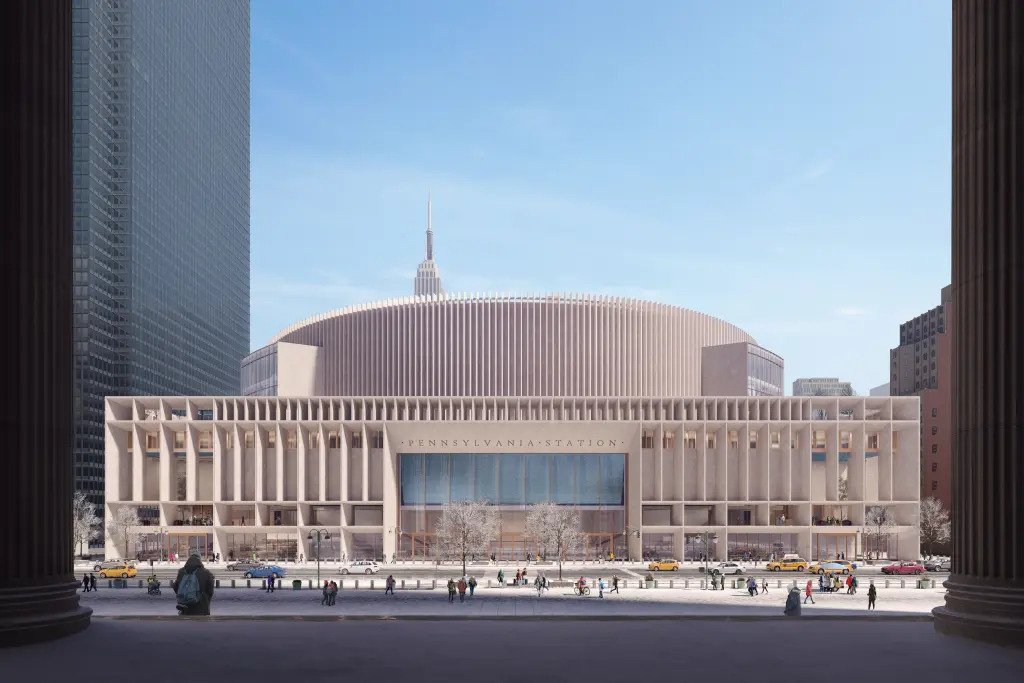
ASTM North America’s proposal envisions a rejuvenated Penn Station that recaptures its former glory as an iconic transit hub. The Post reported that the plan includes two main train halls, a modern mid-block building with a glass exterior, a well-lit passenger concourse, and higher ceilings to alleviate the current cramped experience. The company’s Senior Vice President, Peter Cipriano, expressed the vision to create a grand entrance on Eighth Avenue, ensuring increased light, space, accessibility, and efficiency, according to the Post report.
One of the key changes proposed by ASTM involves the demolition of the Hulu Theater to make way for a new entrance on Eighth Avenue. The Post reported that this adjustment aims to enhance commuter convenience, pedestrian flow, and loading dock improvements. However, this aspect has drawn criticism from the Metropolitan Transportation Authority (MTA), arguing that the acquisition of the Hulu Theater from Dolan would constitute a $1 billion bailout for Madison Square Garden.
The Post also reported that Cipriano disputed what he described as “unfortunate information” about the Hulu Theater proposal, stating that the “total acquisition cost” for the entire project “would be less than $500 million, not a $1 billion or more has been suggested.” He rejected the notion that a deal for the theater would be a “giveaway” to Dolan.
Additionally, there have been claims from ASTM that the MTA has chosen not to review the project plans, while the MTA maintains that it is awaiting requested documentation from the ASTM team.
Speaking to the Post, Vishaan Chakrabarti, creative director of the Practice for Architecture and Urbanism, which is handling design for the site, said, “A lot of hay has been made this theater acquisition. I think in 10 years, no one is going to be paying any attention to that whatsoever.”
During a press briefing, an ASTM official claimed the MTA had “elected not to” review plans for the project, the Post reported. An MTA spokesperson pushed back on that claim.
“It’s simply not the case,” the MTA spokesperson told The Post, adding that agency officials had met with the ASTM team earlier this year and requested additional documentation, including a legal brief related to the proposal, but haven’t heard back.
ASTM’s proposal outlines a “fully wrapped” solution for the project, with a price tag of $6 billion. The cost includes construction, design, property acquisitions, and long-term asset management. The Post reported that the firm plans to commit $1 billion in upfront equity for property acquisition, while $2 billion would come from public funding. This funding includes a projected $1.5 billion grant from the Federal Railroad Administration, derived from the bipartisan infrastructure bill under the Biden administration, and $500 million from New York’s state funding.
The remaining $3 billion would be obtained through loans from the Department of Transportation. Once construction is complete, ASTM would oversee operations and maintenance at the revamped Penn Station site for a 50-year term, according to the Post report. Annual payments from Amtrak, the Long Island Rail Road, and New Jersey Transit, estimated at around $250 million, would cover maintenance costs and be tied to the station’s financial performance.
Earlier this month, the MTA released a report asserting that Penn Station and Madison Square Garden were no longer compatible. However, the ASTM proposal aims to address this issue by preserving Madison Square Garden within a redesigned exterior structure, as was reported by the Post. The developers believe that the revamped Penn Station would serve as a pivotal improvement for the entire neighborhood, acting as the “jelly in the doughnut.”
As the proposal moves forward, further discussions, negotiations, and clarifications will be necessary to address the criticisms and ensure the best outcome for New York City’s transportation infrastructure and its residents.
