



|
Getting your Trinity Audio player ready...
|
Antisemitism Watchdog Warns Mamdani: Inaction Could Turn Rhetoric Deadly
By: Fern Sidman
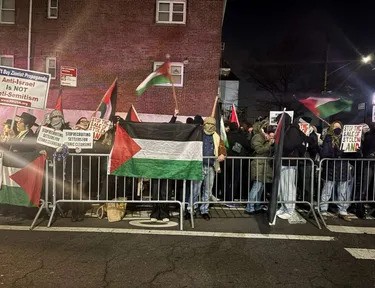
By any reasonable civic standard, Thursday night in Kew Gardens Hills should have passed quietly. The tree-lined residential streets of this Queens neighborhood are typically defined by the rhythms of family life: late-evening dog walkers, children finishing homework, the steady glow from the windows of synagogues and yeshivot that have long anchored the area’s Jewish population. Instead, as reported by Israel National News, the neighborhood became the stage for a confrontation that many Jewish residents describe as profoundly unsettling, if not outright terrifying.
Protesters in Queens chant, “Say it loud, say it clear, we support Hamas here” https://t.co/tGxtEYTEwv pic.twitter.com/RKxD3uY4Ia
— Luke Tress (@luketress) January 9, 2026
According to a report on Friday at Israel National News, a demonstration organized by the Palestinian Assembly for Liberation (PAL-Awda) NY/NJ targeted an Israeli real estate event being held at a local yeshiva. Videos circulated by the organizers themselves showed dozens of protesters, many wearing keffiyehs and waving Palestinian flags, gathering outside the Jewish religious institution. The chants that rang out—“We support Hamas,” along with calls for “intifada” and “people’s war”—did not remain within the realm of geopolitical advocacy. To critics, including the Combat Antisemitism Movement (CAM), they crossed a moral and legal threshold into the endorsement of violence.
CAM, in a strongly worded statement highlighted by Israel National News, condemned the protest in unambiguous terms. The organization warned that the rhetoric heard on the streets of Queens was not merely inflammatory but constituted a form of ideological intimidation directed at the Jewish community itself. The chants, CAM argued, were designed to evoke fear—especially when shouted outside a religious institution located in a densely Jewish residential neighborhood.
Sacha Roytman Dratwa, the CEO of CAM, did not mince words. Speaking to Israel National News, he asserted that the demonstrators were “anti-Semites, masquerading as pro-Palestinian demonstrators,” and suggested that the political climate in New York has emboldened extremists.
“The mass chanting of ‘We support Hamas,’” Roytman Dratwa said, as quoted by Israel National News, “means that they support the mass murder, rape and kidnapping of Jews.” He added that to voice such slogans in a residential area populated by Jewish families was “meant to be violent and threatening.”
The charge is grave, but CAM insists it is not hyperbolic. The organization drew a direct line between the rhetoric in Queens and historical precedents abroad. Roytman Dratwa referenced incidents in Australia, where chants such as “Where are the Jews?” preceded acts of mass violence. The implication is that slogans are not harmless abstractions: they can function as pre-incitement, a linguistic rehearsal for bloodshed.
What makes the Queens protest particularly fraught, according to the Israel National News report, is its location. This was not a rally in front of City Hall or a public square. It unfolded outside a yeshiva, an institution that is not only religious but symbolic—an embodiment of Jewish continuity in the diaspora. For families living nearby, the spectacle of protesters shouting slogans associated with violent movements felt less like political theater and more like targeted intimidation.
In its coverage, Israel National News emphasized that Hamas is a designated terrorist organization, responsible for mass atrocities including the October 7 massacre in Israel. CAM pointed out that expressions of support for such a group go well beyond protected political speech. They are an endorsement of terror itself.
This distinction—between criticism of Israeli policies and open celebration of a violent extremist group—is central to the debate now roiling New York. Civil liberties advocates argue that even reprehensible speech is often protected under the First Amendment. CAM countered, as reported by Israel National News, that there is a qualitative difference between condemning a state and praising a group internationally recognized for mass violence against civilians.
The stakes of this argument extend far beyond Queens. Over recent months, Jewish communities across the Western world have reported a sharp increase in antisemitic incidents following the war in Gaza. These range from vandalism and harassment to threats of physical harm. Against this backdrop, Thursday night’s chants take on an ominous resonance.
New York City’s leadership now finds itself under mounting pressure. CAM has explicitly called on city officials and law enforcement to “respond decisively before extremist rhetoric escalates into physical violence,” a plea echoed verbatim by Israel National News. The organization’s message is clear: inaction today may translate into tragedy tomorrow.
Mayor Mamdani, whose administration has been cited by Roytman Dratwa as a factor in the perceived emboldening of extremists, has not yet offered a detailed public response to the incident. Community leaders are demanding more than perfunctory condemnations. They are asking for concrete measures—heightened police presence around Jewish institutions, clearer guidelines on protest activity near places of worship, and a public reaffirmation that the glorification of terrorist violence will not be tolerated in New York’s streets.
Yet the situation is legally and politically complex. The United States has a long tradition of safeguarding protest, even when the message is deeply offensive. But CAM insisted that the chants in Queens crossed from protected speech into advocacy for violence, a boundary that law enforcement is empowered to police. This tension between civil liberties and communal safety is one that Israel National News has explored repeatedly in its reporting, framing the Queens protest as a case study in how fragile that balance has become.
For the residents of Kew Gardens Hills, the issue is not theoretical. Several parents told Israel National News that they were afraid to let their children walk alone to school the next morning. Others described a visceral sense of vulnerability—an awareness that the symbols of their faith, which once felt like anchors of belonging, have become flashpoints in an increasingly polarized political landscape.
CAM’s warning that “blood will be on the hands of all those who ignored the signs before it is too late,” may strike some as alarmist. But history, the organization argues, is replete with examples in which societies failed to take hateful rhetoric seriously until it metastasized into violence. The invocation of Australia was deliberate, intended to remind policymakers that the pathway from words to wounds is not speculative—it is documented.
In the days following the protest, Jewish advocacy groups have intensified their calls for action. Israel National News reported that coalitions are forming to demand hearings at the City Council level and to press the NYPD for clarity on how it intends to handle similar demonstrations in the future. There is also discussion of legislative proposals that would restrict protests within a certain distance of religious institutions, a move that would almost certainly provoke fierce debate among constitutional scholars.
Beyond the immediate policy questions, the Queens incident has become emblematic of a broader cultural fracture. The language of “people’s war” and “intifada,” once confined to distant conflicts, is now being shouted in American neighborhoods. As Israel National News has observed, this importation of hatreds into local communities represents a new and troubling phase in the politics of protest.
It is perhaps this sense of rupture that gives CAM’s condemnation its urgency. The organization is not merely reacting to a single night of chants; it is sounding an alarm about the normalization of extremist rhetoric in public life.
What happens next will test New York’s capacity to uphold its pluralistic ideals while protecting its most vulnerable residents. Will city leaders draw a firm line against the public glorification of terror, or will they retreat behind the ambiguities of free-speech doctrine? Will law enforcement adapt to a landscape in which ideological intimidation can erupt outside a yeshiva as easily as in a downtown plaza?
For now, the echoes of Thursday night linger in the streets of Kew Gardens Hills. They linger in the anxious glances of parents and in the quiet recalibration of daily routines. In a city that prides itself on diversity, the challenge is no longer merely to tolerate difference, but to confront the point at which difference is weaponized—and to do so before chants become, as CAM so starkly warns, something far more irrevocable.