



|
Getting your Trinity Audio player ready...
|
By: Fern Sidman
By any measure, the collapse of Catherine Almonte Da Costa’s appointment as New York City’s next director of appointments was both abrupt and politically combustible. What began as a routine staffing announcement by Mayor-elect Zohran Mamdani on Wednesday unraveled within hours, after resurfaced social media posts containing crude antisemitic stereotypes and anti-police invective ignited a backlash that reverberated from advocacy organizations to City Hall itself. As reported on Thursday by The New York Post, the episode has become an early stress test of Mamdani’s leadership, judgment, and capacity to navigate a city hypersensitive to questions of hate, inclusion, and public trust.
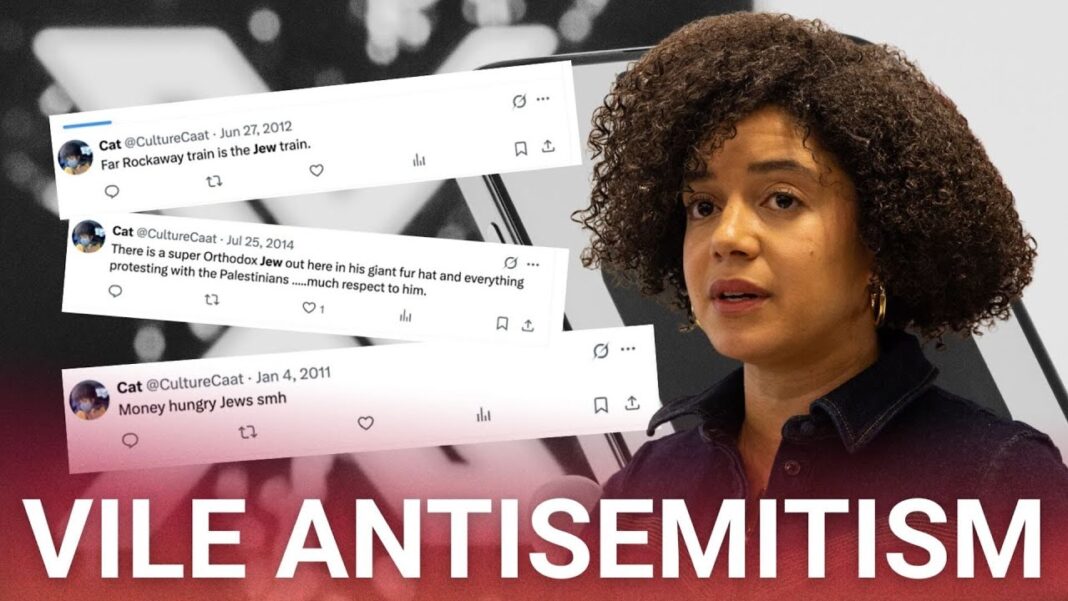
According to the information provided in The New York Post report, Da Costa’s downfall was triggered by a series of posts she made on X, formerly Twitter, in 2011 and 2012—posts that trafficked in language long associated with antisemitic tropes. Among them were references to “money hungry Jews,” remarks about “rich Jewish peeps,” and a dismissive characterization of a New York City subway line as “the Jew train.” Though more than a decade old, the posts struck a raw nerve in a city that has witnessed a disturbing rise in antisemitic incidents in recent years and where sensitivity to such rhetoric is acute.
The Anti-Defamation League of New York and New Jersey moved quickly once the posts were brought to light, publicly demanding to know whether Mamdani’s transition team had been aware of Da Costa’s online history before appointing her to one of the most influential behind-the-scenes roles in city government. As The New York Post reported, the ADL’s statement was blunt and unambiguous: language invoking “money hungry Jews,” it said, was indefensible under any circumstances, regardless of how much time had passed.
“Her social media footprint includes posts from more than a decade ago that echo classic antisemitic tropes and otherwise demean Jewish people,” the ADL wrote, according to The New York Post report. The organization added that while Da Costa may have personal relationships within the Jewish community, those relationships did not obviate the need for accountability—both from her and from the mayor-elect who had elevated her.
The pressure proved overwhelming. By Thursday afternoon, Da Costa had resigned from the post she had been tapped to assume only a day earlier. In a statement cited in The New York Post report, she said she had spoken directly with Mamdani, apologized, and concluded that her presence had become a distraction from the administration’s work.
“These statements are not indicative of who I am,” Da Costa said, emphasizing that she is the mother of Jewish children and expressing what she described as deep sadness and remorse over the harm caused by her words. Yet, as The New York Post report noted, the apology did little to quell broader concerns about how such statements could have gone unnoticed during the vetting process for a senior role tasked with identifying and recruiting talent across the vast municipal bureaucracy.
Compounding the controversy were Da Costa’s past comments about law enforcement, also unearthed by The New York Post. In several posts, she used crude language to deride the New York Police Department, including explicit profanity and references to officers as “piggies,” accompanied by pig emojis. She later became an outspoken supporter of the “defund the police” movement during the 2020 protests following the death of George Floyd, publicly endorsing calls to slash the NYPD budget by $1 billion.
While opposition to policing policies is hardly uncommon in New York’s political ecosystem, The New York Post observed that the tone and tenor of Da Costa’s remarks stood out for their derision. For critics, these posts raised questions not merely about ideology, but about temperament—particularly for someone entrusted with shaping the personnel of an administration responsible for overseeing law enforcement, public safety, and community relations.
Mamdani’s team moved swiftly to distance the mayor-elect from the controversy. A spokesperson for the transition team condemned Da Costa’s remarks as “unacceptable” and insisted they did not reflect Mamdani’s values or those of his forthcoming administration. Mamdani himself later confirmed that he had accepted Da Costa’s resignation, framing the episode as a closed chapter.
Yet the speed with which the appointment disintegrated has not prevented broader political fallout. This was not a low-level staffer but the proposed director of appointments—a role central to determining who fills hundreds of positions throughout city agencies. The incident has therefore become a proxy battle over competence, diligence, and the seriousness with which the incoming administration approaches background checks.
For Jewish advocacy groups, the episode has underscored anxieties about the normalization of antisemitic language in public discourse. The ADL’s intervention reflects a growing insistence that old posts cannot simply be waved away as youthful indiscretion when they mirror enduring stereotypes that continue to fuel real-world harassment and violence.
At the same time, civil libertarians and political allies of Mamdani have cautioned against what they see as an unforgiving culture of retroactive punishment. They argue that a decade-old social media history should be weighed alongside evidence of personal growth and current conduct. Yet even some of those voices privately acknowledged that the phrasing of Da Costa’s posts crossed a line that made her position untenable.
The episode has also revived scrutiny of Mamdani’s broader political circle. Critics have seized on the controversy as evidence of ideological blind spots within a progressive coalition that prides itself on inclusivity but has, at times, struggled with antisemitism within its ranks. Supporters counter that Mamdani’s rapid response—accepting the resignation within hours—demonstrates a willingness to act decisively when confronted with behavior that violates communal norms.
Still, as The New York Post report noted in its analysis, questions remain unanswered. Chief among them is how the vetting process failed to surface posts that were publicly accessible until the day of Da Costa’s resignation. In an era when digital footprints are routinely scrutinized for far less senior roles, the oversight has raised eyebrows among political professionals across the spectrum.
For Da Costa, the resignation marks a sudden and ignominious end to what might have been a significant chapter in her public service career. She previously worked on census outreach under former Mayor Bill de Blasio and was most recently employed as head of culture at the Orchestra, a role she was expected to leave in order to help “bring top talent” into Mamdani’s administration—a phrase that now carries an ironic sting, as The New York Post report dryly observed.
For Mamdani, the affair serves as an early warning that his administration will be judged not only by its policy ambitions but by the rigor with which it enforces its professed values. In a city as politically charged and culturally diverse as New York, symbolism matters, and missteps—particularly those involving antisemitism—are rarely forgiven lightly.
The resignation may close the immediate controversy, but it is unlikely to be the last word. Advocacy groups are expected to continue pressing for assurances that similar oversights will not recur, while political opponents are certain to invoke the episode as evidence of flawed judgment. Whether Mamdani can turn the page decisively, or whether this incident will linger as a cautionary tale throughout his term, remains an open question.
What is clear is that in the hyper-connected age of social media, the past is never truly past. As this saga illustrates—through the lens of The New York Post’s report—words typed in moments of carelessness can resurface years later with career-altering force, reshaping political narratives and testing the credibility of those who choose to elevate the authors of those words to positions of public trust.