



|
Getting your Trinity Audio player ready...
|
By: Fern Sidman
( JEWISH VOICE NEWS) In a Manhattan federal courtroom on Tuesday, the veneer of contrition from a young man who had terrorized Jewish New Yorkers at Israel-Gaza protests dissolved under the weight of his own words — and the testimony of those he attacked. As reported by The New York Post on Tuesday evening, 20-year-old Tarek Bazrouk, a self-professed “Jew hater,” was sentenced to 17 months in federal prison for a string of violent assaults against Jews during pro-Palestinian demonstrations across Manhattan — acts that prosecutors called “repeated, premeditated, and steeped in antisemitic hatred.”
Standing before Judge Richard Berman, wearing a tan jail jumpsuit, Bazrouk turned to two of his victims and offered a brief, seemingly rehearsed apology: “I’m sorry, guys, and I hope that you forgive me for my actions.” But, as The New York Post reported, his words landed hollow. Victim Roman Efraimov, draped in an Israeli flag and a Star of David chain, told the court that Bazrouk “smirked” as he spoke — a gesture that cut through the courtroom’s stillness like a knife.
“I don’t believe that he has remorse or knows the seriousness of the crime,” Efraimov said. “He turned around twice and smirked … I don’t feel it in my gut.”
Judge Berman’s sentence — 17 months in prison, below prosecutors’ request for three years but well above the 12 months suggested by the probation office — carried both punishment and principle. “People who assault Jews, or people of any other ethnicity or faith at protests because of their identity, are very likely to go to jail,” the judge declared, as quoted in The New York Post report. “The rules … do not apply to Jews or Palestinians alone. They apply to everybody.”
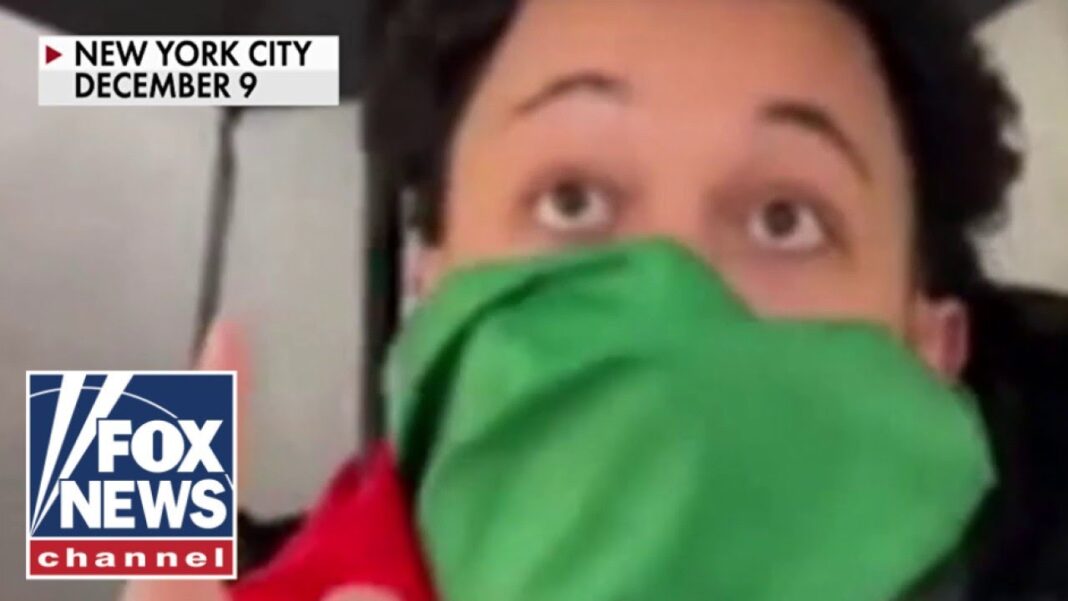
According to court filings reviewed by The New York Post, Bazrouk’s campaign of violence began in December 2024, when he punched a kippah-wearing Columbia University student in the face during a protest, after stealing an Israeli flag from the student’s brother. Just months later, on April 15, 2024, he kicked another Jewish man, Elisha Baker, in the chest while the victim sang Hebrew songs near the New York Stock Exchange. At the time of that attack, Bazrouk wore a green Hamas-style headband — a symbol, prosecutors said, that made his allegiances and motives unmistakable.
Baker, who addressed the court Tuesday, said the experience had forever altered his sense of safety as a Jew in America. “When I looked in his eyes, I saw someone who sought to hurt me and cause me pain just because of who I am,” he said, his voice steady but shaking with emotion. “My experiences as a Jew in America have been altered forever because of the actions of this man.”
A third assault followed in January 2025, when Bazrouk punched Efraimov in the face during a pro-Israel counterprotest at East 18th Street and First Avenue. The Post reported that Efraimov had become a familiar figure at rallies — a proud symbol of defiance, often standing beneath an Israeli flag even as anti-Israel demonstrators hurled slurs and threats. Bazrouk’s punch, prosecutors said, was “motivated by nothing other than antisemitic hatred.”
Federal prosecutors unearthed text messages that revealed not only a violent ideology but also a chilling sense of pride. In May 2024, Bazrouk sent a message to a friend that read, “I’m a Jew hater,” punctuated with a laughing-crying emoji. As The New York Post reported, he was also part of a chat group that shared updates from Abu Obeida, a spokesman for Hamas’s al-Qassam Brigades — the same military wing responsible for the October 7 massacres in southern Israel.
In court, prosecutors described the assaults as part of a broader pattern of radicalization, in which antisemitic propaganda and online extremism transformed protests into breeding grounds for violence. “His hatred was not impulsive,” one prosecutor told the judge. “It was cultivated, celebrated, and acted upon.”
The government urged a sentence of at least three years, arguing that Bazrouk posed “an ongoing danger to Jews” and that his “deeply seeded anti-Jewish animus” could not be dismissed as youthful immaturity. “He did not act out of confusion,” prosecutors wrote. “He acted out of conviction.”
Bazrouk’s public defender, Andrew Dalack, sought mercy, arguing that his client was remorseful and “grappling with the consequences of his terrible decisions.” Dalack cited a 2008 incident in which Bazrouk’s cousin was “killed by Israeli settlers” in the Judea and Samaria region, suggesting that trauma and grief may have shaped his worldview. But, as The New York Post report noted, Judge Berman was unmoved.
“This is a young man who has expressed no understanding of the damage he caused — to his victims, to his community, and to his own moral compass,” the judge said.
In a letter submitted before sentencing — and quoted in The New York Post report — Bazrouk appeared to express genuine contrition: “I don’t want to see more attacks on Israel like the one committed by Hamas on October 7. I don’t want to see any more people in Gaza die of starvation or from bombings. What I know now that I wish I knew a year ago is this: I’m certain that punching and kicking Jewish or Israeli people won’t solve anything.”
Yet prosecutors doubted the sincerity of his remorse, pointing out that the letter came only after his arrest and amid an avalanche of incriminating evidence.
In the courtroom gallery, Bazrouk’s sister, Anwar Bazrouk, wept silently as the judge read the sentence. Before sentencing, she spoke briefly to the court, condemning her brother’s actions and struggling to reconcile them with the values she said her family upheld. “We are all committed to make sure that nothing like this happens again,” she said. “I ask myself about the text messages. I ask myself where he learned to say those things about Jewish people. We come from a humble family that never taught him to say those things.”
Her words reflected a wider unease — the fear, expressed by many New Yorkers, that antisemitic violence has seeped into the cultural mainstream since the Israel-Hamas war commenced in October 2023. As The New York Post has reported, antisemitic incidents in New York have surged, with attacks on visibly Jewish individuals rising sharply during protests. Police data show that hate crimes targeting Jews remain the most frequent category of bias crimes citywide.
In his remarks, Judge Berman sought to strike a careful balance. He emphasized that justice, in cases such as this, must be blind to politics, religion, and ethnicity. “The rules that are applied in this case do not apply to Jews or Palestinians alone,” he said. “They apply to everybody.” But his broader message — that hate-fueled violence, regardless of ideology, would not be tolerated — carried particular resonance amid rising tensions across the city.
Efraimov, speaking to The New York Post after the hearing, called the sentence “fair” but warned that it should serve as a wake-up call. “There are people walking around New York who think violence against Jews is excusable if it’s done under the flag of ‘activism,’” he said. “This shows that it’s not.”
Baker, too, told The Post that the outcome offered some peace of mind: “I feel safer now that I know my attacker will not be roaming the streets for a considerable amount of time. The message the judge sent today was that if you target and assault Jews simply because they are Jewish, you will be held accountable.”
The New York Post has chronicled the alarming rise in antisemitic violence linked to anti-Israel demonstrations throughout 2024 and 2025. In many cases, attacks such as the ones Bazrouk committed have been framed by their perpetrators as “political resistance” — rhetoric that blurs the line between activism and hate crime. Law enforcement officials say the challenge has been distinguishing constitutionally protected protest from acts of intimidation or assault.
Bazrouk’s case, they argue, leaves no ambiguity. His victims were not political adversaries; they were private citizens exercising their own rights — to speak, to assemble, to identify openly as Jewish. That distinction was critical to Judge Berman’s ruling and to the message federal prosecutors sought to send.
“Freedom of expression ends where violence begins,” one Justice Department official told The Post. “The First Amendment is not a shield for hate crimes.”
For New York’s Jewish community, the sentencing represents both vindication and unease. Organizations such as the Anti-Defamation League have praised federal authorities for pursuing hate-crime charges, noting that too many similar assaults go unprosecuted. But many Jews remain fearful, citing a cultural climate in which antisemitic rhetoric has been normalized in academic and activist circles.
The New York Post has repeatedly exposed how campus groups such as Students for Justice in Palestine have promoted slogans like “globalize the intifada” — language that Jewish students say has emboldened acts of harassment and violence. Prosecutors in Bazrouk’s case cited his online interactions with Hamas propaganda channels as evidence of how that radicalization process now happens in plain sight.
“The internet has become the incubator for modern antisemitism,” one senior NYPD official told The Post. “We’re seeing young people radicalized not in mosques or basements, but on social media.”
Whether Bazrouk’s apology was genuine remains an open question. His defense portrayed him as a misguided youth, swept up in a wave of geopolitical anger and online extremism. His victims saw a man fully aware of his hatred, acting on it with intent. The judge’s middle-ground sentence seemed to acknowledge both realities — the potential for redemption and the necessity of accountability.
According to an observation made in The New York Post report, as he was led from the courtroom, Bazrouk glanced once more toward his family. His sister wept quietly. His victims, by contrast, stood motionless. There were no embraces, no gestures of reconciliation — only the unmistakable air of relief that justice, however imperfect, had been served.
In the end, the case of Tarek Bazrouk is not merely about one man’s descent into hate but about a society wrestling with its boundaries — between free speech and violence, between political grievance and moral rot. His 17-month sentence, modest by some measures, carries symbolic weight far beyond the confines of the courtroom.
As The New York Post wrote in its coverage, Judge Berman’s ruling “sends a clear message in an age of blurred moral lines: assaulting another person because of their identity will not be excused as activism, protest, or passion. It is a crime, and it carries consequences.”
In an era when antisemitism once again stalks the streets of New York under the guise of protest, that message — rooted in law, decency, and the equality of all faiths — is one the city urgently needs to hear.