



|
Getting your Trinity Audio player ready...
|
By: Fern Sidman
A volatile figure at the center of recent debates over extremism, immigration, and the limits of political protest once again seized the spotlight in New York City this weekend. On Saturday, Mahmoud Khalil, a 30-year-old anti-Israel activist whose incendiary rhetoric and controversial past have drawn widespread condemnation, addressed a large rally outside the New York Public Library in Midtown Manhattan.
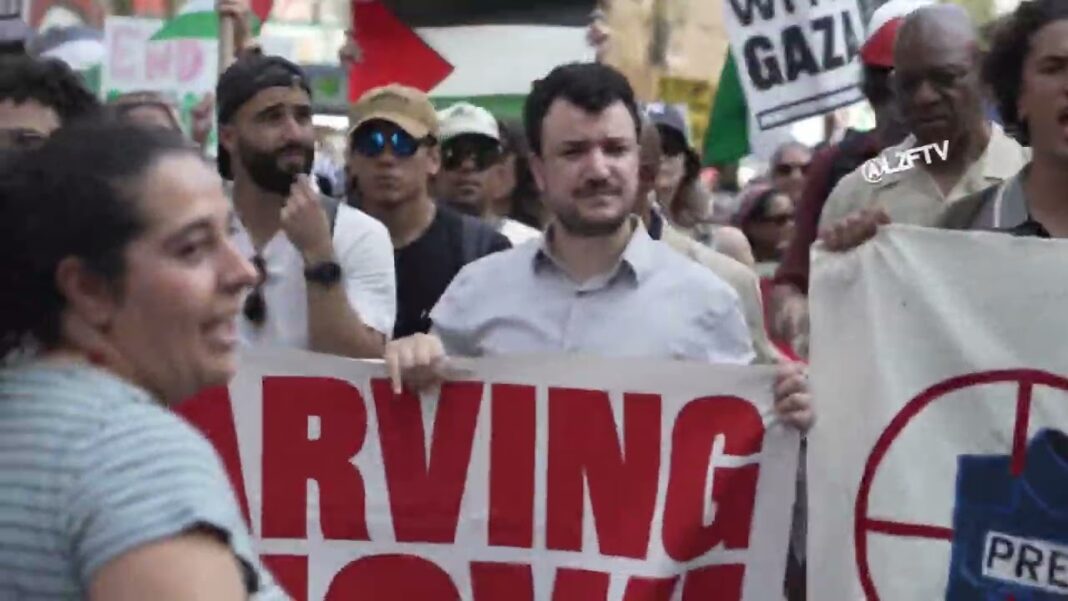
As reported on Saturday in The New York Post, Khalil stood on the library’s marble steps before a crowd estimated at more than 2,000 demonstrators, delivering a seven-minute speech that invoked the name and purported final words of Anas al-Sharif, an Al Jazeera correspondent killed in Gaza last week during an Israeli airstrike.
Israel has asserted that al-Sharif was not merely a journalist but also the commander of a Hamas terrorist cell, an allegation vehemently denied by Al Jazeera. Khalil, however, hailed al-Sharif as a martyr and quoted what he described as his last declaration: “The time is now, the bridges towards liberation start with us.”
The line drew loud applause from the gathered demonstrators, at least one of whom was photographed wearing the green headband traditionally associated with Hamas’ Izz ad-Din al-Qassam Brigades, the armed wing of the terrorist organization.
The crowd, after listening to Khalil and other speakers, marched in unison through the streets of Manhattan toward Columbus Circle, carrying signs and chanting slogans sharply critical of Israel.
Khalil is no stranger to notoriety. As The New York Post has documented, he first came to public attention during his student years at Columbia University, where he was active in pro-Hamas circles and frequently clashed with Jewish students and campus organizations.
His profile rose significantly earlier this year when, in March, he was detained by Immigration and Customs Enforcement (ICE) on the grounds that he posed a potential threat to national security. He was held in a detention center in Louisiana for several months before a federal judge ordered his release in late June, ruling the arrest unconstitutional.
Since then, Khalil has portrayed himself as a victim of government overreach and has become a cause célèbre among some progressive activists. Yet as The New York Post has repeatedly noted, his rhetoric and public statements have consistently drawn sharp criticism for crossing into apologetics for terrorism.
Perhaps most explosively, Khalil ignited national outrage with comments he made during an August 6 interview with The New York Times, in which he attempted to contextualize the October 7, 2023 massacre carried out by Hamas in Israel. That attack left over 1,200 people dead — most of them civilians — and resulted in the abduction of 251 others into Gaza, sparking the ongoing war.
Khalil described the bloodshed as a “desperate attempt” by Hamas “just to break the cycle” of Palestinian suffering. He refused to characterize the assault as a “mistake,” though he did add the caveat that “targeting civilians is wrong.”
The equivocation struck many as grotesque. The New York Post report highlighted the fury that followed, with Jewish groups, elected officials, and private citizens denouncing Khalil for justifying the most brutal act of anti-Jewish violence since the Holocaust.
Elected officials have taken notice. Representative Elise Stefanik, the House Republican Conference Chair and one of the most prominent voices in the GOP, demanded Khalil’s immediate deportation. Brooklyn Assemblyman Kalman Yeger told The New York Post that Khalil’s presence in the country is intolerable.
“Naturalized citizenship is an earned privilege of our nation, and he has not earned it,” Yeger said. “The government should continue taking every lawful step necessary to remove this enemy from the United States.”
Such statements call attention to the degree to which Khalil has become a lightning rod in the broader debate over immigration, national security, and the balance between free speech and public safety.
Even among activists and commentators generally sympathetic to Hamas advocacy, Khalil has come under fire for what some see as self-promotion at the expense of genuine human rights work. On social media platform X, one furious user lambasted him in blunt terms, writing: “Mahmoud Khalil is not a hero. He’s a f–king shill that so many are romanticizing as some Robin Hood. He’s out here saying my people getting gleefully butchered was worth it and you have idiots in Congress taking selfies with him and crying over him? Please be serious.”
The sentiment, cited in The New York Post report, illustrates that Khalil’s notoriety has not translated into universal support, even within activist circles. To many, he embodies the hazards of elevating figures whose rhetoric normalizes extremism under the guise of advocacy.
Saturday’s protest itself raised concerns beyond Khalil’s speech. Photographs published by The New York Post showed participants waving Palestinian flags, carrying signs equating Israel with apartheid, and chanting slogans accusing the Jewish state of genocide. The presence of at least one demonstrator in Hamas-style headgear, however, set off alarm bells for observers who fear that such rallies provide cover for overt expressions of support for terrorism.
Khalil’s decision to quote al-Sharif — a man Israel identified as a terrorist commander — only compounded those concerns. Critics argue that the invocation blurred any distinction between journalism and terrorism, martyrdom and murder.
The episode comes against a backdrop of rising tensions in New York City, where the war in Gaza has become a flashpoint for competing demonstrations. As The New York Post has chronicled in recent months, Jewish New Yorkers have reported feeling increasingly unsafe amid spikes in antisemitic incidents. At the same time, pro-Hamas groups have staged large rallies calling for a ceasefire, sanctions on Israel, and an end to U.S. military aid.
Khalil’s reemergence at Saturday’s event places him once again at the center of these volatile dynamics. His defiant posture and inflammatory rhetoric play into the fears of those who see anti-Israel activism in New York as veering into outright glorification of violence.
Khalil’s immigration status remains a matter of speculation. While his release from ICE custody was secured by a judge’s ruling, federal authorities have not abandoned the case against him. As The New York Post has reported, calls from lawmakers for his deportation continue to intensify, raising questions about whether additional legal avenues could be pursued to expel him from the country.
The challenge for officials lies in balancing constitutional protections for speech — however offensive — against national security concerns. Khalil’s defenders argue that his detention was a violation of his rights; his critics maintain that his statements constitute not mere speech but dangerous incitement.
For now, Khalil’s status as a polarizing figure seems only to deepen. To his supporters, he is a courageous voice confronting what they see as U.S. complicity in Israeli actions in Gaza. To his detractors, he is an apologist for terrorism, exploiting free speech protections to legitimize hatred and violence.
The New York Post report highlighted both the large crowds that turn out to hear Khalil speak and the equally large chorus of voices demanding his removal from the United States.
The sight of Mahmoud Khalil on the steps of the New York Public Library quoting the words of a man Israel identified as a Hamas terrorist was, to many, emblematic of the blurred lines between protest and provocation, advocacy and extremism. His speech, delivered to thousands marching through Manhattan, was a reminder that the debates unfolding in the Middle East now reverberate loudly — and divisively — in New York City.
The question remains whether Khalil will face further legal consequences, or whether his voice will persist as a disruptive, incendiary force in American political discourse. What is certain is that his name has become inseparable from the larger battles over antisemitism, immigration, and the dangerous allure of Jew hatred masquerading as liberation.

This is worth reporting. It is particularly timely when the No. 2 Congressional Democrat, Democrat whip Catherine Clark House, just publicly accused Israel of “genocide” and “starvation”.
https://www.jpost.com/american-politics/article-864621
Facing backlash, she is now trying to renounce it. This is the true face of the new neo-Nazi Democrat party represented by Muslim terrorist Zohran Mamdani.