



|
Getting your Trinity Audio player ready...
|
By: Fern Sidman
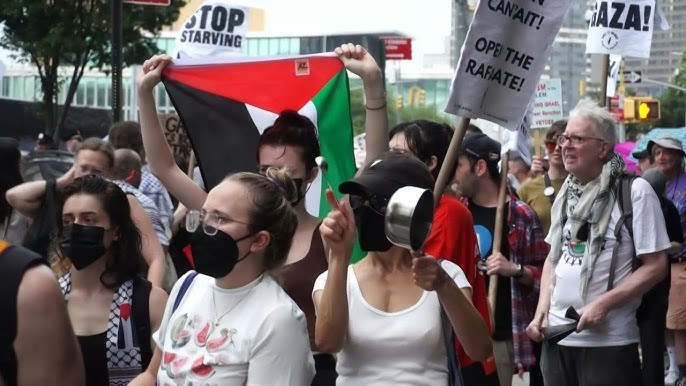
As world leaders converge on New York City for the annual United Nations General Assembly (UNGA), a coalition of radical anti-Israel groups is mobilizing a series of demonstrations that observers warn could escalate into explicit antisemitic rhetoric and intimidation of Jewish New Yorkers.
According to a report that appeared on Wednesday at The Algemeiner, the protests are timed to coincide with speeches by Middle Eastern leaders, as well as appearances by President Donald Trump and Israeli Prime Minister Benjamin Netanyahu. Organizers are promoting the events on social media as an opportunity to pressure the international community to condemn Israel’s military campaign against Hamas in Gaza, but the language used in promotional materials and past actions by these groups has raised serious concerns about the protests spiraling beyond legitimate political dissent.
The rhetoric previewing the protests has already veered into dangerous territory. On Sunday, demonstrators hurled insults at Israel’s Ambassador to the UN, Danny Danon, shouting: “Zionism is terrorism. All you guys are terrorists committing ethnic cleansing and genocide in Gaza and Palestine. Shame on you, Zionist animals.”
As The Algemeiner report indicated, this language mirrors age-old antisemitic tropes that dehumanize Jews and portray Israel as uniquely malevolent, laying the groundwork for harassment and violence under the guise of political protest.
Further amplifying fears, the radical activist collective INDECLINE staged a grotesque stunt outside the UN last week, in which masked protesters kicked a lifelike replica of Netanyahu’s decapitated head as though it were a soccer ball. The spectacle, widely condemned across the political spectrum, drew attention to how protest theater can blur into incitement.
The most prominent organizer of this year’s UNGA demonstrations is Within Our Lifetime (WOL), a Brooklyn-based group that has emerged as one of the most vocal and radical anti-Israel entities in the United States. WOL has pledged to “flood” the UN with pro-Hamas, pro-terror demonstrators, declaring: “This is the time to make our voices impossible to ignore. Come to New York by any means necessary, to stand, to march, to demand the UN act and end the siege.”
As The Algemeiner report has documented, WOL sparked outrage earlier this year when it led a protest against an exhibition commemorating the victims of the Oct. 7 Hamas massacre at Israel’s Nova Music Festival. During that event, demonstrators shouted slogans such as “Resistance is justified when people are occupied!” and “Israel, go to hell!”—statements widely interpreted as endorsements of terrorist violence.
Jewish Voice for Peace (JVP) and the Palestinian Youth Movement (PYM) are also co-organizers of a large march scheduled for Friday, stretching from Times Square to UN headquarters. Both groups have long been accused of whitewashing terrorism while presenting themselves as progressive advocacy organizations.
The Algemeiner has repeatedly chronicled JVP’s track record of excusing antisemitic rhetoric under the cover of “Palestinian liberation.” The organization has defended Hamas’s Oct. 7 atrocities as “resistance,” distributed literature discouraging Jews from using Hebrew liturgy, and urged activists to support groups explicitly committed to Israel’s destruction.
PYM, meanwhile, has been linked to increasingly militant rhetoric. Just weeks ago, The Algemeiner noted that Sen. Tom Cotton (R-Ark.) called for a federal investigation into PYM after one of its leaders, Aisha Nizar, urged followers to sabotage the U.S. supply chain for F-35 fighter jets—a direct assault on a cornerstone of American and Israeli defense cooperation.
The Combat Antisemitism Movement (CAM) issued a stark warning on its website that the planned demonstrations risk crossing the line from political protest into hate speech. “Anti-Israel activists are attempting to hijack the UN gathering to spread antisemitism and delegitimize the Jewish state’s right to exist,” CAM cautioned.
The group emphasized that events like these often serve as platforms for rhetoric that quickly spills into harassment of Jewish students, worshippers, and pedestrians in New York. The concern is not hypothetical. As The Algemeiner has repeatedly documented, previous anti-Israel protests in Manhattan have devolved into chants calling for the eradication of Israel, assaults on visibly Jewish bystanders, and vandalism of synagogues and community centers.
The UN General Assembly has historically served as a flashpoint for demonstrations tied to the Israeli-Palestinian conflict. From pro-Israel rallies championing solidarity with the Jewish state to anti-Israel protests portraying Israel as a pariah, the annual gathering attracts activists seeking the global spotlight.
Yet this year, the tone appears especially volatile. The Algemeiner report emphasized that the imagery of Netanyahu’s decapitated head and chants calling Zionists “animals” illustrate a willingness among some demonstrators to blur the boundary between anti-Israel protest and antisemitic incitement.
That danger is heightened by the UNGA’s sheer scale: thousands of journalists, diplomats, and activists from around the world descend on Manhattan, magnifying both the visibility and potential volatility of protest actions.
Jewish communal organizations are preparing for what many fear will be a hostile atmosphere in Midtown Manhattan during UNGA week. The Algemeiner reported that synagogues and Jewish community centers in the area have already tightened security, while advocacy groups are urging members to report harassment and avoid confrontation with demonstrators.
CAM has even launched a new mobile app, Report It, designed to allow users worldwide to quickly and securely document antisemitic incidents in real time. The app reflects growing recognition that incidents can escalate quickly during mass protests and that data collection is essential for law enforcement and advocacy.
The rhetoric of these groups reveals a consistent pattern: delegitimizing Israel’s existence, excusing terrorism, and portraying Jewish identity itself as a provocation.
As The Algemeiner report observed in its coverage of JVP, the group’s ideological framework positions Jews who support Israel as “complicit in oppression” and therefore as legitimate targets of condemnation. Similarly, PYM’s advocacy of sabotage against U.S. military supply chains shows how anti-Israel activism increasingly bleeds into calls for direct action against American interests.
Such rhetoric emboldens individuals on the fringes, raising the risk of intimidation or violence against Jewish residents of New York. The recent assassination of conservative activist Charlie Kirk by a gunman espousing leftist ideology only underscores the volatility of this moment, and the way radical movements can inspire individuals to deadly action.
JVP and PYM have framed their upcoming march as a demand for international action against Israel. “The time is now for each and every UN member state to uphold their duty under international law: sanction Israel and end the genocide,” the groups said in a joint statement.
But as The Algemeiner report noted, such rhetoric often glosses over the reality that these groups not only oppose specific Israeli policies but Israel’s very right to exist. By calling for “ending the siege” and “upholding international law” without condemning Hamas’s atrocities, they create an atmosphere where antisemitism can flourish under the guise of human rights advocacy.
As the UN General Assembly convenes, the streets of New York City are once again poised to become a stage for the world’s most polarizing debates over Israel and the Middle East. Yet for Jewish New Yorkers and their allies, the prospect of demonstrations dominated by groups such as WOL, JVP, and PYM is less about free expression and more about potential harassment and intimidation.
The Algemeiner report stressed that while political protest is a cornerstone of democratic society, the line is crossed when demonstrators use antisemitic slurs, glorify terrorism, or brandish violent imagery. The events of the coming days will test not only New York’s ability to manage mass demonstrations but also its resilience against a rising tide of antisemitism masquerading as activism.
For now, the Jewish community braces for a fraught week in Manhattan, one where global diplomacy inside the UN will be matched by rancorous protests outside—protests that many fear could reveal the enduring and ugly intersection between anti-Israel ideology and antisemitic hate.
