



|
Getting your Trinity Audio player ready...
|
Another Round of Snow Headed for NYC as Light Accumulation Expected Overnight
By: Andrew Carlson
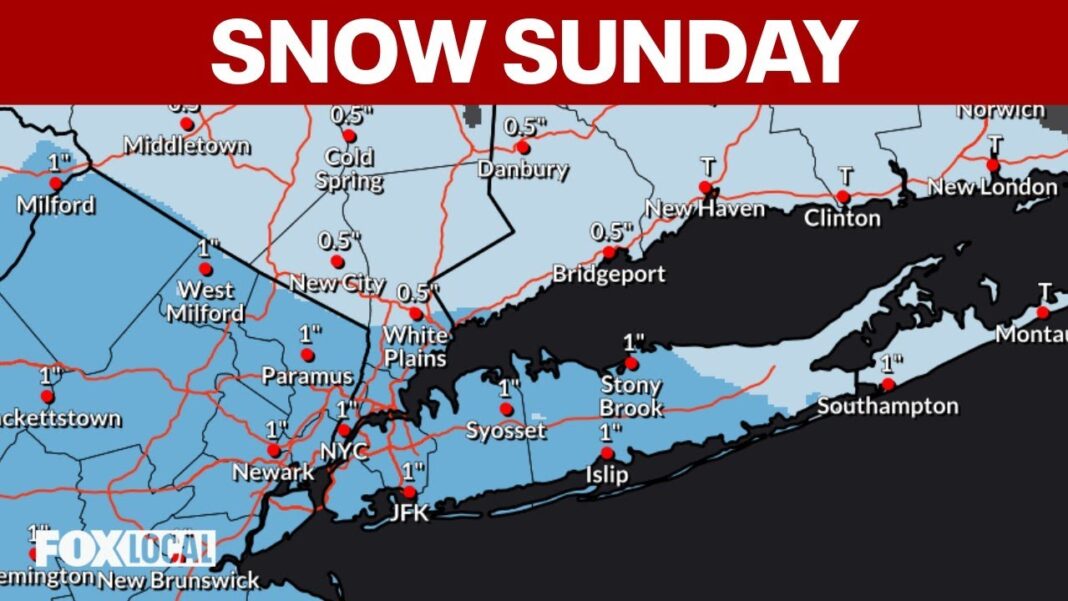
New York City, a metropolis whose rhythms are as relentless as the tides of the Hudson, is preparing for a fleeting but potentially disruptive return of winter. According to forecasts cited by The New York Post in a report on Saturday evening, a modest burst of snow is poised to sweep across the region late Sunday night and into the early hours of Monday, casting a temporary pall of white over streets, rooftops, and commuter routes along the I-95 corridor. The event is not expected to be monumental in terms of accumulation, yet its timing—coinciding with the overnight freeze and the early morning commute on Presidents Day—imbues it with a significance disproportionate to its modest snowfall totals.
The New York Post reported that forecasters anticipate light snow developing as a coastal system strengthens and glides through the Northeast, bringing with it a narrow band of precipitation that will brush New York City, Long Island, and parts of northeast New Jersey. Fox Weather meteorologists, whose projections The New York Post has prominently cited, estimate that most neighborhoods will receive between one and two inches of snow, with some pockets experiencing little more than a cosmetic dusting. For a city accustomed to the drama of nor’easters and paralyzing blizzards, such figures may appear trivial. Yet the meteorological nuance lies not in the quantity of snow but in the confluence of temperature, timing, and urban infrastructure.
Overnight temperatures are expected to dip into the upper twenties and lower thirties—hovering at the threshold where precipitation can cling stubbornly to untreated surfaces. The mercury will be cold enough to permit accumulation on roadways that have not been pretreated, as well as on sidewalks, bridges, and grassy medians. In a city where the choreography of daily life depends on frictionless movement—subway entrances, bus stops, pedestrian crossings—the prospect of even a thin veneer of snow and slush introduces a measure of hazard. The New York Post report cautioned that snow- and slush-covered roads could complicate travel late Sunday night and into the Monday morning commute, when workers, holiday revelers, and essential services intersect in the narrow window between nocturnal quiet and diurnal surge.
The forecasted event, though brief, offers a reminder of the fragility of urban mobility in winter conditions. Slick roads are likely to greet early commuters, particularly in outlying boroughs and suburban approaches where road treatment may be less comprehensive. In these marginal conditions, where precipitation falls lightly but temperatures remain cold enough to preserve it, accidents often multiply. The city’s transportation apparatus, honed through decades of winter storms, is adept at clearing major arteries, but the first hours of snowfall—before plows and salt trucks have fully mobilized—are invariably the most treacherous.
Meteorologically, the system is expected to be transient. The New York Post reported that the snow should taper off early Monday as the coastal low deepens offshore and exits the region, drawing drier air in its wake. By midday, sunshine is forecast to return, restoring the city’s familiar palette of gray concrete and steel. Any accumulation, forecasters say, is unlikely to linger long. Highs are projected to rebound into the 40s by Monday afternoon, with similar temperatures extending into Tuesday and Wednesday, facilitating the rapid melting of residual snow and ice. In this sense, the event resembles a winter cameo—a brief atmospheric interlude rather than a sustained siege.
Yet even ephemeral weather events exert a subtle influence on urban psychology. The New York Post has long chronicled how New Yorkers, though famously resilient, experience seasonal fatigue as winter drags on. A surprise snowfall in late winter can feel like a regression, a reminder that the thaw of spring remains provisional. At the same time, the fleeting return of snow can lend the city a transient hush, a momentary stillness as flakes mute the cacophony of traffic and soften the hard edges of the urban landscape. For some, the sight of snow drifting past illuminated windows in the late hours of Sunday night will evoke a quiet nostalgia; for others, it will signal an unwelcome obstacle to be navigated before the workweek begins.
This particular weather event is likely to be minor and short-lived, a characterization echoed by Fox Weather’s assessment. Nonetheless, the paper has urged residents to plan for a few slick hours overnight into early Monday, especially those traveling during the pre-dawn period. In a city of millions, even a marginal increase in travel difficulty can ripple outward, delaying deliveries, slowing emergency response times, and complicating the intricate ballet of public transit. The Presidents Day holiday, which alters commuting patterns for some while leaving others bound to their routines, adds another layer of complexity to the morning’s potential disruptions.
Beyond Monday, milder conditions are expected to prevail through much of the week, with temperatures in the 40s and partial sunshine offering a reprieve from winter’s harsher moods. Rain chances are projected to return later in the week, on Wednesday and again Friday, a reminder that the atmospheric pendulum will continue to swing between precipitation types as winter yields, reluctantly, to early spring. In the meantime, the brief snowfall serves as a meteorological punctuation mark, an understated reminder of the season’s lingering presence.
The city’s response apparatus—sanitation crews, transportation authorities, and emergency services—stands ready to mitigate the impact of the overnight snow. The New York Post report noted that while the accumulation is not expected to overwhelm resources, the timing demands vigilance. Bridges and overpasses, which cool more rapidly than ground-level roadways, are particularly susceptible to icing. Pedestrians navigating dimly lit sidewalks in the early hours may encounter patches of slickness that belie the otherwise modest accumulation. For cyclists and motorcyclists, the combination of slush and cold pavement poses an elevated risk, prompting advisories for caution or alternative transport.
In the broader narrative of New York’s winter, this event will likely register as a footnote rather than a chapter. Yet the city’s relationship with weather is cumulative; each minor storm adds to a season’s texture, shaping public memory and institutional preparedness. The New York Post’s coverage situated this snowfall within that continuum, neither sensationalizing its impact nor minimizing the practical considerations it entails. In doing so, it reflects the pragmatic ethos of a city accustomed to negotiating with the elements.
As Sunday night deepens and the first flakes begin to fall, New York will briefly don its winter cloak once more. By Monday afternoon, the cloak is expected to slip away, dissolved by sunlight and rising temperatures. The episode will leave behind little more than damp pavement and a renewed appreciation for the tenuous equilibrium between urban life and the weather that periodically disrupts it. In the cadence of the city’s seasons, this fleeting snowfall is a soft note—audible, momentarily disruptive, and quickly absorbed into the ceaseless rhythm of metropolitan life.
