



|
Getting your Trinity Audio player ready...
|
By: Carl Schwartzbaum
A demonstration held in New York City to mark the annual observance of Al Quds Day erupted into a storm of incendiary rhetoric on Friday, with anti-Zionist protesters chanting support for terrorist organizations, invoking centuries-old antisemitic accusations, and calling for the destruction of Israel and the United States. The gathering, which took place amid heightened geopolitical tensions stemming from the ongoing U.S.–Israel war with Iran, drew widespread condemnation and renewed scrutiny of extremist political activism within major American cities.
According to detailed reporting from The Times of Israel on Saturday, the demonstration attracted several hundred participants and was organized by a coalition of left-wing activist groups, including Pal-Awda, the Bronx Anti-War Coalition, and the Workers World Party. While the event was ostensibly framed as a political protest in support of Palestinians and opposition to Israeli policy, many of the speeches and chants reportedly veered far beyond conventional political critique, entering the realm of explicit praise for Iranian-backed terrorist groups and language widely regarded as antisemitic.
The incident has reignited debate about the boundaries between political expression, extremist ideology, and hate speech in the context of Middle Eastern politics and global activism.
Al Quds Day—meaning “Jerusalem Day” in Arabic—was established in 1979 by Iran’s revolutionary leader Ayatollah Ruhollah Khomeini shortly after the Islamic Revolution. The annual event, held on the final Friday of the Islamic holy month of Ramadan, was conceived as a global day of protest against Israel and a demonstration of solidarity with Palestinians.
Over the decades, Al Quds Day rallies have been held in cities across the Middle East, Europe, and North America. While some participants frame the event as an expression of Palestinian solidarity, critics argue that the day has historically been used to promote anti-Israel and virulent antisemitic messaging.
The Times of Israel reported that this year’s rally occurred at a particularly volatile moment, as hostilities between Iran, Israel, and the United States have dramatically escalated. Against that backdrop, many speakers at the New York protest openly framed the conflict in ideological terms, describing Iran as a central force in what they characterized as resistance against Western and Israeli power.
According to the information provided in The Times of Israel report, several speakers delivered fiery addresses praising Iran and framing the war as a broader struggle against what they called “imperialism” and “Zionism.”
One speaker at the rally proclaimed unwavering support for the Iranian regime. “This Al Quds Day holds a special significance,” he told the crowd, “as the United States and its puppet Zionist regime wage full-out war against the Islamic Republic of Iran. We proclaim our support for the Islamic Republic.”
He continued by portraying Iran as a cornerstone of global resistance movements. “Iran is the central pillar in the struggle against U.S. imperialism and Zionism,” the speaker declared. “A war against the Islamic Republic of Iran is a war against anti-imperialism, against anti-occupation, against anti-freedom.”
The Times of Israel report noted that the speech also included references to martyrdom and militant resistance, language that drew enthusiastic chants from portions of the crowd.
During the demonstration, some protesters reportedly expressed open support for organizations designated as terrorist groups by the United States and numerous Western governments. The Times of Israel reported that chants of “We support Hamas here” were heard during the rally. Other demonstrators carried flags associated with Hezbollah and Palestinian Islamic Jihad—groups that have been responsible for numerous attacks against Israeli civilians.
Several protesters also shouted “Khaybar, Khaybar,” referencing a historic seventh-century battle between Muslim forces and a Jewish tribe. The phrase has become widely recognized in contemporary demonstrations as a chant used to threaten Jews with violence. Participants reportedly shouted variations of the chant in Arabic, including “Khaybar, Khaybar, O Jews,” a phrase that critics say evokes historical threats against Jewish communities.
These accusations echo the infamous blood libel, a medieval antisemitic conspiracy theory that falsely accused Jews of murdering Christian children for ritual purposes. The libel fueled centuries of persecution and violence against Jewish communities throughout Europe and the Middle East. Historians widely regard such claims as one of the most dangerous and enduring forms of antisemitic propaganda.
The Times of Israel reported that the chants were directed toward the counter-protesters, who numbered roughly a dozen and included Jewish participants and allies waving American and Israeli flags.
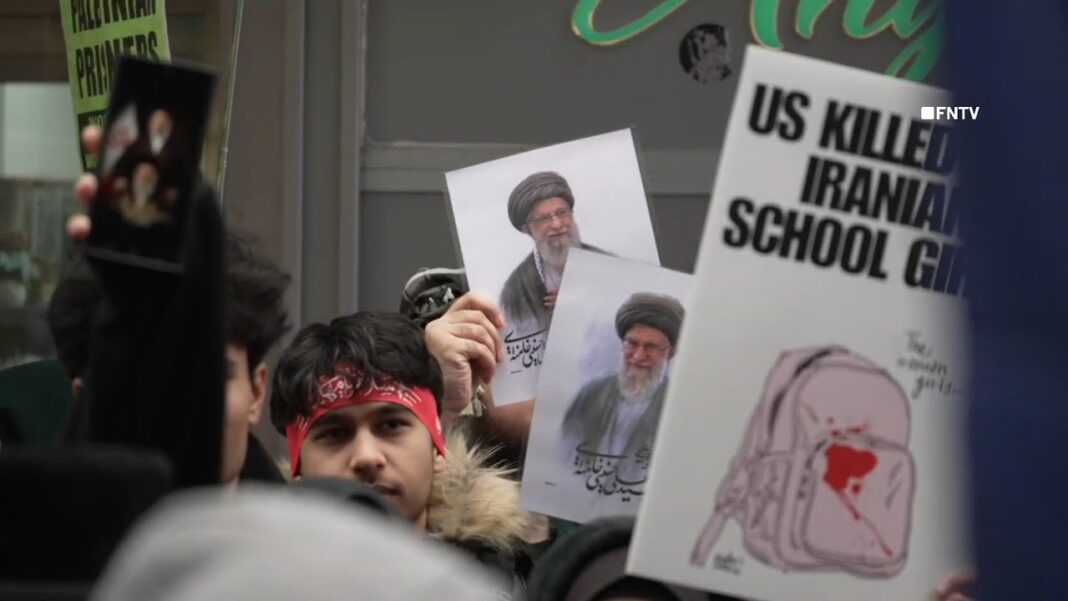
Visual imagery at the rally reinforced the ideological tone of the event. Demonstrators held placards bearing slogans such as “Victory to Palestinian and Iranian resistance” as well as “Free America from Israel” and “Israel weaker than a spider’s web.” The latter phrase references remarks once made by Hezbollah’s late leader Hassan Nasrallah, who used the metaphor to describe what he believed was Israel’s vulnerability.
According to the information contained in The Times of Israel report, some signs displayed images of Iranian leaders, including photographs of the late Ayatollah Ali Khamenei held aloft by participants. In one instance, a child standing on the stage reportedly held a portrait of the Iranian leader, underscoring the rally’s ideological alignment with the Islamic Republic.
Across the street from the rally, a small group of pro-Israel demonstrators assembled to challenge the protesters’ message. The Times of Israel reported that these counter-protesters waved American flags and chanted “USA,” while also shouting accusations that the rally participants were “brainwashed” or supportive of terrorism. The presence of counter-demonstrators added another layer of tension to an already volatile atmosphere, though no significant physical altercations were reported. Police maintained a visible presence in the area to separate the opposing groups and ensure public safety.
Beyond chants and slogans, several speakers delivered remarks invoking conspiracy theories about Jewish influence in global politics and media. One speaker described “Zionists” as “parasites” who had allegedly infiltrated American institutions. “They infiltrated the Oval Office, they infiltrated our legislature, they infiltrated our courts,” she claimed. “They’re even trying to take ownership of our media.” Such language echoes longstanding antisemitic stereotypes portraying Jews as secretly controlling governments and financial systems.
Observers noted that these narratives have circulated widely on social media and extremist forums in recent years.
Another speaker from the Bronx Anti-War Coalition praised figures associated with militant organizations, referencing the October 7, 2023, Hamas assault on Israel—known among Hamas supporters as “Al Aqsa Flood.” According to The Times of Israel report, the speaker described the event as a “strategic earthquake” that would reshape the Middle East. He also paid tribute to militant leaders killed in conflicts with Israel, including Yahya Sinwar, the former Hamas leader, Hassan Nasrallah of Hezbollah and commanders of Iran’s Islamic Revolutionary Guard Corps (IRGC). The remarks drew chants of “Allahu Akbar” from segments of the crowd.
The rally has already triggered significant backlash from political leaders and advocacy organizations concerned about rising antisemitism. Many observers argue that rhetoric glorifying terrorist organizations or invoking blood libels crosses a dangerous threshold from political protest into explicit incitement and hate speech.
The Times of Israel report noted that such incidents occur amid a broader surge in antisemitic incidents in the United States and globally following recent conflicts involving Israel. Jewish community organizations have repeatedly warned that inflammatory rhetoric at demonstrations can fuel real-world violence against Jewish individuals and institutions.
The events in New York highlight how conflicts thousands of miles away can reverberate intensely within diaspora communities and political movements abroad. As The Times of Israel has reported, demonstrations related to the Israeli-Iranian conflict have erupted in numerous cities worldwide, often reflecting deeply polarized views about the war.
For some activists, the rallies represent solidarity with Palestinians or opposition to Western foreign policy. For critics, however, the rhetoric heard at the Al Quds Day demonstration illustrates how political activism can blur into the most egregious manifestations of Jew hatred.
New York City—home to the largest Jewish population outside Israel—has long been a focal point for demonstrations related to Middle Eastern politics. The Al Quds Day protest, with its incendiary antisemitic chants and ideological fervor, underscores the complex and often volatile intersection of global geopolitics, local activism, and social cohesion.
As The Times of Israel report noted, the rally is likely to remain a flashpoint in ongoing debates over free speech, political protest, and the troubling persistence of antisemitic rhetoric in contemporary public discourse. For many observers, the demonstration served as a stark reminder that the battle over ideas and narratives surrounding the Middle East is not confined to distant battlefields—it is unfolding in the streets of cities around the world.
