



|
Getting your Trinity Audio player ready...
|
By: Fern Sidman – Jewish Voice News
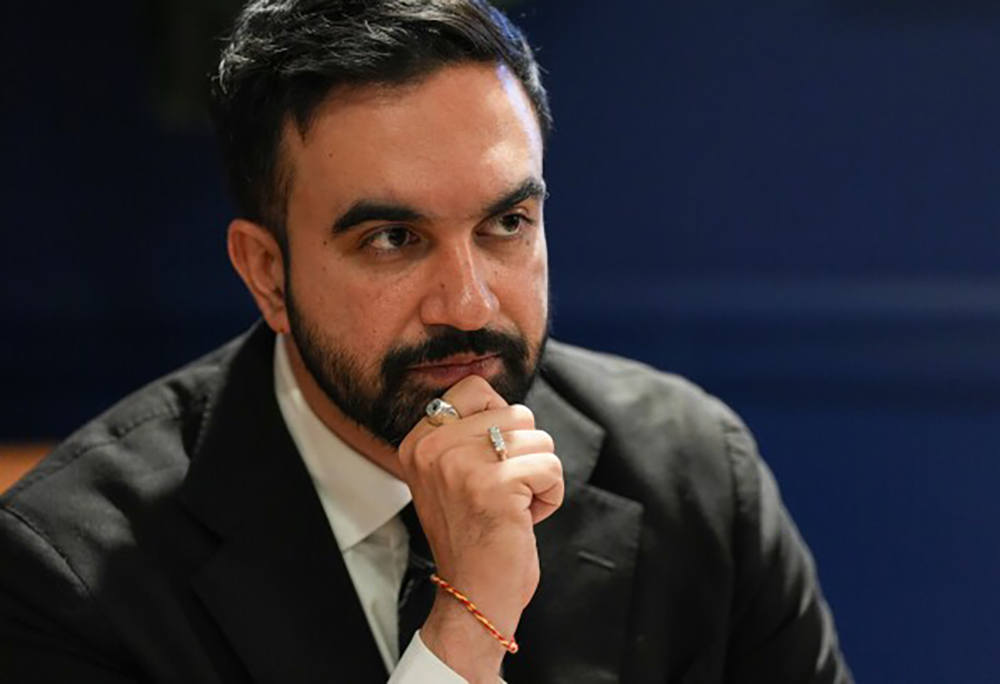
The election of Zohran Mamdani as the next mayor of New York City marks a watershed moment in the political evolution of America’s largest metropolis and, more profoundly, a seismic shift in the intricate relationship between Jewish voters and the progressive left. As The Jerusalem Post has reported, Mamdani’s stunning victory over former Governor Andrew Cuomo—a longtime stalwart of mainstream Democratic politics—has left the city’s traditional power blocs reeling and exposed a generational fault line that could reshape the political landscape of New York for years to come.
At just 34 years old, Mamdani, a self-described democratic socialist and the first Muslim of South Asian descent to be elected mayor of New York, represents a new kind of political insurgency—one driven as much by ideology as by identity. His rise encapsulates a broader transformation within the Democratic Party, where questions about Israel, antisemitism, and the moral weight of the Gaza war have fractured long-standing alliances and forced difficult conversations about the very soul of progressive politics.
As The Jerusalem Post report observed, Mamdani’s victory underscores an unmistakable rupture between older Jewish Democrats—once a dominant voting bloc—and the city’s younger, more progressive electorate. For decades, New York’s Jewish community was a reliable pillar of Democratic power: politically engaged, deeply civic-minded, and fiercely protective of Israel’s right to self-defense.
That equilibrium, however, has begun to collapse. A Pew Research Center study cited by The Jerusalem Post found that while nearly 70% of Jewish Americans over 50 view Israel’s conduct in Gaza as justified, barely half of those under 35 share that sentiment. This generational divergence has created an ideological chasm—one that Mamdani navigated deftly, speaking to the disillusionment of young voters alienated by what they perceive as America’s uncritical support for Israel’s military actions.
In Tuesday’s election, exit polls showed that roughly one-third of Jewish voters supported Mamdani, a remarkable figure given his public endorsement of the Boycott, Divestment, and Sanctions (BDS) movement and his previous refusal to condemn the controversial slogan “Globalize the Intifada.” His appeal among Jewish progressives, according to The Jerusalem Post, was rooted in his ability to separate criticism of Israeli policy from overt antisemitism—a distinction that many Jewish leaders found far too nebulous for comfort.
“The morning after the election, many members of our community woke up with a sense of unease,” said Hindy Poupko, a senior vice president at the UJA-Federation of New York, one of the city’s most influential Jewish nonprofits. “There’s a lot of uncertainty about how Mayor Mamdani might act once in City Hall.”
For months, Mamdani faced accusations of antisemitism stemming from his affiliations with pro-Palestinian activist groups and his endorsement of the BDS campaign, which seeks to isolate Israel economically and culturally. Critics accused him of blurring the line between legitimate criticism of Israeli policy and the demonization of the Jewish state—a critique that The Jerusalem Post reported had taken center stage in the final weeks of the campaign.
After his victory, Mamdani’s first test came swiftly. Hours after the polls closed, antisemitic graffiti appeared on the walls of a Brooklyn Jewish day school. The mayor-elect moved quickly to condemn the act, posting on X: “As mayor, I will always stand steadfast with our Jewish neighbors to root the scourge of antisemitism out of our city.”
His words, while conciliatory, failed to allay the anxieties of many Jewish leaders. Within days, the Anti-Defamation League (ADL) announced the creation of a “Mamdani Monitor,” a dedicated initiative to track his executive appointments and policy decisions for potential harm to the Jewish community. The ADL also launched a citywide hotline for residents to report incidents of antisemitism.
“Our job is quite simple—to protect the Jewish people,” said Jonathan Greenblatt, the organization’s CEO. “When leaders blur moral boundaries, we must hold them accountable.”
The most incendiary flashpoint in Mamdani’s campaign was his association with the slogan “Globalize the Intifada,” which became a rallying cry among activists during campus and street protests following the October 2023 Hamas attacks on Israel. While many viewed the phrase as a metaphor for global resistance against oppression, Jewish organizations—including the Simon Wiesenthal Center and The Jerusalem Post’s editorial board—condemned it as a call for violence against Jews worldwide.
When pressed by business leaders last summer, Mamdani reportedly promised to avoid using the slogan himself and to discourage its use by his supporters. Nevertheless, his refusal to outright repudiate it left a lingering sense of mistrust.
“Mamdani’s rhetoric dances on a dangerous edge,” The Jerusalem Post editorialized in July. “A leader who cannot bring himself to condemn calls for intifada cannot credibly claim to protect New York’s Jewish citizens.”
Yet Mamdani’s appeal cannot be dismissed merely as ideological radicalism. As The Jerusalem Post report noted, he tapped into genuine social frustrations—spiraling housing costs, economic inequality, and the erosion of civic trust—that transcend identity politics. His campaign’s focus on “affordability and dignity” resonated with millions of New Yorkers struggling to keep pace with the city’s relentless expense.
Ironically, some of Mamdani’s Jewish supporters viewed his victory as a moral realignment rather than a betrayal. “I support Mamdani not in spite of his views on Israel and Palestine but because of them,” said Roni Zahavi-Brunner, a 26-year-old Israeli activist who canvassed for his campaign. “Speaking out against genocide should not be considered political risk—it’s a moral necessity.”
This new cohort of pro-Palestinian Jewish progressives, often affiliated with organizations such as IfNotNow and Jewish Voice for Peace, has redefined the contours of Jewish political identity in America. They reject what they see as a false equivalence between Jewish safety and uncritical support for Israel, arguing that true Jewish ethics demand solidarity with the oppressed.
As The Jerusalem Post report pointed out, this faction is growing in influence, particularly among younger Jews who feel alienated from the institutional mainstream—synagogues, federations, and legacy organizations that have long tied Jewish identity to Zionism.
While Democrats grappled with internal division, Republicans seized upon Mamdani’s victory as a chance to redefine their relationship with Jewish voters. Former President Donald Trump, whose pro-Israel credentials remain strong among Orthodox and conservative Jews, was quick to respond.
“Any Jewish voter who supported Mamdani is a stupid person,” Trump declared on Tuesday, igniting predictable outrage from Democrats.
The comment, reported by The Jerusalem Post, shines a spotlight on the precarious balance Republicans must strike as they attempt to attract Jewish voters while distancing themselves from elements of their own party that flirt with antisemitic rhetoric. The controversy surrounding right-wing commentator Tucker Carlson, who recently hosted white nationalist Nick Fuentes on his podcast, exposed that tension starkly. Even Senator Ted Cruz of Texas publicly rebuked Carlson, warning that “a handful of voices spreading this garbage are giving us all a time for choosing.”
Strategists told The Jerusalem Post that Mamdani’s election could become a potent fundraising and organizing tool for the GOP in next year’s midterm elections. “His ascent to Gracie Mansion could rewrite the playbook for Republicans, tightening their hold on the U.S. House,” said Republican strategist Ford O’Connell, referencing the mayor’s official residence.
The political shockwaves of Mamdani’s victory are already reverberating far beyond the city limits. In Albany, Republican Representative Elise Stefanik—a close Trump ally—announced her bid for governor, accusing Democratic incumbent Kathy Hochul of “betraying Jewish New Yorkers” by endorsing Mamdani.
“The Democratic Party in New York has abandoned the Jewish people,” Stefanik told The Jerusalem Post, vowing to make the protection of Jewish life and support for Israel central themes of her campaign.
Analysts believe the battle lines drawn by Mamdani’s election—between progressivism and traditionalism, cosmopolitanism and tribal identity, ideology and survival—will define not just New York’s next decade but the direction of American urban politics more broadly.
Among New York’s Jewish residents, emotions remain raw. “I feel deflated,” said Alison Devlin, a 50-year-old Manhattan resident and lifelong Democrat who voted for Cuomo. “I’m openly Jewish, I’m openly Zionist, and I don’t know what’s going to happen. I don’t know if I’m staying in the city after this.”
Others are more cautiously hopeful. Corinne Greenblatt, 27, who works in higher education, told The Jerusalem Post she believes Mamdani “genuinely wants to engage with all parts of the Jewish community.” She added, “The Jewish community is not monolithic. There are pro-Palestine Jews, pro-Israel Jews, and Jews who have no relationship to Israel at all. The challenge is whether Mamdani can speak to all of them without alienating any.”
For Rabbi Andrue Kahn of Brooklyn, the answer lies in dialogue rather than denunciation. “Let’s give him a chance to prove that his commitment to fighting antisemitism is real,” he said. “If he means what he says about building cross-community solidarity, then maybe—just maybe—something new can grow from this painful division.”
As The Jerusalem Post report framed it, New York stands at a crossroads: between its storied past as a bastion of Jewish political power and an uncertain future defined by shifting allegiances and evolving moral vocabularies.
For nearly a century, the city’s Jewish voters have been central to its identity—builders, thinkers, organizers, and protectors of its civic conscience. Now, as the first Muslim socialist mayor prepares to take office, that legacy faces its sternest test yet.
Whether Zohran Mamdani’s New York becomes a city of greater inclusion or deeper fragmentation remains to be seen. But one truth endures, as The Jerusalem Post report noted in its post-election analysis: New York has always been the mirror of America’s soul. And right now, that reflection is fractured, searching, and profoundly unsure of what comes next.
Please keep in mind that it has long been understood that the Jerusalem Post is and always has been a leftist Democrat anti-Israel propagandist, and that its biased “reporting” should not be relied upon at face value. (I consider it unfortunate that TJV chooses a JPost story upon which to rely). You should expect that its rendition will be skewed against Israel’s and the Jewish people’s interests.
Witness this perverted version of reality: “His appeal among Jewish progressives, according to The Jerusalem Post, was rooted in his ability to separate criticism of Israeli policy from overt antisemitism—a distinction that many Jewish leaders found far too nebulous for comfort.”
Is that what TJV is recommending to American Jews?? To believe that Muslim monster Mamdani is in fact not an “antisemite”? DISGUSTING!
After re-reading Fern Sidman’s report I am convinced that it is an inexcusable betrayal of the Jewish people and TJV’s readers by TJV, for whom Fern speaks. She hides behind quoting others instead of taking a honest principled stand. This is not “balanced“, “neutral“, “objective” reporting. TJV has taken a stand, and it is AGAINST the Jewish people!