



|
Getting your Trinity Audio player ready...
|
By: Abe Wertenheim
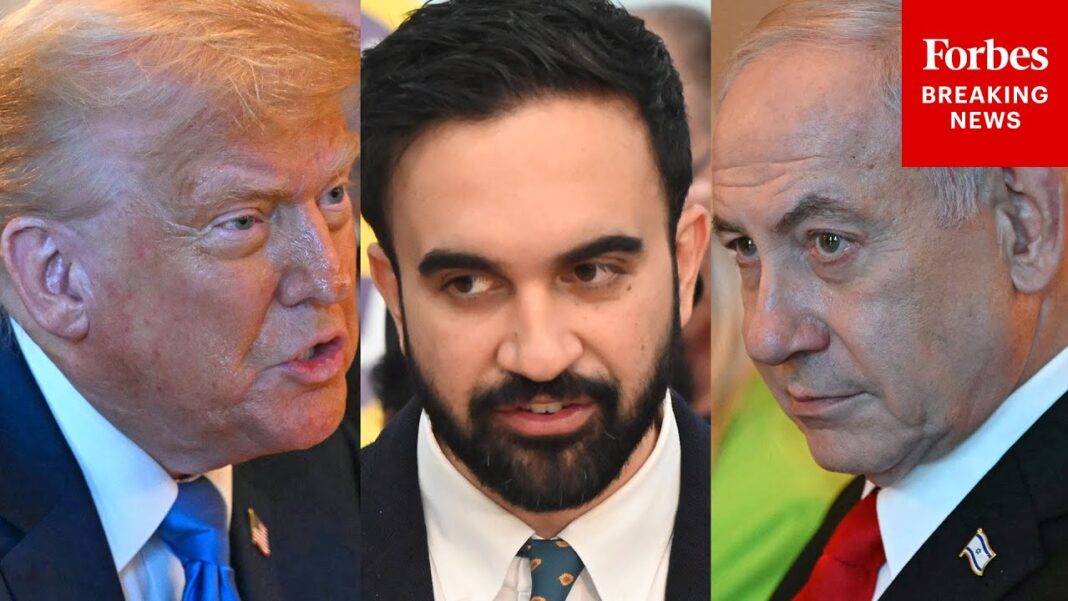
New York City Mayor Eric Adams placed himself squarely in the center of the city’s most contentious political debate this week, announcing that he will meet with Israeli Prime Minister Benjamin Netanyahu during the leader’s upcoming visit while forcefully condemning Democratic mayoral front-runner Zohran Mamdani’s radical pledge to have Netanyahu arrested.
As reported in The New York Daily News, Adams confirmed his meeting with Netanyahu during a Thursday morning press conference, framing the encounter as part of his broader commitment to engaging world leaders and affirming New York’s role as an international capital. “There’s several heads of states I’m going to meet with,” Adams said, according to The New York Daily News. “I’m looking forward to meeting with Prime Minister Netanyahu when he arrives in the city as well. He will be welcomed like our other dignitaries.”
The remarks drew immediate attention not only for the mayor’s embrace of a foreign leader currently facing an arrest warrant from the International Criminal Court, but also for his sharp rebuke of Mamdani, who has made opposition to Israel a defining plank of his campaign.
The political divide between Adams and Mamdani has crystallized around their contrasting views on Israel and its leaders. Mamdani, a Queens assemblyman who stunned the political establishment by winning the Democratic mayoral primary, has repeatedly threatened to order the New York Police Department to arrest Netanyahu should he enter the city under an ICC warrant.
The United States does not recognize the authority of the International Criminal Court, and Adams underscored that point forcefully. As quoted by The New York Daily News, he told reporters: “You have a right to come here and voice the positions from your country. And we respect the rule of law here. We don’t react in a reckless manner of stating that we’re going to arrest a dignitary that’s here.”
The comments were widely interpreted as a direct rebuke of Mamdani’s pledge, which critics argue undermines the city’s reputation as a hub of diplomacy and international engagement.
Adams, a longtime and vocal supporter of Israel, has consistently framed New York as a city that must welcome foreign dignitaries regardless of political disagreements. In 2023, he traveled to Israel to meet with Netanyahu and other leaders, a trip that The New York Daily News report noted as part of Adams’ effort to cement ties with Israel’s government and the city’s Jewish community.
Netanyahu’s visit to New York comes at a politically charged moment. The Israeli prime minister is also scheduled to meet with President Donald Trump next week, underscoring the convergence of domestic American politics and Israel’s international standing. For Adams, the meeting represents both continuity—following his 2023 trip—and contrast, as it provides an opportunity to distinguish his leadership from Mamdani’s hardline positions.
The New York Daily News report emphasized that Adams’ decision to meet Netanyahu signals a clear rejection of Mamdani’s call for confrontation. It also reflects the mayor’s strategic effort to carve out an independent political identity as he pursues re-election outside the Democratic Party line.
Mamdani, meanwhile, has become a lightning rod for criticism. His refusal to condemn the slogan “globalize the intifada,” his criticism of Israel the day after the October 7, 2023 Hamas massacre, and his declaration that he would abandon the International Holocaust Remembrance Alliance (IHRA)’s working definition of antisemitism if elected have all drawn fire from Jewish groups, civic leaders, and national commentators. The New York Daily News report highlighted how Mamdani’s rhetoric has alienated large swaths of New York’s electorate, particularly in communities with deep ties to Israel.
Adams’ embrace of Netanyahu also dovetails with his broader re-election strategy. Running as an independent, the mayor is seeking to present himself as a pragmatic alternative to both Mamdani’s far-left candidacy and the more conventional campaigns of rivals like former Governor Andrew Cuomo, who is also pursuing an independent bid.
Recent reports suggested that the Trump administration may have floated the idea of Adams stepping aside to clear a path for Cuomo to consolidate anti-Mamdani support. Adams, however, dismissed those claims and insisted that he is committed to running a full campaign. “I’m in this race,” Adams said, in comments reported by The New York Daily News, underscoring his determination to remain a central player in the contest.
By aligning himself firmly with Israel and Netanyahu, Adams is betting that New Yorkers who prize stability, international credibility, and support for the Jewish community will rally to his side.
Mamdani has built his campaign on a platform of defiance, often targeting Israel and its supporters in ways that have ignited backlash. His rhetoric following the October 7 massacre—when he criticized Israel just one day after Hamas militants murdered 1,200 people in southern Israel—was widely condemned. The New York Daily News report highlighted the timing and tone of those remarks as emblematic of Mamdani’s radicalism.
Equally controversial was Mamdani’s vow to abandon the IHRA definition of antisemitism, which is widely used by governments and organizations around the world to identify and combat antisemitic behavior. Critics say the move would embolden extremists and erode protections for Jewish communities.
Adams has positioned himself as the antithesis of such policies. His message is one of continuity with New York’s longstanding role as a city that embraces its Jewish community, maintains close ties with Israel, and resists attempts to politicize international diplomacy at the local level.
For New York, the stakes of this debate are unusually high. The city is home to the largest Jewish population outside of Israel and has historically played a central role in shaping U.S.-Israel relations through both political engagement and cultural connections.
The New York Daily News report emphasized that Adams’ meeting with Netanyahu will be closely watched, not just as a diplomatic gesture but as a political marker in a heated mayoral race. By welcoming Netanyahu and rebuking Mamdani’s call for an arrest, Adams is aligning himself with tradition and stability at a moment when his challenger is advocating a sharp and disruptive break.
At the same time, Adams’ decision carries risks. Critics argue that Netanyahu’s ICC warrant makes engagement politically sensitive, and that welcoming him so warmly could alienate progressives and international activists who view the Israeli leader as culpable for human rights violations. But for Adams, the calculation appears clear: he is willing to embrace the controversy in order to distinguish himself sharply from Mamdani and to consolidate support among centrists, independents, and New York’s large Jewish electorate.
As New York prepares for Netanyahu’s arrival, the city finds itself at the nexus of local politics and international controversy. Adams’ announcement sets up a dramatic confrontation with Mamdani over the role of New York in world affairs, the treatment of foreign dignitaries, and the city’s relationship with Israel.
Adams’ message is one of continuity, pragmatism, and respect for the rule of law. Mamdani’s is one of disruption, radical opposition, and defiance of established norms. For voters, the choice will be stark: between a mayor who insists on welcoming world leaders even amid controversy and a candidate who vows to arrest them.
In the words Adams delivered to reporters, as cited in The New York Daily News report, “We don’t react in a reckless manner of stating that we’re going to arrest a dignitary that’s here.” It was both a rebuke of his rival and a declaration of how he sees New York’s place in the global order.
As the mayoral race intensifies, and as Netanyahu’s visit draws near, this clash over Israel and international diplomacy may prove decisive. For now, Adams appears ready to stake his re-election on a simple principle: that New York must remain a city where diplomacy, not disruption, defines its global role.
