



|
Getting your Trinity Audio player ready...
|
By: Ariella Haviv
In the mercurial early stages of any congressional race, polling is often dismissed as a parlor trick—too preliminary, too speculative, too easily skewed by low awareness or transient moods. Yet now and again a snapshot arrives that is less a hint than a jolt, a tremor signaling that the tectonic plates of a campaign have already shifted. Such is the case in New York’s 21st Congressional District, where Sticker Mule CEO Anthony Constantino has burst onto the Republican primary landscape with a commanding early lead that has startled even seasoned political operatives.
According to a poll conducted by Constantino’s campaign, 57 percent of 1,017 respondents indicated support for the outspoken entrepreneur in a three-way hypothetical primary. Robert Smullen, a long-time conservative activist, trailed distantly with 23.3 percent, while Marc Molinaro—former gubernatorial nominee and one-time congressman for neighboring NY-19—lagged further behind at 19.7 percent, despite not having formally declared his candidacy.
The numbers alone are arresting. But it is the underlying sentiment—measured not merely in percentages but in emotional intensity—that may prove decisive in the months ahead.
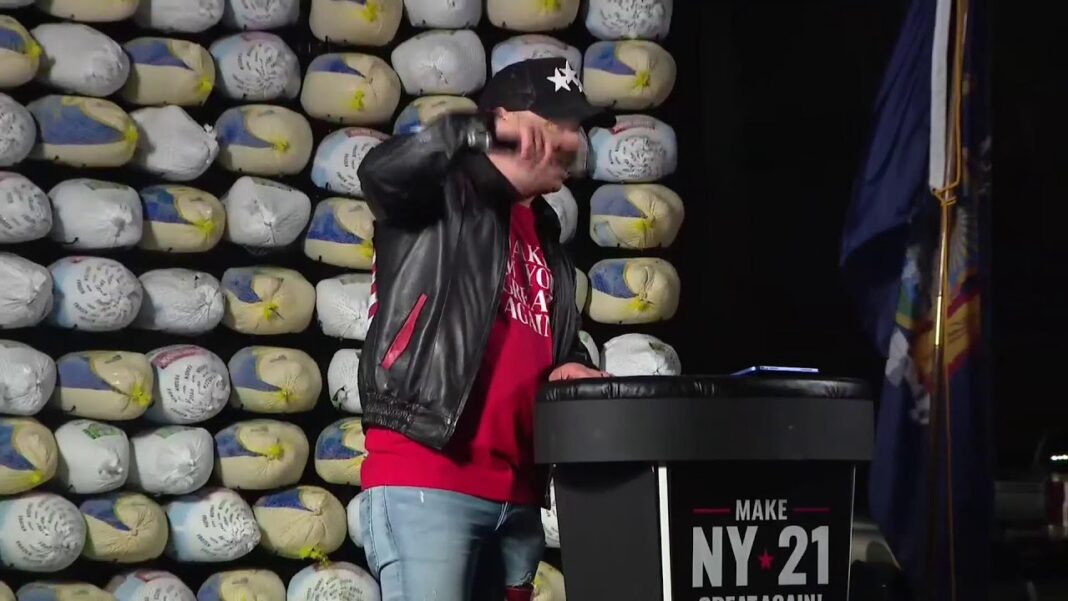
Anthony Constantino is no stranger to publicity. As the CEO of Sticker Mule, a booming online custom printing company headquartered in Upstate New York, he has built a national profile not only through business acumen but also through unapologetically combative political commentary. Over the past year, he has transformed his brand into a political megaphone, launching headline-grabbing campaigns, erecting provocative billboards, and flooding social media with ideological provocations aimed squarely at the Republican grassroots.
This fusion of entrepreneurial bravado and populist rhetoric has, according to the poll, resonated deeply with voters in NY-21, a sprawling, largely rural district stretching across the Adirondacks and North Country. Once a swing seat, the district has in recent cycles tilted reliably Republican, making the GOP primary the true battlefield.
“We included Molinaro in the poll because there are whispers of his interest in the seat,” said Lenny Roudik, Constantino’s campaign manager, explaining why a non-candidate was included in the survey. The campaign wanted to test not merely the declared field, but the gravitational pull of potential entrants—an approach as audacious as it is revealing.
What makes this poll especially intriguing is not only who leads, but how their supporters feel. After asking respondents to explain in their own words why they favored a particular candidate, the campaign subjected the written responses to a ChatGPT-powered qualitative analysis—a novel tactic in congressional politics.
The results were telling. Supporters of Anthony Constantino were described as “highly enthusiastic,” with a pattern of language suggesting an “affirmative choice”—voters were not simply settling for the least objectionable option; they were actively, emotionally committing to him. Their tone was assertive, confident, even evangelical. These were not voters flirting with a candidate; they were rallying behind a cause.
In contrast, backers of Robert Smullen registered “Low” enthusiasm, while Marc Molinaro’s supporters were graded as having “Low to Moderate” emotional intensity. Even more damaging was the assessment that supporters of Smullen and Molinaro exhibited “low emotional commitment”—the kind of tepid allegiance that evaporates at the first whiff of momentum elsewhere.
In the cold mathematics of electoral politics, enthusiasm is not an accessory. It is a multiplier. Campaigns are not won by spreadsheets alone; they are propelled by people who knock on doors in the rain, who badger friends into voting, who flood town halls and drown out opponents. In a midterm cycle where turnout often collapses into apathy, the fervor of a base can mean the difference between a decisive victory and a humiliating defeat.
“The poll results confirm I will be very difficult to beat,” Constantino declared after reviewing the data. “Enthusiasm is crucial in a primary and also in a midterm election. Survey responses indicate I can steal supporters from my rivals, but those who support me will not change their mind easily.”
It is a statement that blends bravado with strategic insight. Constantino is not merely satisfied with his lead; he is already envisioning the battlefield ahead, calculating not only how to defend his base but how to cannibalize the competition. The implication is clear: Smullen and Molinaro may find their existing supporters porous, vulnerable to defection, while Constantino’s bloc appears fortified by conviction.
The campaign’s polling methodology is decidedly unconventional. Rather than commissioning a traditional phone survey from a professional firm, Constantino regularly conducts what he describes as “quick and dirty” text-message polling of all registered Republicans in NY-21. By blasting thousands of voters directly and tallying the responses, his team bypasses the gatekeepers of the political consulting class.
Critics might dismiss such an approach as unscientific. Yet with more than 1,000 respondents and a yawning margin between the frontrunner and his rivals, the campaign insists the results are statistically meaningful.
Moreover, Constantino has pledged to supplement these text surveys with more sophisticated telephone polling in the near future, aiming to corroborate the findings and silence skeptics. Those results, his team says, will be released publicly once available.
Robert Smullen and Marc Molinaro now face an unenviable reality: they are campaigning, or contemplating campaigning, in the shadow of a political juggernaut.
Smullen, long a fixture in conservative activism circles, has struggled to ignite a mass following beyond his core supporters. The poll’s depiction of his base as emotionally disengaged underscores a familiar dilemma: ideological alignment without charismatic magnetism.
Molinaro’s predicament is arguably more acute. Once considered a rising star in New York Republican politics, his electoral fortunes have waned in recent years. His potential interest in NY-21 may reflect both ambition and necessity—a bid to reclaim relevance. Yet entering a race where another candidate commands nearly three times his support, and where his own backers are characterized as lukewarm, could prove politically ruinous.
NY-21 is not merely a seat; it is a crucible for a new kind of Republican politics. The district blends blue-collar sensibilities with libertarian instincts, cultural conservatism with economic frustration. It is fertile ground for a candidate who speaks not in policy white papers but in punchy, populist declarations.
Constantino’s ascent suggests that Republican voters in the North Country are hungry for a fighter—someone who promises not just to represent them in Washington, but to wage war on their behalf. His campaign’s early polling success may be less about name recognition than about narrative dominance: he has framed himself as the insurgent CEO taking on a moribund political establishment, and voters appear to be rallying around this narrative.
Of course, early polls do not crown kings. They invite counterattacks. Smullen and Molinaro, should they choose to fight, will undoubtedly seek to puncture Constantino’s aura, questioning his experience, his temperament, or the seriousness of his policy proposals. Outside groups may enter the fray, reshaping the race with money and messaging.
Yet the emotional architecture revealed by this survey suggests that dislodging Constantino will be no simple task. Enthusiasm, once ignited, is notoriously resistant to persuasion. And in a primary electorate that often rewards conviction over caution, the candidate who inspires devotion holds a structural advantage that no ad buy can easily erase.
As the NY-21 Republican primary edges closer, one truth has already crystallized: Anthony Constantino is no longer merely a contender. He is the axis around which the entire race now turns. Whether this early earthquake proves to be a passing tremor or the prelude to a political landslide will depend on the months ahead—but for now, the numbers, the narratives, and the passion all point in the same direction.