



|
Getting your Trinity Audio player ready...
|
By: Justin Winograd
When Bishop Ronald Hicks steps into the role of Archbishop of New York, he will not merely inherit one of the most prominent pulpits in global Catholicism; he will assume leadership of an institution still profoundly scarred by decades of clerical sexual abuse and the unresolved anguish of its victims. As The New York Post reported on Thursday, Hicks’s arrival comes at a moment of institutional fragility, legal uncertainty, and deep moral reckoning for an archdiocese struggling to reconcile its spiritual mission with the long shadows of its past.
At 58, Hicks brings with him experience forged in the Diocese of Joliet, Illinois, where he confronted his own share of abuse allegations and civil litigation. Yet in New York, the scale is larger, the scrutiny more intense, and the stakes immeasurably higher. The New York Post report noted that Hicks succeeds Cardinal Timothy Dolan, who is retiring upon reaching the mandatory age of 75, leaving behind an archdiocese “reeling,” as one prominent victims’ advocate described it, from the cumulative weight of scandal, settlements, and eroded public trust.
Central to the unease surrounding Hicks’s appointment is a proposed $300 million settlement intended to compensate approximately 1,300 survivors of childhood sexual abuse by clergy and lay staff affiliated with the Archdiocese of New York. The agreement, negotiated under Cardinal Dolan, is widely seen as both a moral obligation and a litmus test of the Church’s sincerity in addressing past wrongs.
According to the information provided in The New York Post report, this settlement is not yet finalized, despite public perceptions to the contrary. Mediation is ongoing, and while the archdiocese has taken dramatic steps to amass the necessary funds, uncertainty looms over whether the process will survive the transition in leadership.
Attorney Mitchell Garabedian, a longtime advocate for abuse survivors who helped expose systemic cover-ups in the Boston archdiocese more than two decades ago, voiced deep skepticism. Speaking to The New York Post, Garabedian warned that Hicks may represent continuity rather than change. “Bishop Hicks is a company man,” he said bluntly, suggesting that institutional loyalty could eclipse survivor-centered reform. “If he was not a company man, then he would not be the next Archbishop.”
The New York Post has detailed the extraordinary financial maneuvers undertaken by Cardinal Dolan in anticipation of the settlement. These include a 10% reduction in the archdiocesan payroll and the liquidation of some of the Church’s most valuable real estate assets. Among them is the sale of the land beneath the Lotte New York Palace hotel, one of Manhattan’s most prestigious properties, for an estimated $490 million.
Additional funds—approximately $100 million—are expected from the sale of the former archdiocesan headquarters at First Avenue and East 56th Street. Portions of these proceeds are earmarked not only for survivor compensation but also for servicing existing debts incurred from earlier settlements and legal costs.
To many observers, these sales represent a painful but necessary reckoning. To others, they underscore the immense institutional cost of decades of secrecy and inaction. The archdiocese is now balancing its moral debts against its financial solvency, a calculus fraught with ethical implications.
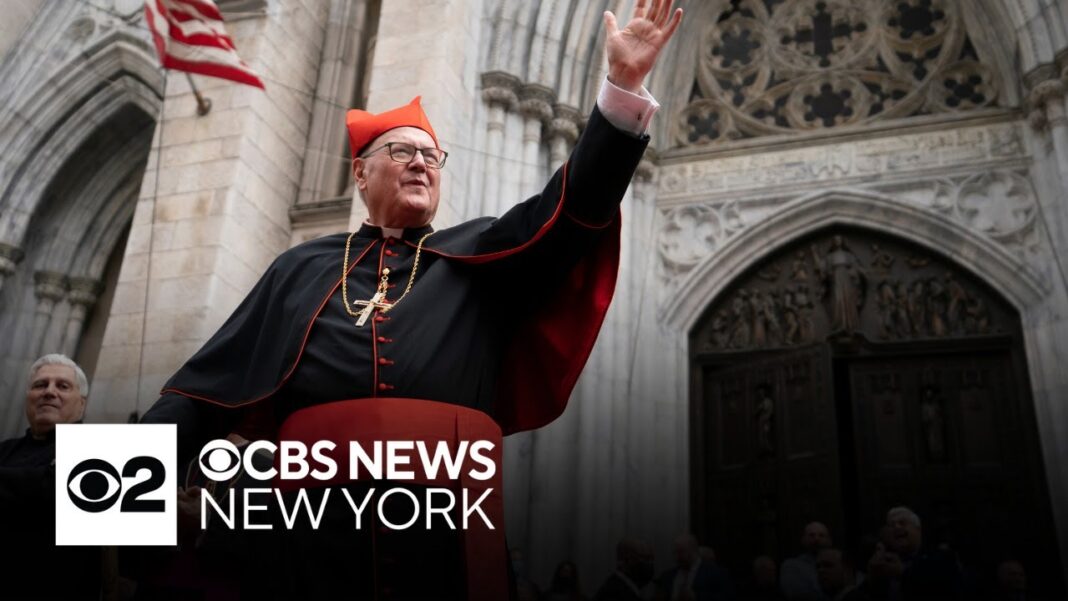
At his first public appearance alongside Cardinal Dolan at St. Patrick’s Cathedral, Hicks struck a tone of cautious acknowledgment rather than bold commitment. Asked directly about the financial and moral burdens awaiting him, he responded that he was “committed to learning about the issues before our church, including the funds the archdiocese has set aside to help resolve sexual abuse claims.”
While Hicks emphasized accountability, transparency, and healing, his measured language did little to reassure some survivors’ advocates. As The New York Post reported, critics interpreted his remarks as procedural rather than empathetic—an emphasis on process rather than pain.
The Coalition for Just & Compassionate Compensation, a prominent advocacy group, went so far as to write directly to Pope Leo XIV, expressing alarm that the leadership change itself could destabilize the delicate mediation process. Their letter warned that any disruption would not be merely administrative but “deeply personal and harmful” to survivors who have already waited years, if not decades, for justice.
Jeff Anderson, an attorney representing approximately 300 abuse victims, echoed this uncertainty in comments cited by The New York Post. He stressed that despite public narratives, no binding settlement has yet been reached. “All the Archdiocese of New York and Cardinal Dolan have agreed to do is go into a process of mediation,” Anderson said. “There is no settlement. There are no terms of settlement that are even close to being reached.”
Anderson also noted that the Church’s legal position has weakened in recent years, particularly after changes to New York law expanded the statute of limitations for abuse claims. Courts have increasingly ruled in favor of survivors, eroding the Church’s once-formidable legal defenses.
Still, Anderson struck a cautiously optimistic note about Hicks’s arrival. While acknowledging he does not know the incoming archbishop personally, he suggested that “new blood” could offer an opportunity for progress—if matched by genuine resolve.
As The New York Post report indicated, the Archdiocese of New York now stands at a crossroads emblematic of the broader Catholic Church’s struggle worldwide. The faithful are dwindling, vocations are declining, and public confidence has been profoundly shaken. For survivors, the question is not theological but existential: Will the Church finally place their healing above its own institutional preservation?
Bishop Hicks’s tenure will likely be defined by how he answers that question—not in homilies, but in actions. Will he honor the spirit, not merely the letter, of settlement negotiations? Will he engage survivors directly, or delegate their pain to lawyers and mediators? Will transparency be a guiding principle, or a carefully managed façade?
Hicks inherits not only a balance sheet strained by litigation but a moral ledger weighed down by betrayal. His leadership will be scrutinized not just by parishioners, but by a city, a nation, and a global Church weary of apologies unaccompanied by accountability.
New York is no ordinary diocese. It is a media capital, a legal battleground, and a symbolic epicenter of American Catholicism. As such, Hicks will operate under an unforgiving spotlight, one that magnifies missteps and demands clarity where ambiguity once sufficed.