



|
Getting your Trinity Audio player ready...
|
By: Jamie Herndon
New York’s John F. Kennedy International Airport is on the cusp of a transformation that its stewards believe will redefine how the world experiences America’s largest city. Later this year, after years of construction carried out amid the daily churn of one of the planet’s busiest aviation hubs, the airport is set to unveil its vast new Terminal 1—a $9.5 billion investment that officials hope will propel Kennedy into the top tier of global airports. The project, detailed in a recent interview with The New York Times and reported by VIN News on Monday, represents not merely an expansion, but a fundamental reimagining of the airport’s role as New York’s primary gateway to the world.
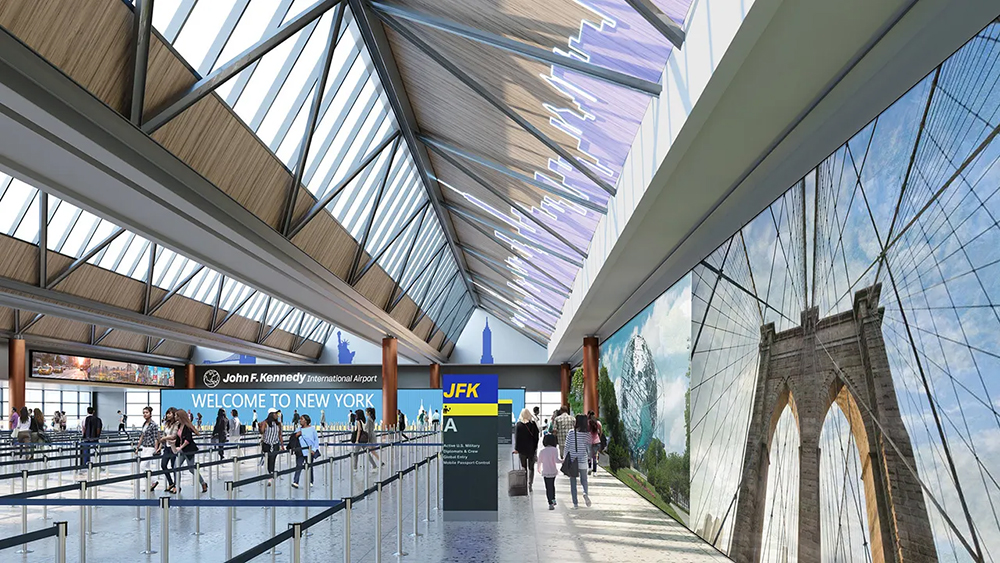
Spanning an astonishing 2.6 million square feet—nearly rivaling the floor space of the Empire State Building—the new Terminal 1 is designed to overwhelm travelers in the best possible way. Wide, open concourses replace the cramped corridors that have long defined JFK’s reputation. Sightlines stretch from security checkpoints to aircraft gates, allowing passengers to orient themselves intuitively, reducing the sense of dislocation that often accompanies air travel. According to the report at VIN News, airport planners have deliberately emphasized transparency and scale, aiming to create an environment that feels both monumental and navigable.
The Port Authority of New York and New Jersey, which oversees JFK, has been unapologetically ambitious in its vision. Officials have described Terminal 1 as a “world-class, knock-your-socks-off gateway,” a phrase that reflects both the aspirations and the pressures surrounding the project. For decades, JFK has been a paradox: one of the world’s most important international airports, yet frequently criticized for outdated facilities and a fragmented passenger experience. The new terminal is intended to close that gap decisively.
Jessica Forse, the Port Authority executive leading the redevelopment, told The New York Times that the complexity of the undertaking cannot be overstated. The terminal is being constructed while Kennedy remains fully operational, a logistical challenge that would test even the most seasoned infrastructure planners. The difficulty has been compounded by the fact that the AirTrain—JFK’s elevated rail system—runs directly through the building. Coordinating heavy construction around an active transit artery and constant passenger flow has required meticulous planning and, at times, improvisation.
Yet Terminal 1 is only the most visible component of a much broader overhaul. The Port Authority is simultaneously investing roughly $4 billion in supporting infrastructure: redesigned roadways to ease traffic congestion, expanded parking facilities, upgraded utilities, and modernized systems intended to handle record passenger volumes. The VIN News report noted that these behind-the-scenes improvements are critical to the terminal’s success. A state-of-the-art building, after all, cannot fulfill its promise if travelers remain mired in gridlock before they ever reach the check-in counter.
The redevelopment of JFK comes on the heels of widely praised transformations at LaGuardia Airport and Newark Liberty International Airport. Once derided as symbols of urban dysfunction, both facilities have undergone sweeping renovations that have earned international design awards and improved passenger satisfaction. The Port Authority hopes to replicate—and perhaps surpass—that success at Kennedy. The VIN News report observed that the stakes are particularly high: JFK is not only an airport, but a global emblem of New York itself.
Terminal 1 is also part of a carefully sequenced strategy to modernize the airport without overwhelming it. The first phase, scheduled to open later this year, will begin welcoming passengers even as construction continues on subsequent sections. This phased approach allows the airport to incrementally retire older facilities while maintaining capacity. Alongside Terminal 1, a privately developed Terminal 6 is also taking shape, further expanding JFK’s footprint and providing airlines with additional options for modern operations.
The design philosophy behind Terminal 1 reflects broader shifts in how airports are conceived. Rather than treating terminals as mere conduits for processing passengers, planners increasingly view them as civic spaces—places that shape first and last impressions of a city. Terminal 1 incorporates this thinking, emphasizing natural light, generous seating areas, and amenities that encourage travelers to linger rather than endure.
For airlines, the new terminal promises operational efficiencies and a platform for premium services. For passengers, it offers the prospect of a smoother journey through security, clearer wayfinding, and a sense of calm often absent from major hubs. And for New York, it represents a statement of intent: a declaration that the city is willing to invest at scale to remain competitive in a fiercely contested global aviation landscape.
Still, the transformation has not been without its critics. Large infrastructure projects inevitably invite scrutiny over cost overruns and timelines. At $9.5 billion, Terminal 1 is among the most expensive airport projects ever undertaken in the United States. Port Authority officials argue the price tag reflects both the scale of the ambition and the long-term economic benefits. JFK supports hundreds of thousands of jobs and generates billions in regional economic activity; modernizing it, they contend, is not optional but essential.
The opening of Terminal 1 later this year will not mark the end of JFK’s evolution, but rather a pivotal chapter in an ongoing story. Additional construction will continue as part of the airport’s long-term redevelopment plan, with the goal of creating a cohesive, world-class complex rather than a patchwork of aging terminals. The VIN News report described the effort as a generational investment—one that will shape travel to and from New York for decades to come.
As the finishing touches are applied and anticipation builds, the symbolism of the moment is hard to miss. For years, JFK has been criticized as an unworthy first impression for a global capital. With Terminal 1, New York is attempting to turn that narrative on its head. If the Port Authority’s vision is realized, travelers arriving at Kennedy later this year may find themselves stepping not into a relic of the past, but into a confident, expansive statement about the city’s future—a front door worthy of the world it serves.
