



|
Getting your Trinity Audio player ready...
|
A Midnight Coronation for a Radical Agenda: Mamdani’s Subway Swearing-In Signals a Troubling New Era for New York
By: Reuven Y. Epstein
New York City has never lacked for theatricality, but the inauguration of mayor-elect Zohran Mamdani threatens to substitute symbolism for substance in ways that should unsettle anyone who cares about the city’s economic vitality, civic cohesion, or moral compass. At the very moment when New Yorkers are desperate for stability after years of flight by businesses, residents, and investors, Mamdani has chosen to cloak the assumption of power in secrecy, ideological signaling, and spectacle — an inauguration staged not in the daylight of democratic accountability, but beneath the streets in a sealed subway station that has not served the public in nearly eighty years.
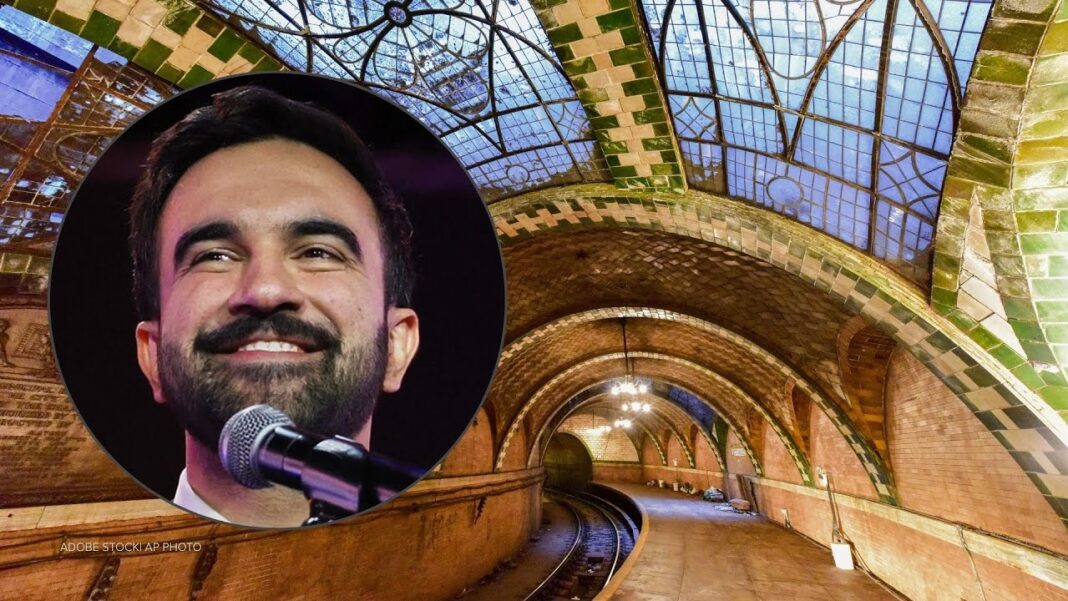
Just before midnight on New Year’s Eve, Mamdani will officially become the 111th mayor of New York City in a closed ceremony inside the abandoned Old City Hall subway station. The oath will be administered by Attorney General Letitia James, with only Mamdani’s family and a small inner circle present. The location is often romanticized as an architectural jewel of the early transit system — with its vaulted ceilings and decorative tilework — but the symbolism is far less charming when viewed through the lens of the politics Mamdani represents. This is a mayor who campaigned against capitalism, disparaged the city’s business class, and embraced rhetoric rooted in democratic socialism that many see as indistinguishable in practice from municipal communism.
It is difficult not to see this underground ritual as emblematic. Mamdani, a polarizing figure from the outset of his campaign, now begins his tenure out of sight of the public, away from the neighborhoods already anxious about what his agenda will mean for jobs, property values, and public safety. His critics argue that it reflects a deeper pattern: a leader more comfortable performing for an ideological base than grappling with the pragmatic realities of running the most complex city in America.
Hours later, at 1:00 p.m. on January 1, Mamdani will take a second, highly choreographed public oath — this time administered by Vermont Senator Bernie Sanders on the steps of City Hall. This is not a mere ceremonial flourish. Sanders is the most recognizable face of the American democratic socialist movement, and his starring role in the inauguration is a deliberate declaration of intent. Mamdani is not pretending to be a centrist reformer. He is announcing, in bold type, that New York City is now to be governed according to an ideology that has left a trail of fiscal wreckage and capital flight in cities that have tried similar experiments.
The contrast between the two ceremonies is stark. The first, underground and private, is cloistered from dissent. The second, public and populist, is designed to broadcast triumph not over entrenched political elites, but over the very economic system that made New York a global capital of opportunity. For business owners already on edge after years of regulatory hostility and tax increases, the image of Sanders swearing in a mayor who rails against landlords, investors, and private enterprise is less inspiring than terrifying.
From 11:00 a.m. to 3:00 p.m., the inauguration festivities will spill across Lower Manhattan, from the storied Canyon of Heroes to City Hall Park. Traditionally reserved for ticker-tape parades honoring soldiers, astronauts, championship teams, and heads of state, the Canyon of Heroes is a corridor of earned acclaim. That Mamdani’s celebration will occupy this sacred civic space has struck many New Yorkers as jarring. It is one thing to honor those who risked their lives for the nation or achieved greatness on the world stage. It is another to anoint a mayor whose defining feature is ideological militancy.
For Jewish New Yorkers in particular — who comprise the largest Jewish population of any city outside Israel — Mamdani’s ascent is fraught with unease. His long record of hostility toward Israel, his alignment with groups that portray Zionism as illegitimate, and his refusal to draw clear moral lines against slogans and movements that are patently antisemitic have created a climate of deep distrust. This is not a theoretical dispute over foreign policy. In neighborhoods already grappling with a horrifying surge of antisemitic incidents, Mamdani’s rhetoric is experienced as a threat to communal safety and belonging.
The irony is painful. Maimonides Hospital, yeshivas, synagogues, kosher businesses, and Jewish philanthropic institutions have been pillars of New York’s social fabric for generations. Yet Mamdani enters office with a reputation for viewing Zionism — a core component of Jewish identity for many — as something to be dismantled rather than understood. For a mayor to be sworn in beneath the streets while large segments of the Jewish community feel politically erased above them is not poetic; it is tragic.
Supporters of Mamdani argue that the underground ceremony is merely a creative homage to the city’s hidden history. But in a moment when New York is hemorrhaging employers and middle-class families, gestures matter. The symbolism of choosing a shuttered station over an open, inclusive civic space is not lost on those who fear his policies will shutter far more than subway platforms.
By the end of New Year’s Day, Mamdani will have been sworn in twice, feted for four hours along one of the city’s most iconic boulevards, and celebrated as a trailblazer by an energized left. But the real test will not be the beauty of the tiles at Old City Hall or the roar of the crowds at City Hall Park. It will be whether New York’s fragile economy can survive a mayor whose worldview treats profit as sin, private ownership as injustice, and Jewish national self-determination as a moral failing.
In that sense, Mamdani’s inauguration is less a beginning than a warning. A city that once defined aspiration is about to be governed by a man whose politics are defined by grievance — against markets, against Israel, and against anyone who dares to defend the structures that made New York a magnet for the world. Whether the city emerges revitalized or diminished will depend on how quickly its residents recognize that the true cost of this midnight coronation may be paid in daylight, for years to come.