



|
Getting your Trinity Audio player ready...
|
A Holocaust Survivor’s Warning Echoes Through NYC: Park East Synagogue Under Siege & the Rising Normalization of Anti-Jewish Hostility
By: Fern Sidman – Jewish Voice News
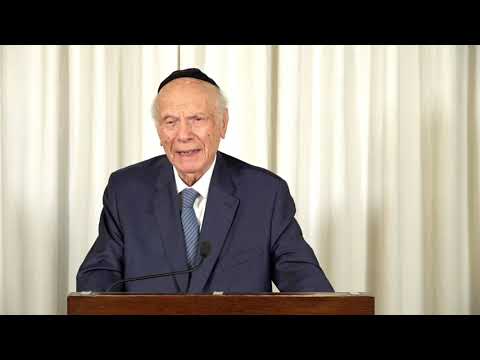
When Rabbi Arthur Schneier speaks, the weight of history presses into every syllable. At 95 years old, the senior rabbi of Manhattan’s venerable Park East Synagogue carries memories that most Americans only encounter through books or museums. But last week, as he watched an anti-Israel mob fill the sidewalks outside his synagogue—shouting threats, chanting eliminationist slogans, and attempting to intimidate Jews attending a community event—those memories came roaring back with chilling clarity.
In an interview with the New York Post, Schneier recounted the moment with brutal honesty. “I’m a Holocaust survivor. I saw my synagogue [in Vienna] burn on Kristallnacht with the police standing by and not intervening,” he said. “Thank God in the United States, the police are protecting us against the hate-mongers.”
But the scene on Manhattan’s Upper East Side—outside a synagogue that has stood since 1890 and that Schneier has shepherded for more than half a century—was a reminder that protection, lately, feels fragile. And as The Jewish News Syndicate (JNS) reported on Sunday, antisemitism of a type once unthinkable in New York City has surged into the mainstream, fueled by anti-Israel radicalism that increasingly targets not just the State of Israel but Jewish institutions and Jewish life itself.
For Schneier, Kristallnacht is not metaphor. It is memory. It is lived experience. And while the protesters outside Park East Synagogue did not unleash physical violence, they brought with them the unmistakable vocabulary of menace.
According to The New York Post report and confirmed by JNS, the crowd—estimated at around 200 activists—shouted: “Destroy Israel!” “We need to make them scared!” “Take another settler out!” “Death to the IDF!”
Many waved Palestinian flags and openly celebrated the violence of Oct. 7, 2023, when Hamas terrorists murdered 1,200 Israelis, raped women, and burned entire families alive. The organizers of the protest, the extremist group Pal-Awda NY/NJ, later bragged on social media that they had shown up “to declare ‘Death to the IDF’”—an explicit glorification of terrorism and an implicit threat to Jews in New York who support Israel or have family serving in the Israeli army.
One protest speaker shouted, “Make them scared,” referring to synagogue attendees—Jews walking into their house of worship in one of America’s supposedly safest neighborhoods.
For Schneier, the warning could not have been clearer.
“This disturbing event,” he said, “should serve as a warning not to be silent. No house of worship should be subjected to this type of demonstration.”
Park East Synagogue is not simply a religious space. It is a historic institution—founded in 1890, representing generations of Jewish life on the Upper East Side. For decades, Rabbi Schneier has made it a center of interfaith dialogue, diplomacy, and Jewish continuity. Hosting Nefesh B’Nefesh—an organization that helps North American Jews move to Israel—was entirely consistent with its mission. Aliyah, as the JNS report noted, is a central dimension of Jewish identity and religious expression.
Yet the mob outside treated aliyah as if it were a criminal act, chanting slogans that demonize Jewish immigration as “colonialism” and calling for the “resistance”—the preferred euphemism for Hamas—to “take another settler out.”
In an era where campus radicals frequently frame Jewish communal activities as political provocations, this mob adopted the same language and brought it directly to the doorstep of a synagogue.
While many public officials condemned the demonstration, the response from Mayor-elect Zohran Mamdani—already deeply controversial for his extreme anti-Israel positions—ignited outrage.
Mamdani issued a statement saying he “discouraged” the protest’s rhetoric but then pivoted into blaming the synagogue itself, asserting through his spokesperson that “these sacred spaces should not be used to promote activities in violation of international law.”
This accusation—that hosting an educational event about aliyah constitutes an international crime—is both factually absurd and morally reprehensible. Jewish immigration to Israel is protected, not prohibited, under multiple pillars of international law dating back to the British Mandate. As JNS has pointed out in numerous reports, the claim that facilitating aliyah violates international law is a common talking point among anti-Zionist activists but has no grounding in reality.
Mamdani’s formulation effectively suggested that the protesters had reason to target the synagogue—a justification dangerously close to victim-blaming.
The group behind the protest, Pal-Awda NY/NJ, doubled down the following day. They referred to the October 7 massacre as a liberation breakthrough, writing: “Two years ago today, the Palestinian Resistance broke the gates of the world’s largest open-air prison…”
That same propaganda—the erasure of Hamas’s atrocities and the recasting of terrorism as “resistance”—has been the hallmark of the post–October 7 radical left, and its normalization in New York is a trend that JNS has tracked with increasing alarm.
Mayor Eric Adams swiftly condemned the protest, describing the chants as “desecration” and promising to visit the synagogue upon his return. “Church, mosque, synagogue,” he said. “It makes no difference. Screaming vile language outside any of them isn’t protest—it’s desecration.”
But Schneier’s warning landed heavier. “I saw my synagogue burn with police standing by,” he told the Post. “Thank God in the United States the police are protecting us.”
His gratitude was real. But the fear beneath it was unmistakable. Because what unfolded at Park East Synagogue is indicative of something very different from ordinary political protest. As the JNS report emphasized, what New York is experiencing is not merely anti-Israel activism but a new wave of antisemitic radicalization cloaked in the language of decolonization and social justice.
Schneier made clear that he was deeply moved by expressions of solidarity from civic and religious leaders. He thanked Governor Kathy Hochul and NYPD Commissioner Jessica Tisch and expressed appreciation for messages from clergy across many denominations.
Yet solidarity, he warned, must not replace vigilance. The events outside Park East Synagogue may not have involved physical violence, but they were rooted in rhetoric historically associated with violence against Jews—from the Intifada to the horrors of Kristallnacht itself.
More than 80 years after Kristallnacht, one of its youngest survivors is sounding an alarm—not about Europe, but about New York.
His message, as reported by JNS and reinforced in interviews, was stark: Jewish institutions cannot assume safety. Anti-Israel radicalism is increasingly indistinguishable from antisemitism. The normalization of violent rhetoric is a precursor to the normalization of violent deeds. Moral clarity is required from political leaders—especially those who seek to govern a city with the world’s largest Jewish population outside Israel.
Rabbi Schneier survived Kristallnacht because others remained silent. His message today is that silence is no longer an option—certainly not for Jews, and not for a city whose identity has always been inseparable from the security of its Jewish community.
In a moment when anti-Jewish hostility is spreading across campuses, streets, and now houses of worship, the voice of a Holocaust survivor should not be merely heard. It should be heeded.