



|
Getting your Trinity Audio player ready...
|
By: Fern Sidman
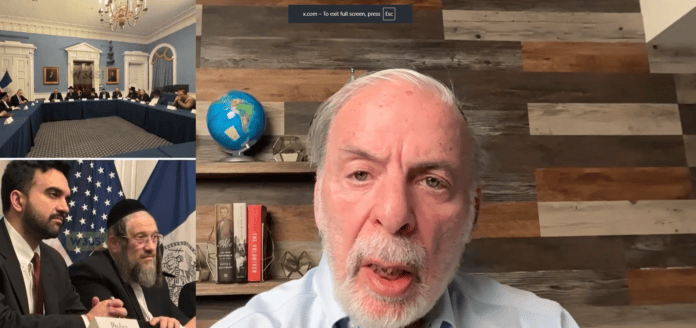
A fierce and emotionally charged critique from former New York State Assemblyman Dov Hikind has ignited renewed debate over political leadership, communal responsibility, and the alarming rise of antisemitism in New York City. In a widely circulated video statement, Hikind condemned both Jewish leaders who recently met with Mayor Zohran Mamdani and the mayor himself, accusing them of failing to confront what he described as a rapidly worsening crisis facing Jewish residents.
According to a report on Tuesday at VIN News, Hikind’s remarks reflect a growing frustration among segments of the Jewish community who believe that rising hostility, intimidation, and violence have not been met with sufficient urgency or action by city leadership.
The controversy stems from a recent meeting between Mayor Mamdani and a group of Jewish representatives, which was intended to foster dialogue and address concerns. However, Hikind’s account portrays the gathering as deeply disappointing and emblematic of what he sees as a broader failure of leadership.
JEWISH BETRAYAL IN NYC
Event- Jewish leaders meet with with @NYCMayor
Taking pictures ✅
Hugs✅
Empty words✅Mayor asked to host a hostage kidnapped by Hamas – SILENCE pic.twitter.com/MBAp3dhoXV
— Dov Hikind (@HikindDov) March 17, 2026
In his video, Hikind described an overly cordial atmosphere, noting “a lot of hugging, a lot of handshakes,” and the taking of photographs. For him, these gestures symbolized a misplaced emphasis on optics rather than substance. “This was not the time for smiles and photos,” Hikind argued, insisting that the severity of the situation demanded direct and uncompromising discussion.
As reported by VIN News, Hikind expressed particular frustration that participants did not press the mayor more forcefully on issues affecting Jewish safety in the city.
Underlying Hikind’s criticism is a profound concern about the dramatic resurgence of antisemitism across New York City. Incidents ranging from verbal harassment to physical assaults have been reported with increasing frequency, creating a climate of fear and unease.
As VIN News has documented, Jewish residents in several neighborhoods have reported feeling less secure, particularly in areas where tensions related to international conflicts have spilled over into local discourse.
For Hikind, who is the founder and president of Americans Against Antisemitism, and others who share his perspective, this environment demands decisive action from elected officials—action they argue has not been forthcoming.
Hikind’s critique of Mayor Mamdani is particularly pointed. While acknowledging that the mayor has made public statements about inclusivity and solidarity, Hikind argues that such expressions amount to little more than platitudes in the absence of concrete measures.
“He talks about embracing the Jewish community,” Hikind suggested, “but where is the action?”
According to coverage by VIN News, critics contend that the mayor’s response to rising antisemitism has been insufficient, lacking both urgency and specificity. They argue that beyond general statements condemning hate, there has been little evidence of a comprehensive strategy to address the problem.
Compounding these concerns are allegations that Mayor Mamdani’s own public comments have contributed to the problem. Hikind and others have pointed to statements perceived as strongly critical of Israel, as well as remarks that they interpret as sympathetic to groups hostile to the Jewish state.
While supporters of the mayor may view such positions as part of a broader political perspective, critics argue that they risk emboldening individuals who harbor antisemitic views.
As highlighted by VIN News, the intersection of international politics and local community relations has become increasingly fraught, with rhetoric on global issues often influencing behavior on the streets of New York.
Hikind’s argument is that leadership carries a responsibility not only to speak carefully but also to recognize the potential consequences of public statements.
One moment during the meeting has drawn particular attention. According to Hikind, an attendee suggested that the mayor invite a former hostage to a future event, an idea intended to provide perspective and balance. Hikind claimed that the mayor responded with a smile but did not engage substantively with the suggestion. For Hikind, this exchange exemplified what he sees as a broader pattern: opportunities for meaningful dialogue being met with superficial responses.
As noted in reporting by VIN News, he criticized the participants for not pressing the issue further, arguing that such moments should be used to demand clarity and commitment.
The controversy has sparked a wider conversation within the Jewish community about the most effective ways to engage with political leaders. Some argue that maintaining open lines of communication, even in difficult circumstances, is essential. Others, echoing Hikind’s perspective, believe that stronger, more confrontational approaches are necessary when core concerns are at stake.
This debate reflects deeper questions about leadership, representation, and strategy. Should community leaders prioritize access and relationship-building, or should they focus on holding officials accountable, even at the risk of strained relations?
As VIN News has observed, there is no consensus, and opinions vary widely depending on individual experiences and perspectives.
The issues raised by Hikind’s remarks extend beyond a single meeting or a single administration. They touch on fundamental questions about public safety, social cohesion, and the responsibilities of elected officials in a diverse and dynamic city.
New York has long been home to one of the largest Jewish populations in the world, a community that has contributed significantly to the city’s cultural, economic, and social fabric. Ensuring its safety and well-being is not only a communal concern but a civic imperative.
In the final analysis, Hikind’s critique serves as a call for what he sees as a return to substance over symbolism. His remarks challenge both political leaders and community representatives to move beyond gestures and engage directly with the issues at hand.
Whether one agrees with his assessment or not, the intensity of his response reflects the seriousness of the concerns being raised. As antisemitism continues to pose a challenge in New York City, the demand for effective leadership and meaningful action is likely to grow.
The question now facing both the mayor and the community is whether future engagements will rise to meet that demand—or whether the gap between words and action will continue to widen.

Jewish “leaders” have yet to learn, the more you bend over, the harder they kick you.Coward and whore Chuck Schumer is a typical House Jew. He called this lout, Mamdani to congratulate him on his win vs. condemning Mamdani’s anti-Israel actions and words. Mamdani labels Israel a “genocidal killer” who has “no right to exist as a Jewish State” & supports BDS, gives platforms to Hamas supporters, hires Jew haters such as Mallory who calls Jew hater Louis Farrakahan her “GOAT-Greatest of All Time.” And so what do Jewish leaders do? Hug and fawn over this double mouthed bigot who pretends he is just a humanitarian and denies he is a Jew hater. I guess you can fool all of the people, all of the time in 2026. We used to be able to smell the stench of Jew hate. We used to be able to stand up to it.Now we are like prisoners who embrace their captors in the hope of surviving instead of loudly condemning this Mamdani and others like him, instead of standing tall and demanding our full Jewish Civil Rights & the IRHA. If Jewish “leaders” can’t learn from their own history that the way to survive is to be a loud, proud, brave, Zionist Jew, then no one can help them. They will get what’s coming to them and their children. By gobbling up the crumbs this bigot throws them while he plans to ostracize Jews who support Israel is beyond belief. Aren’t Jews supposed to be smart? When did they get stupid?
Correction/typo: should be IHRA (not IRHA).
International Holocaust Remembrance Alliance which bigot Mamdani rejects.
I personally would rather go down fighting but Jewish “leaders” are going down, face down in the dirt, like beggars.
This is exactly the same as the Judenrat in European cities meeting with the Nazi overlords, all sorts of smiles and assurances of work in The East. This proved disastrous fir the Jews and in the end the Judenrat were unwilling collaborators.
The zohran has found his useful Jewish idiots