



|
Getting your Trinity Audio player ready...
|
By: Fern Sidman
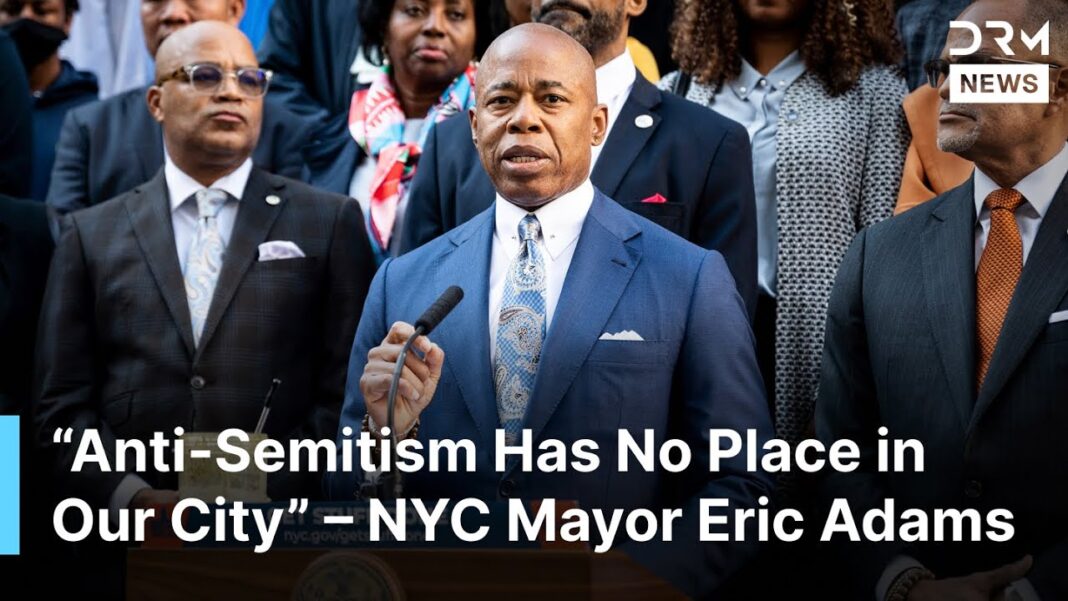
On a cold winter evening marked by solemnity and resolve, Mayor Eric Adams convened a Hanukkah celebration and menorah lighting on Monday evening that transcended ceremonial tradition, emerging instead as a profound civic statement about memory, identity, and moral responsibility. Gathered amid city officials, community leaders, and members of New York’s Jewish population, Adams delivered remarks that were at once intimate and expansive, personal and political, rooted in the anguish of lived experience and animated by an unyielding call to collective courage.
The mayor began not from the elevated distance of office, but from a place of deliberate proximity. Rejecting the pageantry that often accompanies political authority, Adams spoke of his desire to step “down among you,” to dismantle the figurative ropes that too often separate leaders from those they serve. His message was unmistakable: he did not come to be venerated, nor to cloak himself in the illusion of untouchable power. Instead, he came to affirm a shared humanity. “Your pain,” he told the assembled crowd, “I feel your pain.” It was an assertion not merely of empathy, but of identification—an insistence that the burdens carried by one community reverberate across the entire civic body.
Surrounding Adams was a visible constellation of municipal leadership, a deliberate tableau underscoring that this was not a solitary expression of solidarity but an institutional one. Among those present were senior commissioners, long-serving public servants, and key figures within the city’s Jewish leadership, including Deputy Mayor Moshe Levy and the leadership of New York City’s Office to Combat Antisemitism. The mayor acknowledged each with care, weaving personal anecdotes into public recognition, and reminding the audience that governance, at its best, is a cumulative effort sustained by individuals who labor—often quietly—over many years.
Yet it was in his reflections on grief that Adams’ remarks reached their most piercing intensity. He recounted standing backstage beside Devorah Halberstam, whose son Ari was murdered in a terror attack on the Brooklyn Bridge decades ago. The mayor spoke of visiting Ari’s gravesite regularly, particularly when traveling to see the Grand Rebbe, a ritual that he described not as obligation but as remembrance. In doing so, Adams confronted a misconception that too often accompanies public discussions of violence: the belief that pain dissipates once the immediate physical threat has passed.
“The bullet’s trajectory,” he observed, “is only the beginning.” The true devastation, he argued, lies in the enduring emotional trauma that tears through families and communities, leaving scars that no statistic or policy briefing can fully capture. For the Jewish community, Adams noted, this trauma is neither isolated nor episodic. It is cumulative, layered atop centuries of persecution and remembrance, carried forward through generations.
From this deeply personal meditation, Adams pivoted to a broader indictment of contemporary discourse surrounding antisemitism. He decried what he described as a proliferation of euphemisms—polished language and rhetorical evasions designed to obscure the persistence of hatred. With increasing urgency, he rejected the framing of antisemitism as a proxy debate over geopolitics. “This is not about a piece of property in the Middle East,” he said. “This is not about Israel. This is about Jewish people.”
To underscore the point, Adams traced a stark historical continuum. Antisemitism, he reminded his audience, did not begin with modern nation-states or contemporary conflicts. It existed when Jews were confined to quarters in ancient Rome, when they were expelled from Spain, when biblical narratives spoke of exile, and when the machinery of the Holocaust sought their annihilation. To suggest otherwise, he warned, is to participate—wittingly or not—in the erasure of history.
The mayor’s insistence on historical clarity served a larger purpose: to dismantle what he characterized as the dangerous normalization of hatred. By reducing antisemitism to a debate over maps and borders, Adams argued, society risks granting cover to those who harbor animus not toward policies, but toward people. This “comfortability with hating Jews,” as he described it, is not confined to any one nation or era. It is a global phenomenon that adapts its vocabulary while preserving its intent.
Hanukkah, Adams reminded the gathering, is a festival of dedication—of rededication, in fact—to principle and identity in the face of coercion. That symbolism, he suggested, imposes obligations in the present moment. Dedication must manifest as action: confronting ignorance, challenging false narratives, and refusing to allow hatred to metastasize unchallenged. He expressed particular outrage that, in the aftermath of violent attacks targeting Jews, some responses conspicuously failed even to name antisemitism as such. Silence, he implied, is not neutrality but abdication.
Perhaps the most provocative segment of Adams’ address came when he turned his attention outward, posing a pointed question to the broader coalition of groups with whom the Jewish community has historically stood in solidarity. “Where are they now?” he asked, referring to allies who have benefited from Jewish advocacy in their own struggles for recognition and justice. Moral consistency, Adams suggested, demands reciprocity. One cannot accept support in times of need and retreat into ambiguity when another community is under threat.
“You cannot be neutral in this conversation,” he declared. Detachment, in moments of moral crisis, is itself a choice. Adams framed his presence that evening not as political theater, but as an act of preservation—of communal bonds, of shared values, of the fragile architecture of pluralism. History, he warned, offers ample evidence that hatred rarely confines itself to a single target. What begins with one group inevitably expands outward.
In articulating this warning, Adams drew upon the long-standing alliance between Jewish communities and other marginalized groups in New York City. These communities, he noted, have marched together, organized together, and mourned together. Yet he lamented what he described as a generational amnesia—a fading awareness among younger New Yorkers of this shared history. Reclaiming that memory, he suggested, is among his enduring missions, extending beyond the formal boundaries of his mayoralty.
Adams was unequivocal in rejecting any notion that his commitment would wane with political transitions. “I am going nowhere,” he said, emphasizing that leadership is not confined to a single administration. The work ahead, he argued, requires continuity of principle across successive governments. To be mayor of New York City is to be mayor for everyone: for Spanish speakers and Asian communities, for those who worship in mosques, synagogues, churches, temples, and gurdwaras alike. Leadership cannot be situational or selective; it must be consistent.
This insistence on consistency carried Adams into contentious territory. Without delving into policy specifics, he challenged the logic of denying Israel’s right to exist while affirming the legitimacy of other religious and national entities. Such positions, he argued, betray a fundamental inconsistency. One cannot recognize the Vatican as a center of Catholic leadership, acknowledge the spiritual authority of Tibetan monks, or accept the religious foundations of nations across the Middle East, while singling out the Jewish state for delegitimization. Moral arguments, Adams stressed, must be applied evenly, or they risk collapsing under their own contradictions.
Yet for all the gravity of his message, Adams was careful to resist the paralysis of fear. He urged Jewish New Yorkers not to retreat from public life—to enter synagogues without hesitation, to ride the subway without removing symbols of faith, to wear the Star of David openly even in moments of mourning. Fear, he warned, is precisely the outcome sought by those who traffic in hatred. To live openly and visibly is to deny them victory.
In a powerful gesture of solidarity, Adams extended this principle across all communities. Just as no African American should be afraid to be Black, no Muslim afraid to be Muslim, no LGBTQ+ New Yorker afraid to live authentically, so too should Jews feel no compulsion to hide who they are. New York City’s identity, he suggested, is forged precisely through this refusal to be diminished.
As the menorah’s candles were lit, Adams invoked the Maccabees—the ancient figures who resisted cultural erasure and reclaimed their sacred space. “Where are the Maccabees?” he asked, transforming a historical reference into a contemporary challenge. His answer was both personal and collective. “I am a Maccabee,” he said, calling on others to claim the same mantle by standing against darkness with courage and conviction.
The evening carried an unmistakable sense of transition. With the current administration nearing its conclusion, Adams framed the moment not as an ending, but as a beginning. The work of confronting antisemitism, of defending pluralism, of insisting upon moral clarity, does not conclude with a term of office. It is an enduring civic endeavor, one that demands vigilance from leaders and citizens alike.
As the menorah burned steadily against the winter night, its light offered a quiet but potent metaphor. Hanukkah does not commemorate the absence of threat, but the persistence of hope. In hosting this celebration, and in delivering remarks that fused personal memory with historical consciousness, Mayor Eric Adams articulated a vision of New York City as a place that refuses to surrender to hatred—where light is not merely symbolic, but an obligation to be sustained, protected, and passed on.
In a time marked by fracture and fear, the menorah lighting stood as more than ritual. It was a declaration: that the city, in all its diversity and complexity, remains committed to standing together against darkness, and that its leaders are prepared, at least on this night, to stand plainly among the people—bearing witness to pain, to history, and to the enduring promise of light.