



|
Getting your Trinity Audio player ready...
|
By: Tzirel Rosenblatt
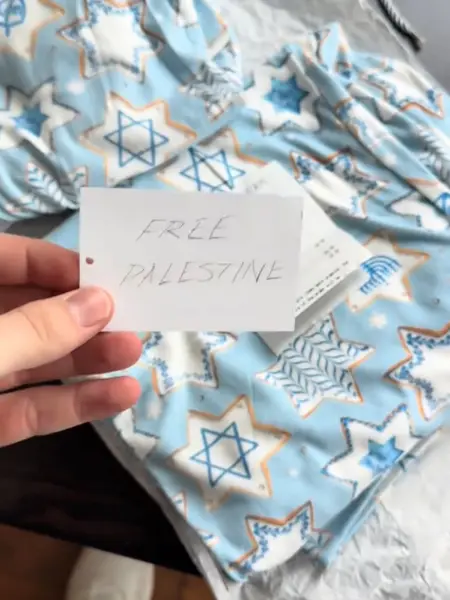
What should have been a tender, intimate moment of celebration at the outset of Hanukkah instead became a jarring confrontation with the realities of contemporary antisemitism for a young Jewish couple in New York City. As reported on Tuesday by The New York Post, a Hanukkah-themed gift purchased from Bloomingdale’s—a luxury retailer synonymous with polish, discretion, and brand discipline—arrived bearing an unexpected and deeply disturbing message: a handwritten note reading “Free Palestine,” tucked conspicuously inside the package.
The incident, now under formal investigation by Bloomingdale’s, has reverberated far beyond the walls of a single fulfillment center. Amplified through social media and covered by The New York Post, it has become a potent symbol of how political hostility toward Israel, and toward Jews more broadly, is increasingly intruding into private spaces and personal rituals—particularly at a time when Jewish communities worldwide are on edge following violent antisemitic attacks, including the massacre at a Hanukkah celebration in Bondi Beach, Australia.
According to the report in The New York Post, Arielle Harris, a New Yorker, received the gift on the first night of Hanukkah from her boyfriend, Andrew Jones. The present itself was unremarkable in the best possible way: festive pajamas adorned with Stars of David and menorahs, the sort of cozy, affectionate gesture that marks the holiday’s emphasis on warmth, light, and continuity. But when Harris opened the package, she found more than fabric and tissue paper. Placed deliberately atop the receipt, on a Bloomingdale’s-branded card, was the note—brief, political, and unmistakably antagonistic.
“At first I was like, ‘Ha, what—‘Free Palestine’?’” Harris told The New York Post, describing the moment of disbelief that quickly gave way to unease. Her boyfriend’s reaction, Jones said, was immediate and visceral. “My heart dropped,” he told The New York Post, emphasizing that he had not opened the package before giving it to her and had no reason to suspect anything was amiss.
The couple’s confusion soon hardened into alarm. As The New York Post reported, Harris and Jones contacted family members for guidance, acutely aware of the broader climate in which the incident occurred. Just days earlier, Jews celebrating Hanukkah on Bondi Beach had been gunned down in what authorities described as an antisemitic terrorist attack. Against that backdrop, the insertion of a political slogan—one frequently weaponized against Jews—into a Jewish holiday gift felt less like a prank and more like a violation.
“This never should have happened,” Harris said in a TikTok video that quickly amassed tens of thousands of views, as documented in The New York Post report. “Bloomingdale’s needs to answer for their employees.” Her video struck a chord, not only because of the act itself but because of the setting: a private celebration, disrupted by what Harris later described to The New York Post as an intrusion that made the gift feel “violating,” likening it memorably to discovering “a cat peed on it.”
The online reaction was swift and polarized. While many viewers expressed outrage and solidarity, others accused Harris of fabricating the incident—an allegation Jones addressed directly on social media. “Craziest part is how many commenters think I faked this,” he wrote in a post cited by The New York Post. “Typical denials of antisemitism.” That skepticism, the couple suggested, was itself emblematic of a broader unwillingness to acknowledge how antisemitism manifests in subtle, deniable forms.
Bloomingdale’s response was prompt but cautious. Jones told the newspaper that the couple spoke with a “pretty senior executive” at the company, who offered what he described as a heartfelt apology and issued a full refund. More significantly, Harris relayed that Bloomingdale’s had begun opening packages at the fulfillment center from which the gift originated, seeking to determine whether the incident was isolated or indicative of a wider breach.
In a statement confirmed to The New York Post, a Bloomingdale’s spokesperson characterized the note as an “unauthorized and unacceptable act,” emphasizing that antisemitism or discrimination of any kind “has absolutely no place in our business and does not align with our values or our care for our customers.” The company said the matter was being treated with “the utmost seriousness” and remained under investigation.
Yet for Harris and Jones, the apology, while necessary, was not sufficient to erase the emotional impact. As The New York Post report noted, the couple said they were still unsure whether they would shop at Bloomingdale’s again. The damage, in their view, was not merely transactional but symbolic. “Our nice moment, private celebration was totally turned upside down by this note,” Jones told the newspaper.
The incident has drawn commentary from prominent figures in the Jewish community and beyond. Deborah Lipstadt, the former U.S. special envoy to monitor and combat antisemitism, weighed in sharply, writing on X: “A ‘free Palestine’ note in a Bloomingdale’s Chanukah gift. No limits. No shame.” Her reaction underscored a growing concern among Jewish leaders that slogans ostensibly framed as political critique are increasingly deployed in ways that target Jews indiscriminately, regardless of context.
What makes the Bloomingdale’s episode particularly unsettling, as The New York Post report has emphasized, is its mundanity. This was not a protest, a rally, or a heated exchange in a public square. It was a quiet act, carried out anonymously, inserted into a commercial transaction and delivered into a Jewish home during a religious holiday. Its power lay precisely in that intimacy—the sense that nowhere, not even a sealed box from a venerable department store, is immune from intrusion.
For Harris, however, the aftermath has also revealed a countervailing force: solidarity. She told The New York Post that the outpouring of supportive messages online has helped her and Jones move forward. Friends, family, and strangers alike reached out with words of encouragement, reinforcing the idea that while antisemitism may be persistent, it is not uncontested.
“Given everything that’s happened, everyone we know is being positive—it’s giving us hope,” Harris said, as quoted by The New York Post. “It’s a sad thing and a sad reality, but it’s not going to stop us from living our life and enjoying this Jewish holiday.”
That resolve—quiet, defiant, and rooted in continuity—may ultimately be the most enduring response to the incident. Still, the questions raised by the episode linger. How did such a note pass through a corporate fulfillment system? Was it the act of a single rogue employee, or a symptom of lax oversight at a moment of heightened tensions? And perhaps most importantly, what responsibilities do major institutions bear in ensuring that their platforms, physical or digital, are not used to target customers based on identity?
Bloomingdale’s investigation may yet provide concrete answers. But the broader implications extend beyond one retailer or one couple. They speak to a society in which political animus increasingly bleeds into everyday life, and in which Jewish Americans, even as they light candles meant to symbolize resilience and hope, find themselves confronting hostility in the most unexpected places.
In that sense, the small handwritten note discovered inside a Hanukkah gift has become something larger: a mirror reflecting the anxieties of a community and the challenges facing a nation struggling to draw clear lines between political expression and personal harassment. Whether those lines can be reinforced—by corporations, by civic leaders, and by individuals—remains an open question. But as Harris and Jones have made clear, retreat is not an option. The candles will be lit, the holiday observed, and life carried forward, even as vigilance becomes an unavoidable companion to celebration.