



|
Getting your Trinity Audio player ready...
|
By: Fern Sidman
A 94-year-old retired physician and author, whose extraordinary life has spanned continents and historic upheavals, was the victim of a sudden and unprovoked punch inside an Upper East Side Apple store this week — an incident that, as The New York Post reported on Thursday, has left him physically sore, psychologically shaken, and deeply concerned about the vulnerability of others to similar attacks.
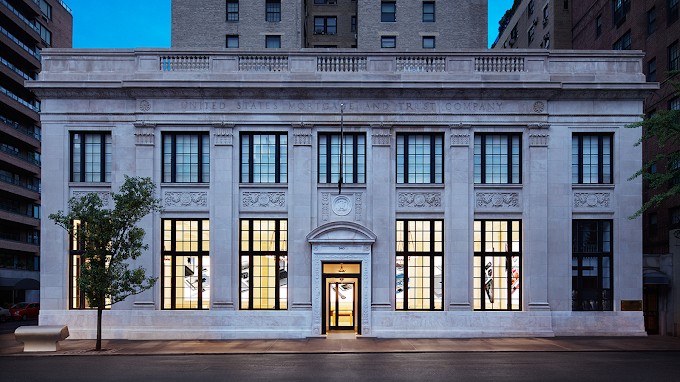
The assault occurred at approximately 5:45 p.m. on Tuesday inside the Apple store on Madison Avenue near East 74th Street. The victim, who asked to be identified only as Moshe, had just purchased a new Apple Watch and was leaving the store with his longtime companion, 78-year-old Evelia, when the suspect — described by police and witnesses as “crazy” and “deranged” — blindsided him with a forceful punch to the face.
Speaking to The New York Post two days later, Moshe recounted the chain of events with precision. As the couple prepared to leave, they noticed commotion near the entrance. “We were in [the store] for a long time, and then we went to leave, and … there was some ruckus going on. Somebody was doing something to somebody else,” Moshe said.
Concerned, he suggested they wait until the situation calmed. “So I told [Evelia], ‘Let’s wait for a second until everything clears.’” Once the entryway appeared safe, they began to leave — only to be confronted by the assailant, who without warning struck Moshe in the jaw.
“[Evelia] immediately ran after him, and in the meantime I was falling,” Moshe recalled. He believes his proximity to a wall lessened the severity of the fall. “Otherwise, it could have been much worse. I had hit my head, hit my back, and the punch was really like this,” he said, demonstrating the motion by pressing his fist to his jaw.
While Moshe avoided hospitalization — a decision aided by his decades of medical training — the emotional aftermath has been more difficult to navigate. “Subconsciously, I’m still living the experience because it was traumatic,” he told The New York Post. “Finding myself unable to react the way that I would have liked to do … this is kind of depressing.”
Though he remains hopeful for full recovery, the attack has left him with what he described as a persistent sense of vulnerability. “I’m still under that feeling of insecurity, that maybe if I walked on the street, this may happen again to me or to somebody else.”
Moshe’s life story — detailed in his recently published memoir, “Benghazi, Tel Aviv, New York: A Journey from Adversity to Success” — depicts a lifetime of resilience. Born in Libya, he fled with his family when Nazi forces advanced into North Africa. His youth was spent moving between Sudan, Egypt, and Italy, where he attended medical school.
He later emigrated to Israel, serving as a soldier in the 1948 War of Independence before eventually settling in New York City. There, he built a distinguished career as an internist and rose to become director of a prominent medical group, continuing to practice medicine well into his late eighties. At one point, he also taught martial arts, a skill that in this incident offered little protection against a surprise blow from behind.
Drawing on his medical expertise, Moshe quickly determined that he did not require emergency treatment. “There was no blood and no trouble breathing,” he said, noting that he accompanied officers to a local precinct to provide a statement instead of visiting a hospital.
He said the suspect’s behavior suggested a man “deranged in one way or the other” and “really quote-unquote ‘crazy.’” Reasoning with such an individual, he added, would have been impossible.
“I really cannot blame what the city [is doing], but there is definitely a need for some department of some people to take care of people like this guy, because there are more than one obviously walking around the city,” he told The New York Post. “And I think I was lucky. It could have been much worse.”
According to Evelia, a store employee revealed that the suspect had been inside the Apple store earlier, attempting to purchase a phone. His credit card was reportedly declined, triggering visible frustration. Moments later, he was seen harassing a woman parked outside the store.
“These people have to be caught,” Evelia told The New York Post. “He could have done it to somebody else, and to have to do this to a 94-year-old, it’s really shocking.”
Police described the suspect as a tall man, at least six feet in height, with a slim build and a dark complexion. At the time of the assault, he was wearing a black T-shirt, blue pants, and tan shoes. He fled north on Madison Avenue immediately after the attack and remained at large as of Thursday evening.
The NYPD is urging anyone with information to contact the Crime Stoppers Hotline at 1-800-577-TIPS (8477), or for Spanish speakers, 1-888-57-PISTA (74782). Tips can also be submitted anonymously via the Crime Stoppers website or through X (formerly Twitter) @NYPDTips.
While the investigation into Tuesday’s attack continues, the incident highlights ongoing concerns about unprovoked violence in New York City — particularly against older residents. The New York Post has chronicled a series of similar assaults in recent months, many involving victims who were blindsided in public spaces by assailants exhibiting erratic behavior.
Public safety experts note that the randomness of such incidents makes them particularly difficult to prevent and deeply unsettling for communities. For elderly residents, the physical consequences of even a single punch or fall can be severe, and the emotional toll often lingers long after any visible injuries heal.
Although Moshe expressed measured understanding toward city authorities, he emphasized the need for targeted measures to address potentially dangerous individuals before they act. His remarks echo sentiments shared by many New Yorkers interviewed by The New York Post in the wake of similar attacks — a desire for proactive intervention rather than reactive policing.
For Evelia, the focus remains on apprehending the attacker. “He could have done it to somebody else,” she said, reiterating her shock that such an assault could happen in broad daylight on one of Manhattan’s busiest retail corridors.
Despite the trauma, Moshe’s account is framed by perspective forged over decades of navigating adversity. From escaping wartime Libya to practicing medicine in New York, his life has been defined by persistence. This latest ordeal, he suggested, is another chapter — though one he hopes will not be repeated.
“This is my city,” he said to The New York Post. “But now there’s this sense that you have to be on guard, even just walking out of a store.”
