



|
Getting your Trinity Audio player ready...
|
By: Ariella Haviv
By any historical measure, the memorandum signed Monday inside the austere corridors of The Department of Health & Human Services (HHS) marks one of the most sweeping policy realignments in modern American medicine. With a single signature, Acting CDC Director and HHS Deputy Secretary Jim O’Neill accepted a set of recommendations that could fundamentally reshape how childhood immunizations are administered across the United States — and how Americans understand public health itself.
The move, which followed a directive from President Trump to benchmark American childhood vaccination practices against those of peer nations, has already reverberated throughout scientific, medical, and political communities. For decades, the U.S. childhood immunization schedule stood as the most expansive in the developed world. Now, under the guidance of The Department of Health & Human Services (HHS), that framework is being recalibrated — not abandoned, officials insist, but refocused.
The origins of this moment trace back to December 5, 2025, when President Trump issued a Presidential Memorandum instructing the Secretary of HHS and the Acting Director of the CDC to conduct an unprecedented review of international vaccination schedules.
The directive was blunt: if peer developed nations were achieving equal or superior health outcomes with fewer routine vaccines, The Department of Health & Human Services (HHS) was to consider adopting those best practices — while preserving Americans’ access to every vaccine currently available.
What followed was a months-long, multi-agency inquiry involving consultations with foreign health ministries, comparative epidemiological modeling, and internal review by senior leaders at HHS, the NIH, the FDA, and the Centers for Medicare & Medicaid Services.
Dr. Jay Bhattacharya, Dr. Marty Makary, and CMS Administrator Dr. Mehmet Oz submitted a consolidated decision memorandum to Acting CDC Director O’Neill. On Monday, he signed it.
In a statement released through The Department of Health & Human Services (HHS), O’Neill summarized the findings in unambiguous terms: “The data support a more focused schedule that protects children from the most serious infectious diseases while improving clarity, adherence, and public confidence.”
That phrase — public confidence — appears repeatedly in HHS documentation. According to the scientific assessment, childhood vaccination rates declined steadily between 2020 and 2024. Trust in health institutions eroded at the same time, a phenomenon the report calls “a critical vulnerability in the public health infrastructure.”
Dr. Makary, speaking through HHS channels, was even more direct: “Public health works only when people trust it. That trust depends on transparency, rigorous science, and respect for families.”
The comparative study examined immunization schedules in 20 developed nations. Its conclusions were stark. The United States recommended protection against more diseases — and administered more doses — than any peer nation, without achieving higher overall vaccination uptake.
In 2024, the U.S. targeted 18 diseases with its routine childhood schedule. Denmark, by contrast, immunized against 10 — and still reported high child health outcomes.
This discrepancy, HHS analysts concluded, was not merely a scientific curiosity but a systemic flaw. In many European nations, high vaccination rates are sustained not through mandates but through voluntary compliance rooted in trust, education, and social cohesion.
The Department of Health & Human Services (HHS) determined that quantity alone was not a proxy for quality — nor for public buy-in.
Under the newly accepted recommendations, the CDC will preserve its three-tier framework, all covered by insurance without cost-sharing:
Immunizations Recommended for All Children
Immunizations for High-Risk Groups
Immunizations Based on Shared Clinical Decision-Making
However, the definition of what belongs in the first tier has been dramatically narrowed.
The following vaccines are no longer universally recommended by default: COVID-19, Influenza, Hepatitis A, Hepatitis B (including elimination of the universal birth dose for infants born to HBsAg-negative mothers), Rotavirus, Meningococcal ACWY, and Meningococcal B.
Together, these changes account for a reduction of approximately 55 doses across childhood.
Remaining in the universal category are vaccines protecting against Measles, Mumps, Rubella, Polio, Pertussis, Tetanus, Diphtheria, Hib, Pneumococcal Disease, HPV and Varicella.
Dr. Oz, speaking via HHS, emphasized: “All vaccines currently recommended by CDC will remain covered by insurance without cost-sharing. No family will lose access.”
Perhaps the most consequential dimension of the reform lies not in what was removed — but in what The Department of Health & Human Services (HHS) now demands of science itself.
The assessment calls for a renaissance in vaccine research methodology: placebo-controlled randomized trials, long-term observational studies, and deeper post-market surveillance.
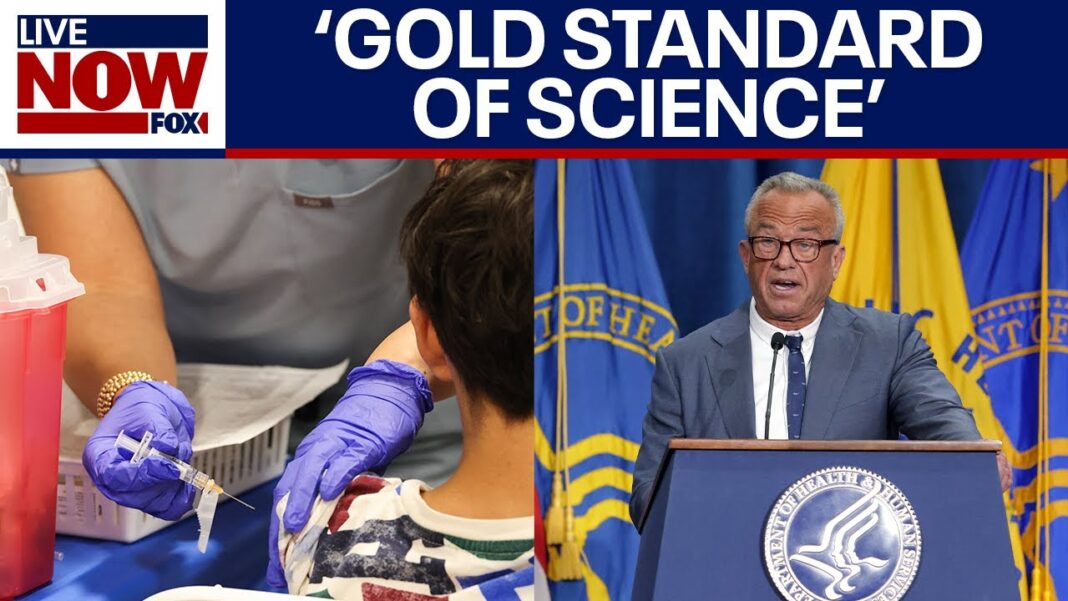
Dr. Bhattacharya framed it bluntly: “Science demands continuous evaluation. This decision commits NIH, CDC, and FDA to gold standard science, greater transparency, and ongoing reassessment.”
HHS agencies are now tasked with funding what the memo terms “gold standard science” for every vaccine on the schedule.
Secretary Robert F. Kennedy Jr., whose public skepticism of institutional medicine predates his tenure at HHS, cast the shift as a civilizational reset: “We are aligning the U.S. childhood vaccine schedule with international consensus while strengthening transparency and informed consent. This decision protects children, respects families, and rebuilds trust in public health.”
For supporters, the changes represent long-overdue humility — an acknowledgment that centralized authority cannot substitute for consent. For critics, the fear is unmistakable: that removing universal recommendations may invite outbreaks of preventable disease.
The Department of Health & Human Services (HHS) counters that the opposite is true. By rebuilding trust, officials argue, voluntary compliance will rise — not fall.
The operational burden now falls on state health departments, pediatric associations, insurers, and educators. HHS and CDC will launch a national campaign to train clinicians, inform parents, and ensure that shared decision-making becomes not an abstract principle but a lived clinical practice.
This transition will not be simple. The Department of Health & Human Services (HHS) acknowledges that confusion and backlash are inevitable. But the agency’s leadership appears prepared.
As one senior HHS official put it privately, “You don’t rebuild a collapsing bridge by painting over the cracks. You tear it down and start again.”
Whether history will vindicate this moment as the rebirth of public trust — or condemn it as a perilous gamble — remains to be seen. What is certain is that the American childhood immunization paradigm, untouched for generations, has now been irrevocably altered.
And The Department of Health & Human Services (HHS) is placing its institutional reputation on the line to defend it.
