



|
Getting your Trinity Audio player ready...
|
By: Mercura Wang
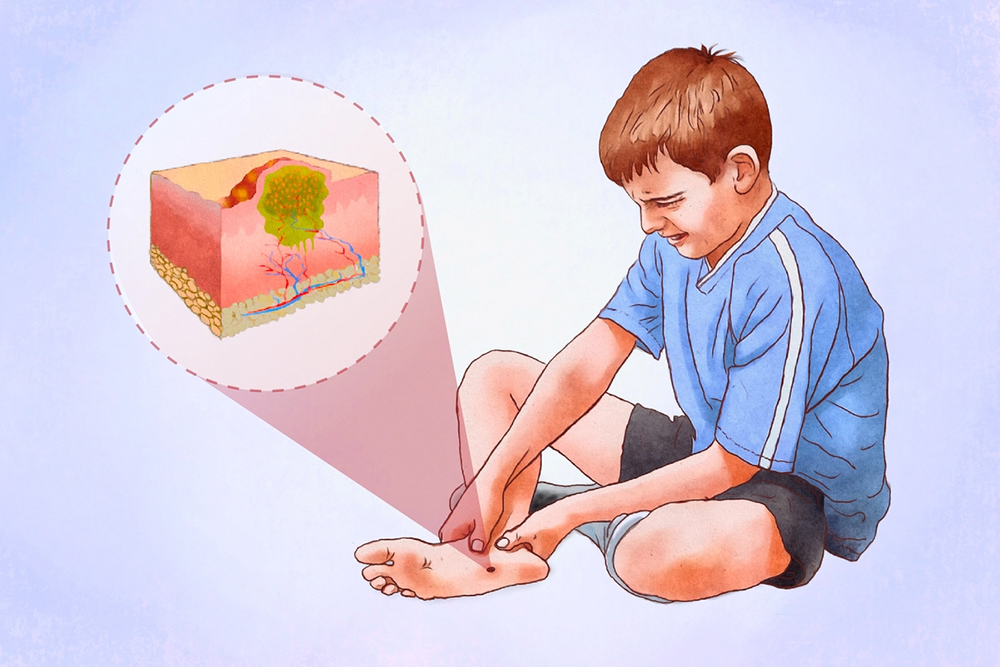
Plantar warts, also known as plantar verrucae and foot warts, are common skin growths caused by the human papillomavirus (HPV). They develop when the virus infects the skin, typically appearing on the bottom—the plantar side—of the foot.
The virus is species-specific to humans, making people the primary reservoir for HPV. It is estimated that 40 percent of people are infected with HPV, and warts develop in 7 percent to 12 percent of those infected.
What Causes Plantar Warts?
Warts are caused by an infection in the outer layer of the skin, called the epidermis.
The virus typically enters through small cuts or breaks on the sole of the foot.
Plantar warts often spread through direct contact with infected skin or contaminated surfaces in public places such as changing rooms, shower stalls, and around swimming pools. Plantar warts can also be transmitted through autoinoculation or self-spread by scratching or rubbing. HPV does not spread through body fluids, except from the wart itself.
Once HPV comes into contact with a host, it enters the skin through breaks, cuts, or other weak areas on the bottom of the foot. After penetrating the surface, the virus infects the skin’s basal layer, where stem cells actively divide. The virus enters the infected cell and, after an incubation period of one month to 20 months, establishes viral DNA within the host cell. After infection, three outcomes are possible: the infection can clear if the person is immune to that specific HPV type, remain latent, or develop into a visible plantar wart.
In addition to exposure to HPV, other risk factors for plantar warts include:
Having a history of plantar warts: People who have had plantar warts before are more likely to experience recurrence.
Age: Warts are most common in children and adolescents, with peak incidence between ages 12 and 16
Poor hygiene practices: Inadequate foot hygiene or sharing personal items may increase the risk of infection.
Broken skin: Plantar warts are more likely to develop on wet, damaged, or broken skin.
Certain occupations: Jobs or activities that involve barefoot movement on shared surfaces—such as in sports or dance—can increase vulnerability to HPV. For example, gymnasts and dancers often practice barefoot on communal floors.
What Are the Symptoms and Signs of Plantar Warts?
Warts are noncancerous localized thickenings of the skin, and plantar warts are those that develop on the soles of the feet. Plantar warts can appear anywhere on the sole or toes, often forming on pressure points such as the heels and balls of the feet. The warts can range in size from a few millimeters to over 1 centimeter.
In many cases, plantar warts do not cause symptoms. Some signs may include:
Thickened skin: A plantar wart often resembles a callus because of its tough, thick tissue. Myrmecial warts usually protrude from the surface of the skin and grow deeper into the skin. This growth typically occurs slowly, starting small and enlarging over time.
Pain: Because the soles are weight-bearing and rub against footwear, plantar warts can cause discomfort. Walking, standing, or squeezing the sides of the wart may be painful. Myrmecial warts tend to be deep and tender, while mosaic plantar warts are typically painless.
Tiny black dots: These dots, which often appear on the surface of the wart, are actually dried blood trapped in capillaries—tiny blood vessels.
Loss of skin lines: Unlike calluses, which retain natural skin pattern, plantar warts disrupt or erase these lines.
What Are the Types of Plantar Warts?
There are two types of plantar warts:
- Solitary Warts (Myrmecial Plantar Warts)
Solitary warts are individual, tender warts that grow inward and may develop additional “satellite” warts nearby. They can range in color from flesh-toned to yellow or grayish-brown.
- Mosaic Warts
Mosaic warts consist of a group of small warts growing close together in one area. Mosaic warts are generally more challenging to treat than solitary warts.
How Are Plantar Warts Diagnosed?
The following methods are used to diagnose plantar warts:
Observation: Doctors usually diagnose plantar warts based on their appearance. Skin lines do not continue across the wart, and tiny black dots may be visible. Warts may also bleed when shaved.
Dermatoscopy: Dermatoscopy uses a dermatoscope—similar to a magnifying glass—to enlarge skin details up to 10 times. Under dermatoscopy, warts show red or purple dots (blood vessels) surrounded by white rings (thickened skin).
Paring: Paring involves carefully shaving or scraping away the thickened outer layer of the wart to reveal diagnostic features, such as tiny black dots.
Biopsy: Biopsy may be performed when the diagnosis is uncertain or if the lesion appears darker than the surrounding skin, has an irregular shape, bleeds, or grows rapidly. Biopsy is rarely needed, as plantar warts are usually benign.
Swab method: The swab method uses tissue samples collected via swab for histopathological study or polymerase chain reaction testing for HPV DNA. The swab method is as effective as a biopsy but is noninvasive, quicker, and more comfortable for patients.
What Are the Possible Complications of Plantar Warts?
While usually benign, plantar warts can occasionally lead to:
Cancer: In rare cases—especially in people who are immunocompromised—long-standing warts may undergo malignant transformation into squamous cell carcinoma or plantar verrucous carcinoma.
Knee or hip pain: Pain from myrmecial plantar warts can interfere with walking and sports activities, which may lead to joint pain.
Secondary infections: Injured or scraped plantar warts can become infected with bacteria.
What Are the Treatments for Plantar Warts?
Plantar warts can be difficult to treat and frequently recur, but they often disappear on their own, particularly in children under age 12. However, this process may take months or even years, as HPV can survive on surfaces for extended periods.
Most plantar warts can be treated with pharmacist advice and over-the-counter treatments.
See a doctor if the wart is painful, bleeding, changing, interfering with daily life, spreading despite treatment, or if you have diabetes, reduced foot sensation, or a weakened immune system.
First-Line Treatments
First-line treatments are typically the most accessible and least invasive options for managing plantar warts. These methods are often effective, especially in early or mild cases.
Wait and see: Allowing warts to resolve naturally works in about 58 percent of cases involving solitary warts. However, the approach is less effective for mosaic warts and is not recommended for people with weakened immunity.
Topical creams and ointments: Applying salicylic acid or silver nitrate daily until the wart disappears is a common treatment method. Salicylic acid removes dead skin and boosts immune response, requiring use over several months. Silver nitrate is applied directly to destroy wart tissue over a shorter course. Proper application and precautions are essential to avoid skin damage and potential toxicity.
Duct tape: Covering the wart with duct tape for six days, then soaking, filing, and leaving it uncovered overnight may help. The process can be repeated for up to two months. Although evidence is mixed, some people report success with this approach.
Over-the-counter pain relievers: Taking medications such as acetaminophen or ibuprofen may help relieve discomfort associated with plantar warts.
Second-Line Treatments
Second-line treatments are typically considered when first-line methods fail or when warts are persistent, widespread, or particularly painful. These options may involve more intensive procedures or specialized therapies.
Cryotherapy: Cryotherapy involves freezing warts with liquid nitrogen, and is typically repeated every two to three weeks for up to three months. Using salicylic acid between sessions may enhance results. Cryotherapy often causes pain, blisters, and burns, and may reduce mobility for several weeks. It is generally not recommended for children due to side effects. Clinical trials report low cure rates ranging from 6 percent to 65 percent for plantar warts, as the thick epidermis on the soles can limit effectiveness. Cryotherapy may be more effective on warts in other areas of the body.
Hyperthermia: Hyperthermia raises skin temperature to promote viral cell death (apoptosis) and stimulate an immune response. Hypothermia requires specialized equipment—such as exothermic skin patches, radiofrequency devices, or infrared lasers—and carries a risk of burns, which limits its use in general practice.
