



|
Getting your Trinity Audio player ready...
|
By: Carl Schwartzbaum
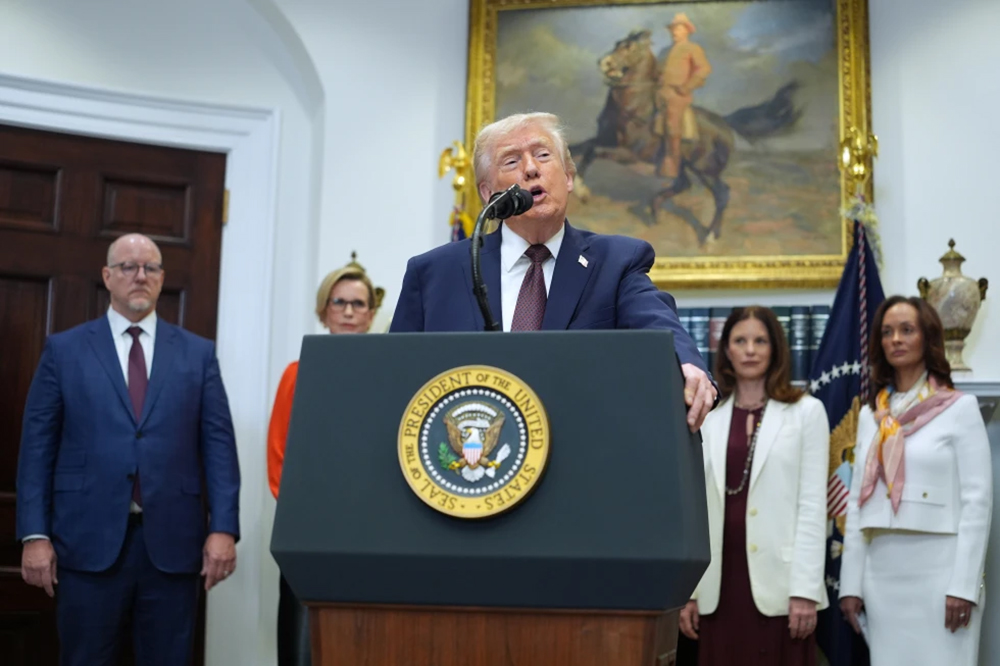
President Donald Trump’s announcement on Friday that nine of the world’s largest pharmaceutical companies have agreed to significantly lower prescription drug prices in the United States marks one of the most consequential developments in American health policy in years, according to a report on Friday by the Associated Press (AP). The agreement, which Trump framed as a decisive victory for patients and taxpayers alike, aims to bring U.S. drug prices closer to those paid in other advanced economies and represents a rare moment of convergence between government pressure and corporate acquiescence in an industry long resistant to price controls.
As detailed by the Associated Press, the companies involved—Amgen, Bristol Myers Squibb, Boehringer Ingelheim, Genentech, Gilead Sciences, GSK, Merck, Novartis, and Sanofi—have agreed to cap Medicaid drug prices at levels comparable to those charged in peer nations. Beyond that, newly launched medications from these firms will be subject nationwide to what is known as “most-favored-nation” pricing, a benchmark designed to ensure Americans do not pay more than patients in other developed countries for the same drugs. According to the AP report, this pricing model will apply across the commercial market, cash-pay transactions, Medicare, and Medicaid alike.
For decades, the United States has stood as an outlier in global pharmaceutical pricing, with Americans often paying two to three times more for brand-name medications than patients abroad. AP reporting has repeatedly highlighted how this disparity has strained household budgets, burdened public health programs, and fueled political outrage across the ideological spectrum. Trump’s latest move, administration officials say, is intended to address precisely that imbalance by leveraging the size of the American market to force concessions that previous administrations failed to secure.
The announcement underscores a central paradox of the U.S. healthcare system: while most Americans are insulated from the full sticker price of drugs through employer-sponsored insurance or government programs, the underlying costs still ripple through premiums, taxes, and public budgets. Medicaid beneficiaries already pay nominal co-payments—often just a few dollars per prescription—but the program itself shoulders enormous expenses. Lower drug prices, therefore, promise to ease pressure on state and federal budgets that collectively fund Medicaid, potentially freeing resources for other healthcare priorities.
Uninsured Americans, who lack negotiating power and often face the full brunt of pharmaceutical pricing, stand to benefit as well. The AP reported that for these patients, the agreement could be life-altering, particularly for those reliant on high-cost, chronic medications. Still, experts caution that even substantial discounts may leave some drugs costing hundreds of dollars per month, underscoring the limits of any single reform.
William Padula, a professor of pharmaceutical and health economics at the University of Southern California, told the Associated Press that Medicaid already enjoys some of the most favorable pricing in the system, meaning the immediate fiscal impact could be modest in certain cases. “It can’t be bad,” Padula said, noting that while the downside appears minimal, the full benefits will take time to assess. His remarks, cited by the AP, reflect a broader consensus among health economists that structural reforms often yield incremental, rather than immediate, gains.
What makes the agreement particularly noteworthy, according to AP analysis, is the breadth of its scope. In addition to pricing concessions, the participating companies have committed to selling pharmacy-ready medications directly to consumers through a new platform, TrumpRx, scheduled to launch in January. Administration officials told the Associated Press that the platform is designed to cut out intermediaries and allow patients to purchase drugs straight from manufacturers, potentially increasing transparency and reducing costs.
The deal also contains provisions aimed at national preparedness. Several of the companies—including Merck, GSK, and Bristol Myers Squibb—have agreed to donate significant quantities of active pharmaceutical ingredients to a national reserve. These ingredients would be formulated and distributed as essential medications, such as antibiotics, rescue inhalers, and blood thinners, in the event of a public health emergency. The Associated Press reported that this aspect of the agreement reflects lessons learned from recent supply chain disruptions, which exposed vulnerabilities in the nation’s access to critical medicines.
Perhaps the most striking element of the announcement involves Bristol Myers Squibb’s decision to provide its blockbuster blood thinner, Eliquis, free of charge to the Medicaid program. Eliquis is not only the company’s most prescribed drug but also one of the most widely used medications within Medicaid. It has generated tens of billions of dollars in revenue since its introduction, making it one of the most profitable drugs in pharmaceutical history.
Padula described the Eliquis donation as a meaningful gesture toward health equity. “It’s a thoughtful health equity move that they can afford given that it’s been such a blockbuster,” he said. The decision signals, at least symbolically, an acknowledgment by pharmaceutical giants that access to essential medicines need not be sacrificed at the altar of shareholder returns.
The agreement announced Friday builds on earlier deals struck this year between the Trump administration and other major drugmakers, including Pfizer, AstraZeneca, EMD Serono, Novo Nordisk, and Eli Lilly. As the Associated Press has chronicled, these negotiations followed Trump’s public letters to executives at 17 pharmaceutical companies, in which he criticized the stark disparity between U.S. drug prices and those abroad. Administration officials told the AP that Trump made clear he was prepared to impose tariffs of up to 10 percent on pharmaceutical imports if companies failed to cooperate—a threat Trump himself later characterized as necessary to compel industry leaders to “do the right thing.”
From the perspective of Wall Street, the reaction has been cautiously optimistic. The AP report noted that analysts view the agreements as a stabilizing force that could ultimately benefit pharmaceutical companies by reducing political risk and preserving their long-term ability to invest in research and development. Padula echoed this sentiment, telling the Associated Press that the deals are “good for their stock and good for their future” in innovation, even if the broader impact on public health outcomes remains to be seen.
Still, questions abound regarding the durability and enforceability of the agreements. Critics argue that without statutory changes, future administrations could alter or abandon the pricing framework, leaving patients once again vulnerable to escalating costs. Others warn that pharmaceutical companies may respond by increasing prices in other markets or by shifting research priorities away from therapies perceived as less profitable under the new regime.
The Associated Press report also highlighted the complexity of translating negotiated price reductions into tangible improvements in population health. “Nothing really matters here unless our health gets better as a country,” Padula said, encapsulating a sentiment shared by many experts who stress that affordability is only one piece of a much larger healthcare puzzle. Access, adherence, and outcomes must all improve for reforms to achieve their intended purpose.
For Trump, however, the announcement represents a signature policy achievement he is eager to tout. In public remarks cited in the AP report, the president framed the agreement as proof that assertive leadership can succeed where incremental reforms have failed. By confronting pharmaceutical executives directly and wielding the threat of tariffs, Trump has positioned himself as a champion of consumers in a sector often criticized for opacity and excess.
Whether history will judge the agreement as a turning point or merely a partial step remains uncertain. What is clear is that the deal has reignited a national conversation about the balance between innovation, profit, and public responsibility in healthcare. In a country where prescription drug costs have long been a source of anxiety and anger, the announcement has offered at least a measure of hope—tempered by the recognition that meaningful change in healthcare rarely comes easily or swiftly.
As the TrumpRx platform prepares to launch and the pricing commitments begin to take effect, policymakers, patients, and industry leaders alike will be watching closely. The Associated Press will undoubtedly continue to track how these agreements unfold, scrutinizing whether they deliver on their promise to make medicines more affordable and accessible for millions of Americans. In the meantime, the announcement stands as a reminder that even in one of the most powerful and profitable industries in the world, sustained political pressure can still yield concessions with the potential to reshape lives.