



|
Getting your Trinity Audio player ready...
|
By: Kuo-Pin Wu
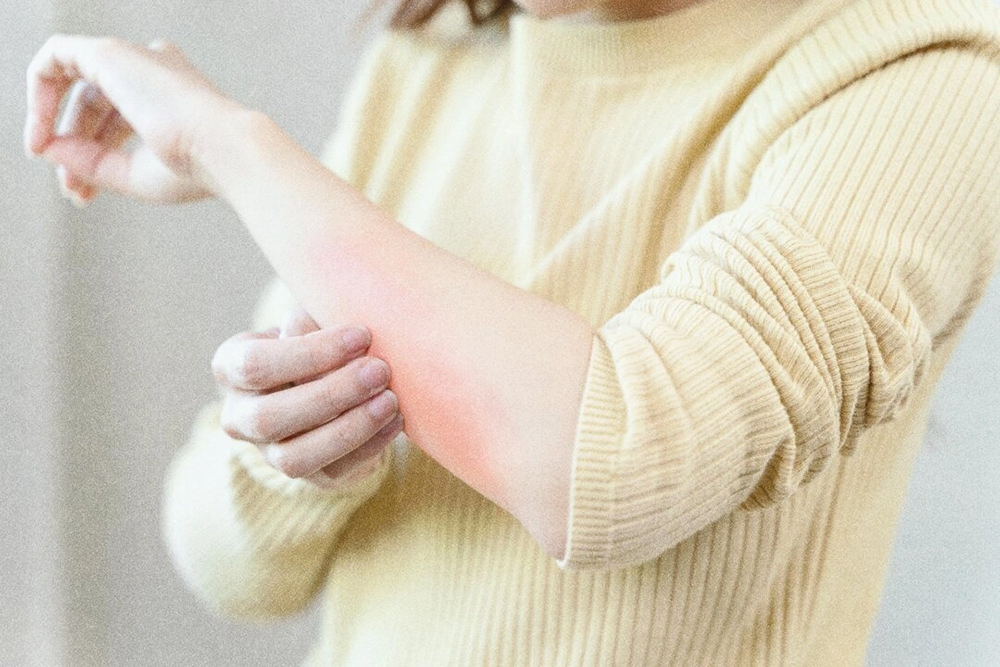
Itchy skin is more than an annoying problem—it can be a constant source of discomfort, leading to sleepless nights and worsening symptoms with each scratch. Whether triggered by food, environmental factors, or internal imbalances, the cause of itching is often more than skin-deep. Traditional Chinese medicine (TCM) offers time-tested remedies to address itching, focusing on both immediate relief and long-term healing.
Diet: The Link Between Food and Itching
What you eat plays a significant role in skin health. Certain foods can trigger allergic reactions or stress the digestive system, leading to itching.
Foods—such as fish, shrimp, crab, and meats like beef, pork, lamb, and chicken—can trigger food-related itching, especially when eaten in excess. Overeating these rich or hard-to-digest foods may stress the digestive system and provoke an immune response.
Skin reactions may include map-like red wheals, swollen red patches, papules, or blisters of various sizes. If not treated promptly, systemic symptoms such as vomiting, diarrhea, fatigue, or general malaise may develop, indicating internal toxin buildup.
In cases of severe allergic reaction, immediate medical attention is essential.
Alcohol-Induced Itching
Some people may experience itching shortly after drinking alcohol, followed by the appearance of widespread red patches or small red papules. As the body metabolizes the alcohol and eliminates it—typically through sweat or urine—both the itch and the rash often subside and may resolve without treatment.
External Factors That Trigger Itching
Beyond food and drink, external elements—including environmental toxins and parasites—can provoke intense itching, often signaling deeper imbalances or underlying conditions.
Toxin-Induced Itching
The classical TCM text “General Treatise on the Causes and Symptoms of Diseases (Zhubing Yuanhou Lun)” states that medicines with strong toxicity should not be introduced through the mouth, nose, ears, or eyes, as doing so may lead to persistent itching—and in severe cases—the toxins may invade internal organs.
Toxin-induced itching typically manifests as widespread, swollen, red patches and may include red papules or wheals. A common modern example is an allergic reaction to inhaled insecticides.
In the early stages of boils or abscesses, people may experience intense, localized itching—often an indication that toxic heat has not yet fully developed or concentrated.
A traditional remedy for early-stage boils that involve pus or blistering includes eating a porridge made from mung beans, red beans, and Job’s tears—also known as coix lacryma-jobi, a type of grain commonly used in TCM—in equal parts. This preparation is believed to help reduce symptoms, often within two to three days.
Parasite-Induced Itching
Parasite-related itching—commonly associated with scabies—often appears in skin folds and crevices, such as the webs of the fingers and toes, the anus, genital area, lower abdomen, and under the breasts. In some cases, the itching may spread across the entire body.
During the day, the parasites typically remain dormant and hidden beneath the skin. At night, however, they become active—moving through the skin to mate and feed, intensifying the itching.
The sensation is often described as sharp and piercing, like being pricked by tiny thorns, and can be extremely uncomfortable. Scratching may break the skin and release pale yellow fluid, and the condition is highly contagious.
In TCM, people with a damp-heat constitution are more prone to parasitic infections. Damp heat refers to a body condition with an imbalance of excessive dampness—when the fluids in the body become stagnant—and heat, which refers to internal inflammation or irritation. The imbalance of moisture and heat in the body creates an environment where parasites thrive. The famous Ming dynasty physician Chen Shigong noted that “when dampness and heat combine, they give rise to worms that spread throughout the body.” Damp-heat conditions are characterized by symptoms like greasy skin, sticky stools, and strong body odor.
Natural Remedies for Skin Itching
While conventional medications offer relief, many people seek natural remedies that are gentle yet effective. TCM and natural oils offer time-tested options to soothe irritated skin and reduce itchiness. Below are several remedies commonly used in clinical practice.
Perilla Leaf (Zi Su Ye)
In one clinical case, a person developed widespread skin itching and red, swollen hives after eating seafood. The symptoms closely resembled urticaria (hives) and caused significant discomfort. I recommended using Perilla leaf (Zi Su Ye) to treat the condition.
Perilla leaf is a commonly used herb in TCM, traditionally employed to alleviate allergic reactions caused by seafood, particularly fish and shellfish. I advised the person to use approximately 30 grams of dried Perilla leaves, boiling them in 1,000 milliliters of water and simmering for no more than 10 minutes. The decoction can be taken slowly like a warm herbal tea.
After following this method, the person’s itching resolved within just one day, without the use of any conventional medications. The rapid improvement reinforced the traditional use of Perilla leaf as a remedy for seafood-related allergic reactions.
Perilla leaf can also help relieve general allergic skin itching, making it a simple, natural, and effective herbal remedy.
Coconut Oil
In clinical practice, coconut oil is one of the natural remedies I most frequently recommend.
Nongreasy relief for itching: In addition to being edible, coconut oil also provides effective relief for itchy skin. Unlike many conventional oils, it absorbs quickly and leaves little to no oily residue, making it especially suitable for topical use.
Effective for massage: Coconut oil also works well as a massage oil, providing soothing relief for itching and easing muscle tension and soreness.
Safe for infants and children: Coconut oil is particularly suitable for infants and young children.
When children experience skin irritation, they often scratch or put their hands in their mouths. Nonnatural ointments may pose a risk if accidentally ingested. In contrast, coconut oil is safe even if swallowed, making it a gentle and reliable choice for sensitive skin.
Research has shown that lauric acid, a primary component of coconut oil, possesses antibacterial activity. For people with atopic dermatitis, topical application of coconut oil can help moisturize the skin and lower the risk of Staphylococcus aureus infection.
Traditional Herbal Formulas for Skin Itching
A 2023 systematic review indicated that TCM—whether used alone or combined with Western medical treatment—can be more effective than Western medicine alone in managing chronic itching, including conditions such as psoriasis, eczema, and urticaria.
Below is one classical herbal formula used in clinical practice.
Liao Du Tang
Liao Du Tang, first recorded in the classical medical text “Complete Methods to Treat Ulcers (Yang Yi Da Quan),” was historically described as a remedy that “treats all long-standing, painful, and itchy sores.”
Liao Du Tang is primarily used to address stubborn and chronic skin conditions, particularly those involving persistent itching, inflammation, or skin thickening.
This formula consists of the following key herbs:
Fo-ti (He shou wu)
Schizonepeta (Jing jie)
Angelica pubescens (Du huo)
Saposhnikovia (Fang feng)
Clematis (Wei Ling Xian)
Sesame seed (Hu ma)
Acorus (Shi chang pu)
Sophora root (Ku shen)
Together, these herbs are believed to clear heat (inflammation), remove toxins, and relieve itching. While it can be very effective, consulting with a qualified TCM practitioner before using it regularly is recommended.

The easiest thing to relieve itching is therapeutic grade peppermint essential oil. Must be from a reputable company, not some cheap copy.