




|
Getting your Trinity Audio player ready...
|
Four minutes. No needles. No radiation. 99% accurate. Mayo Clinic is a shareholder. And almost nobody is covering it.
By: Mitch Schneider
A few weeks ago, in a small office in Petah Tikva, an Israeli company called AccuLine published the results of a clinical trial that had been running across seven medical centers in Israel.
They tested 305 patients. They compared their results against coronary angiography, the most accurate diagnostic tool that exists for detecting blockages in the arteries of the heart.
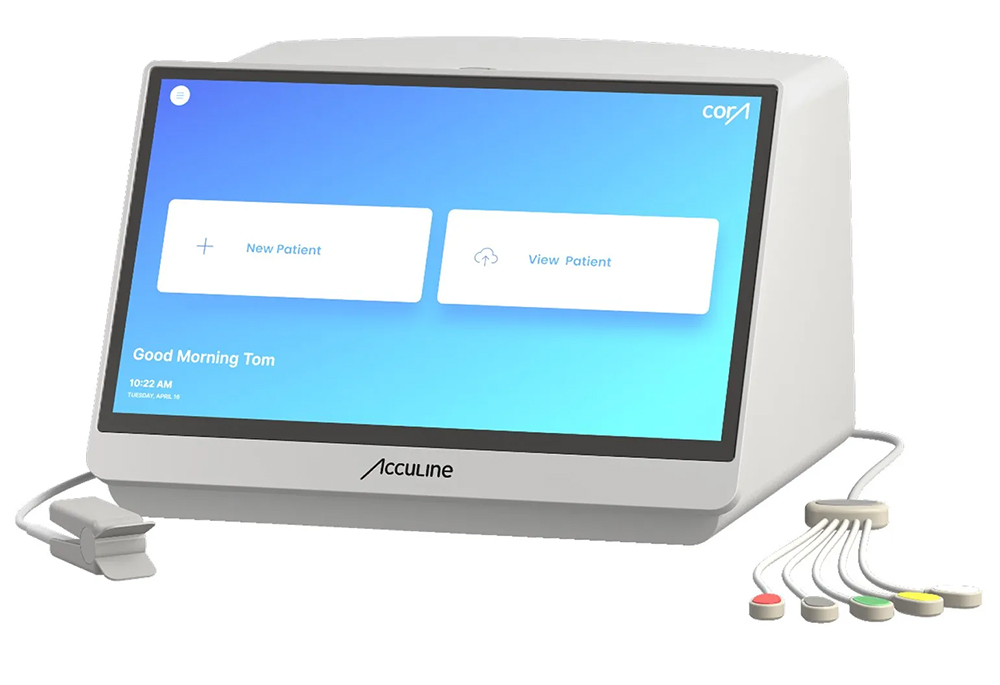
AccuLine’s system is called CORA. It is an AI-powered, non-invasive, tabletop device designed for the rapid, point-of-care detection of Coronary Artery Disease (CAD). It achieved 94% sensitivity and a 99% negative predictive value.
If you’re not a doctor, here’s what that means: when CORA says your arteries are clear, it’s right 99 out of 100 times. When it flags you as high-risk, you go straight to a specialist. Not in six months. That day.
The test takes four minutes. Electrodes on the body, similar to a standard ECG. No needles. No radiation. No contrast dye. No treadmill. No hospital visit. Any trained medical staff can run it in a regular doctor’s office.
And most people have never heard of them.
To understand why that matters, you need to understand the problem they’re solving.
The Problem Nobody Talks About
Heart disease is the number one killer of human beings on the planet. Nineteen point two million people in 2023, according to the Global Burden of Disease study published in the Journal of the American College of Cardiology last September. One out of every three deaths, globally. In the United States alone: 919,000. Someone has a heart attack every 40 seconds. Two hundred thousand of those people have already had one before.
Coronary artery disease is the most common type. The arteries that supply blood to your heart narrow and harden over time. That’s what causes heart attacks. An estimated 250 million people worldwide are living with it. Many have no idea.
Now here’s the part that should make you angry.
If you walk into your family doctor’s office today worried about your heart, the most widely available screening tool is still an exercise stress test. Treadmill. Walking. Heart rate goes up. Doctor watches your ECG. That test has been around for decades, and a meta-analysis of over 24,000 patients found it has a sensitivity of about 68%. It misses roughly a third of people with significant coronary artery disease. The European Society of Cardiology downgraded it to a Class 2b recommendation. It requires physical exertion that many of the people most at risk simply cannot perform. And when results come back inconclusive, which happens often, the next step is usually a catheter threaded into your arteries. Radiation. Contrast dye. Hospital stay.
More advanced noninvasive options do exist. CT angiography, stress echocardiography, nuclear imaging. Significantly more accurate. But they require specialized equipment, trained technicians, and imaging centers that most family doctors don’t have access to. They’re expensive. They’re not something you walk in and get during a routine checkup.
So for most people, in most places, the first real screening they’ll get for the deadliest disease in human history is a test that misses a third of cases. And the next option up means a hospital.
My father went through two open-heart surgeries. The tools available at the time couldn’t give his doctors a clear answer. He did the treadmill. Got inconclusive results. Was told to come back. By the time anyone was certain, he was on the operating table. Twice.
That’s the gap AccuLine was built to close. And the way they did it is genuinely new.
What Makes CORA Different
CORA doesn’t do what a stress test does, only better. It does something fundamentally different.
AccuLine’s team discovered two novel bio-signals in the heart’s electrical activity that correlate with coronary artery disease. Signals no existing diagnostic tool was designed to capture. They built AI algorithms that simultaneously analyze three data streams: cardiac electrical activity, blood oxygen saturation, and respiratory phase. CORA processes those signals together and identifies patterns associated with significant coronary blockages that a treadmill ECG was never built to see.
The company was co-founded by CEO Moshe Barel, Prof. Aharon Frimerman, who heads Interventional Cardiology at Hillel Yaffe Medical Center, and Prof. Shai Revzen, a computer science professor at the University of Michigan.
The trial was conducted at seven major Israeli medical centers including Ichilov, Wolfson, and Assuta. Every patient’s CORA results were validated against coronary angiography. The data held.

Now, 305 patients is a strong start, not a final verdict. AccuLine knows that, which is why the next phase is a 2,000-patient trial across 20 U.S. medical centers, designed to confirm these results at scale in real-world clinical settings. That’s what FDA clearance requires, and that process is underway now.
But the numbers from this first trial are hard to ignore. 94% sensitivity. 99% negative predictive value. No needles, no radiation, no physical exertion, no hospital. If those numbers hold at scale, the way we screen for coronary artery disease changes completely.
And the people betting on it aren’t small.
Follow the Money
Mayo Clinic became a shareholder in AccuLine in 2023. Not a consultant. Not an advisor. A shareholder. They signed a know-how license agreement to develop CORA for the American market and have been collaborating on clinical development ever since.
Mayo Clinic does not do that casually.
Other investors include eHealth Ventures, Maccabi Healthcare Services (one of Israel’s largest HMOs, covering over two million Israelis), and grants from the Israel Innovation Authority and Google’s AI Startups Fund.
Total raised: $5.5 million. A seed round. From founding to a completed multi-center clinical trial, a Mayo Clinic equity partnership, and an FDA pre-submission package. Most medical device companies burn through more than that before they have a working prototype.
Read that again. $5.5 million. From zero to Mayo Clinic.
Which brings us to the part that actually matters.
What This Means for the People You Love
Your father is 67. He’s been putting off seeing a cardiologist because the idea of a hospital workup makes him anxious. He doesn’t want the treadmill. He doesn’t want the catheter. So he doesn’t go. With CORA, he walks into his regular doctor’s office, sits down for four minutes, and walks out knowing. If he’s clear, he’s clear. If something’s wrong, he’s referred immediately.
Your mother has a family history of heart disease. Every time she feels short of breath, part of her wonders. She doesn’t need an invasive procedure to find out. She needs a four-minute test at her doctor’s office.
You’re 50. You watched a parent go through bypass surgery. You think about it more than you’d admit. Getting a definitive answer has always meant specialized testing, long waits, and real money. CORA puts that answer inside a routine checkup. Early. Before it becomes a crisis.
That’s what changes when screening moves out of the hospital and into the places people actually go.
AccuLine estimates the U.S. market at $7 billion. But the reason this story matters has nothing to do with market size.
Built in Israel. For Everyone.
As someone living in Israel, I see what this country builds every day. And most of the world has no idea.
AccuLine is based in Petah Tikva. Validated across seven Israeli hospitals. Backed by Israel’s largest HMO. Funded by the Israel Innovation Authority. Funded by Google. Partnered with Mayo Clinic. Heading to twenty American hospitals.
Not because anyone asked Israel to build this. Because 19.2 million people a year are dying from something that can be caught earlier, and a team in Petah Tikva decided the world’s best option shouldn’t be a treadmill and a prayer.
That’s what this country does. Not in speeches. Not in slogans. In hospitals and labs and clinics. Quietly. For everyone.
And somewhere right now, a family doctor is reading about CORA for the first time. And realizing that the way we screen for heart disease is about to change.
For your parents. For mine. For all of them.
Built in Israel. For everyone.
(This article originally appeared on www.sharingfromisrael.substack.com)
