



|
Getting your Trinity Audio player ready...
|
By: Tzirel Rosenblatt
For decades, Baruch and Rivka Wilhelm lived in a world softened by silence. He, 61, had lost much of his hearing as a child after being struck by a car; she, 56, was born with severe hearing impairment. Together, they built a life — raising five children, enduring hardship with grace, and communicating through a blend of lip-reading, intuition, and deep mutual understanding.
Now, as VIN News reported on Monday, their journey has taken a miraculous turn. After more than thirty years of marriage, the couple from Nachalat Har Chabad in Kiryat Malachi decided to undergo cochlear implant surgery — together — at the public Assuta Hospital in Ashdod. The decision, they said, transformed their lives in ways they could never have imagined.
“We went into surgery with joy and came out with joy,” Baruch told VIN News. “For the first time, I heard the ticking of a clock.”
Baruch’s hearing began to fade when he was only three years old. A tragic accident — a collision with a passing car — left him with permanent damage. “Since then, my hearing gradually deteriorated,” he said. “My whole life was lived in a world of partial silence.”
Rivka, by contrast, never knew what it meant to hear. Born with hearing loss, she adapted early to a life without sound. Yet she carried a profound longing — a quiet awareness of all she was missing. “As a teenager, I traveled to see the Lubavitcher Rebbe,” she recalled in her conversation with VIN News. “When I realized I couldn’t truly hear him, that’s when I understood the depth of what I was missing. I made a decision right then: I would only marry someone who truly understands me.”
Their match came through a shadchan — a matchmaker — but it was not without hesitation. “At first, I thought — it’s hard enough that I don’t hear well, and now her too?” Baruch admitted. “But when I heard more about her, and especially after the Rebbe crossed out the word ‘if’ in my letter asking about the match, I understood this was meant for me. Within a week, I made the best decision of my life.”
From that moment, silence became their shared language. The couple built a warm, faith-filled home, relying on gestures, notes, and patience. They raised five children, all hearing, and found strength in their community in Nachalat Har Chabad.
As the years passed, the Wilhelms learned to adapt to a world that often took sound for granted. But when the COVID-19 pandemic arrived, the challenges became overwhelming. Masks made lip-reading impossible, and the isolation deepened. “I realized I needed a more meaningful solution than what I had,” Rivka said.
Rivka, who works as a school safety coordinator, began consulting with doctors and therapists about new technologies that could restore hearing. A speech therapist encouraged her to consider a cochlear implant, explaining that recent advancements had revolutionized its effectiveness.
“I knew the technology had advanced, and it felt like the right step,” Rivka told VIN News.
Baruch, initially reluctant, needed time to come around. The thought of surgery was daunting, and years of adapting to silence made the idea of change both thrilling and frightening. “Rivka was the brave one,” he said. “She told me, ‘I’m doing this. Are you coming with me?’ And I came.”
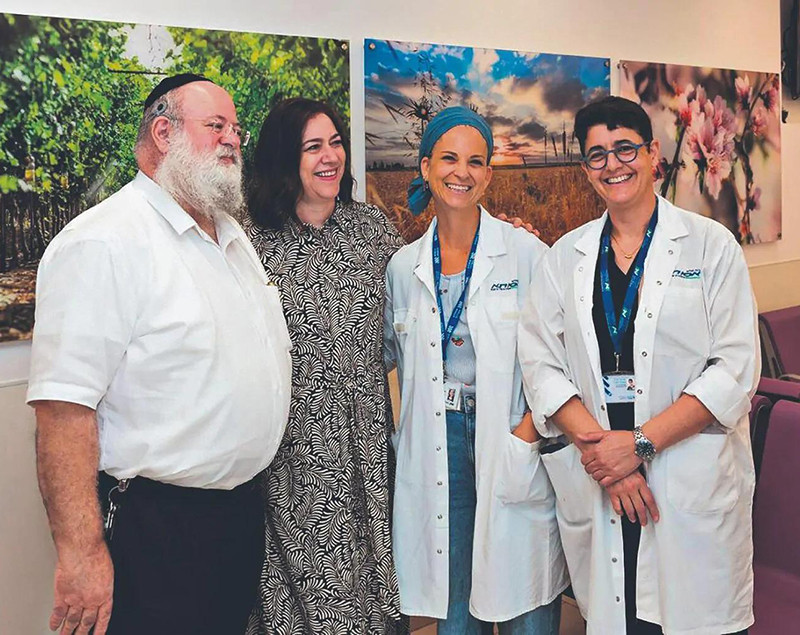
The couple turned to Professor Sharon Avnat-Tamir, head of the Otology and Cochlear Implant Unit at Assuta Ashdod Public Hospital. From their first consultation, they felt reassured.
“From the very first moment, we felt we were in the best hands,” Baruch said. “The doctors explained everything with patience and sensitivity. They treated us not as patients, but as partners.”
The surgeries — performed within days of each other — were a success. For the Wilhelms, the true miracle came not in the operating room, but in the moments that followed.
“When we heard each other for the first time, we just broke down in tears,” Baruch told VIN News. “Suddenly I was hearing sounds I didn’t know existed.”
Rivka described a similar rush of emotion: “Baruch came home from synagogue crying — he had heard the prayers. For us, it feels like a mission to tell others it’s possible.”
Small, everyday sounds have now become extraordinary treasures. The ticking of a clock, the rustle of leaves, the soft cadence of whispered conversation — all once beyond their reach — have returned as precious revelations.
“One Shabbat at home,” Baruch recounted, “I heard a ‘tick tick’ and thought it was a leaking faucet. Then I realized it was the clock. I’ll never forget that moment.”
For Rivka, sound has redefined spirituality. “When I heard my husband’s voice clearly for the first time, it was like meeting him all over again,” she said. “It’s like Hashem gave us back a sense we never fully had.”
The couple’s joy, as the VIN News report noted, is not only personal but deeply communal. Friends, family, and neighbors from their Chabad community in Kiryat Malachi have followed their story with heartfelt excitement, celebrating the Wilhelms’ courage as a modern-day miracle.
Cochlear implants — tiny electronic devices that stimulate the auditory nerve directly — have revolutionized hearing restoration for those with profound loss. The implant bypasses damaged portions of the ear, translating sound into electrical signals the brain can interpret.
But as the VIN News report explained, the technology’s real power lies not only in its engineering but in the human determination behind it. For the Wilhelms, undergoing the surgery together was both symbolic and practical — a shared act of faith and partnership after decades of mutual endurance.
Professor Avnat-Tamir praised their decision as “deeply inspiring,” noting that the couple’s story has encouraged other patients to consider similar procedures. “They faced their fear together,” she said. “And what they gained was not only hearing but renewed connection — to each other and to the world around them.”
The Wilhelms’ story resonates far beyond medical achievement. It is, as the VIN News report described, “a testament to faith, perseverance, and the enduring power of love.”
Baruch and Rivka attribute their courage to their strong religious conviction and the guidance of the Lubavitcher Rebbe. “The Rebbe gave us strength even in silence,” Rivka said. “Now, we hear — but that faith carried us through all the years when we didn’t.”
Their experience has inspired them to advocate for greater awareness about hearing loss and the life-changing possibilities of cochlear implants. They have begun speaking to other families facing similar challenges, emphasizing that technology and faith can coexist harmoniously in the pursuit of healing.
“We want others to know that it’s possible,” Rivka told VIN News. “It’s not just about hearing sound — it’s about hearing life. Every little noise, every word, every prayer — it’s a gift.”
Today, the Wilhelms live surrounded by sound — the laughter of grandchildren, the melodies of Shabbat songs, and the rhythm of daily life. What once was muted has become a symphony of gratitude.
“Every sound reminds me of the miracle we received,” Baruch said. “When I wake up in the morning and hear birds outside, I think — this is what the world really sounds like.”
For Rivka, the journey is deeply spiritual. “We were never truly silent,” she reflected, “but now, Hashem has given us a new voice to praise Him with.”
As the VIN News report poignantly observed, their story stands as a beacon of hope for anyone living in quiet isolation — a reminder that even after decades of silence, the world can still sing again.