



Edited by: Fern Sidman
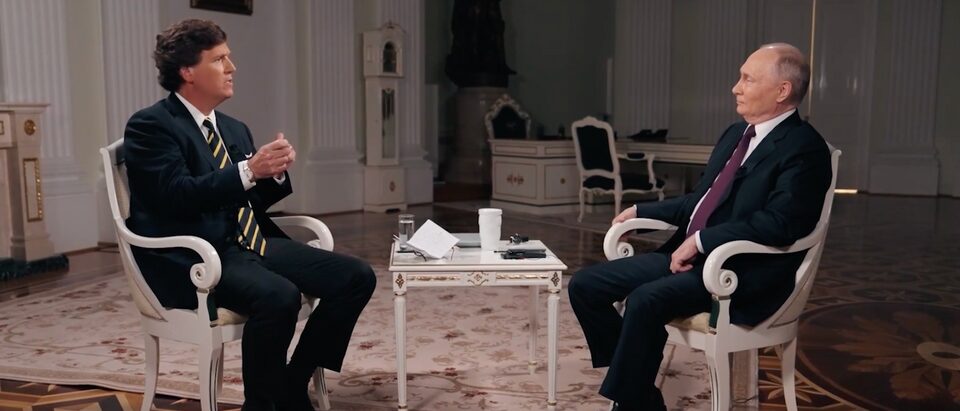
In a move that underscores President Vladimir V. Putin’s strategic efforts to court allies in the West, a two-hour interview, aired on Thursday evening, with one of America’s most influential conservative commentators, Tucker Carlson, has reignited debates over Russia’s geopolitical ambitions and its ongoing conflict with Ukraine.
The interview, conducted in the opulent environs of the Kremlin, marks a significant departure from traditional diplomatic channels, as Putin sought to directly engage with American conservatives, particularly amidst Republican lawmakers’ hesitation to provide aid to Ukraine, as was reported by the New York Times. Putin’s message, conveyed through Carlson’s platform, advocated for a negotiated settlement that would see the United States acquiesce Ukrainian territory to Russia in exchange for ending the war.
Ep. 73 The Vladimir Putin Interview pic.twitter.com/67YuZRkfLL
— Tucker Carlson (@TuckerCarlson) February 8, 2024
Throughout the exchange, Putin’s rhetoric displayed a mixture of historical revisionism, geopolitical posturing, and thinly veiled appeals to American political sensibilities. According to the information provided in the NYT report, he leveraged familiar Kremlin narratives regarding Russia’s historical claims to Eastern European territories, while also delving into tangential topics such as artificial intelligence, Genghis Khan, and the Roman Empire.
Central to Putin’s argument was his assertion that Russia’s invasion of Ukraine was driven by a desire to halt what he perceives as Western aggression against Russia. The NYT report pointed out that by framing the conflict as a defensive measure, Putin attempted to justify Russia’s incursion into Ukrainian territory while simultaneously positioning himself as a pragmatic peacemaker open to dialogue with the West.
Notably, Putin’s remarks diverged from his usual evasiveness regarding the endgame of the Ukraine conflict. The NYT report also observed that rather than espousing visions of military triumph, he emphasized the necessity of reaching a diplomatic resolution, signaling a willingness to engage in negotiations with Western powers.
Putin’s suggestion that NATO and the West consider accepting Russian control over parts of Ukraine as a means of ending the conflict underscores his adeptness at leveraging diplomatic overtures to advance Russia’s strategic interests. The report in the NYT also said that by presenting potential concessions as opportunities for both sides to save face, Putin aimed to portray Russia as a reasonable actor on the world stage, willing to compromise for the sake of stability.
However, the lack of an immediate release of the original Russian version of Putin’s remarks raises questions about potential nuances lost in translation, as viewers were left to rely on dubbed interpretations aired during Carlson’s broadcast, the report added.
In a departure from his usual portrayal of Russia as a bulwark against the perceived moral decay of the West, Putin highlighted the pragmatic nature of Western society while affirming Russia’s commitment to traditional values and moral principles.
The release of the interview generated significant buzz in Russia’s state-run media, which meticulously chronicled Carlson’s visit to Moscow, emphasizing the Kremlin’s ongoing efforts to engage with Western audiences and shape perceptions on the global stage, the report in the NYT said. Despite occasional saber-rattling and diplomatic friction, Putin’s willingness to engage with Western media outlets highlights Moscow’s enduring aspiration to cultivate ties and promote its narrative beyond its borders.
Addressing contentious issues such as nuclear threats and the arrest of American journalist Evan Gershkovich, Putin sought to present Russia as a rational actor capable of finding common ground with the United States. The report added that by acknowledging areas of potential cooperation while refuting accusations of belligerence, Putin’s remarks spoke volumes about the complexities of contemporary geopolitics and the intricacies of Russia’s diplomatic maneuvering.
Putin’s strategic objectives, as outlined by Tatiana Stanovaya, a senior fellow at the Carnegie Russia Eurasia Center, include securing a peace deal that cements Russia’s control over captured territories in Ukraine and installing a friendly government in Kyiv, as was noted in the NYT report. To achieve these goals, Putin appears to be banking on leveraging American influence to pressure Ukraine into negotiations, a strategy that places a spotlight on the intricate interplay of diplomatic, military, and geopolitical factors at play in the region.
However, Putin’s historical digressions and rhetorical flourishes, while familiar to Russian audiences, may have left American viewers perplexed. Speaking to the NYT, Nina L. Khrushcheva, a professor of international affairs, noted that Putin’s verbose discussions of Russian history may have alienated American audiences, highlighting the challenge of bridging cultural and linguistic divides in international diplomacy.
As Russia asserts its influence on the global stage and confronts Western powers, the interview serves as a microcosm of the broader dynamics shaping international relations, offering insights into Putin’s strategic objectives and the complexities of contemporary diplomacy.
Overall, Putin’s interview with Carlson serves as a stark reminder of Russia’s continued efforts to shape the narrative surrounding the Ukraine conflict and to cultivate alliances in the West. As geopolitical tensions persist, the implications of Putin’s diplomatic maneuvering will undoubtedly reverberate across international relations, shaping the course of future negotiations and strategic calculations on both sides.