



|
Getting your Trinity Audio player ready...
|
By: Fern Sidman
Under the soft glow of candlelight and the solemn strains of ancient melodies, Yeshiva University transformed its Washington Heights campus Monday evening into a sanctuary of mourning, reflection, and defiant hope. Students, faculty members, rabbis, and communal leaders gathered for a vigil honoring the victims of Sunday’s brutal antisemitic attack at a Hanukkah celebration on Australia’s Bondi Beach—an act of violence that reverberated across continents and pierced the heart of the global Jewish community.
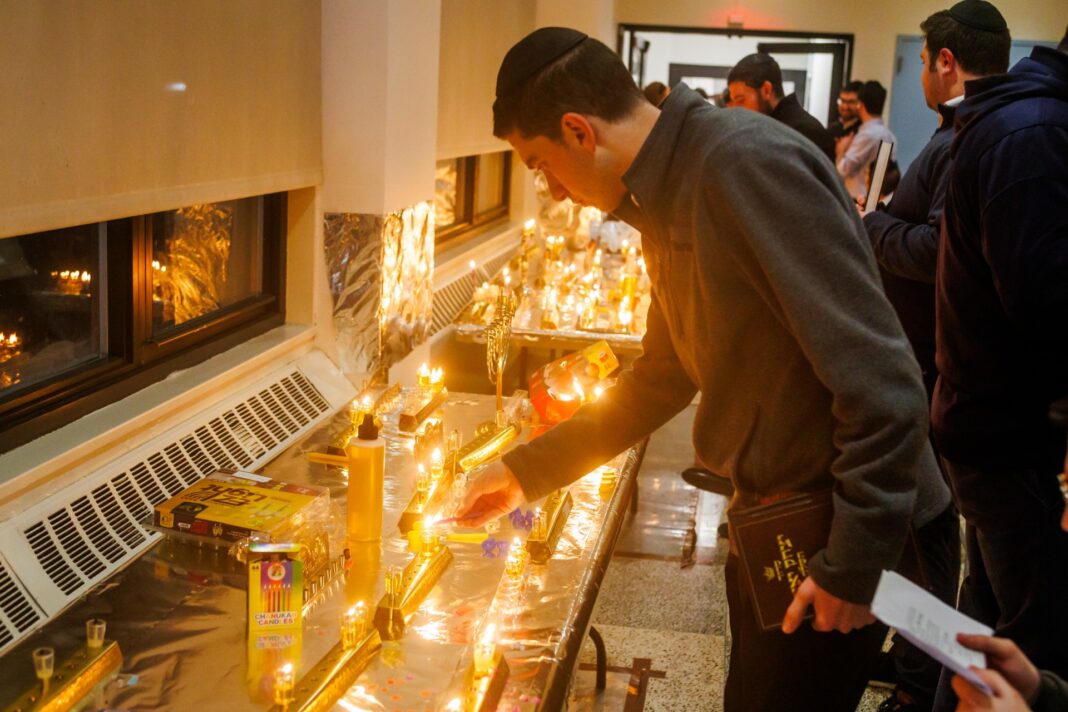
The gathering, held on the second night of Hanukkah, was at once intimate and universal. It fused the private grief of families shattered by terror with the collective anguish of a people confronting a resurgent and emboldened hatred. As candles were lit on a campus menorah, their flames flickering against the winter darkness, the vigil served as a powerful counterpoint to the violence that had sought to extinguish Jewish life and joy at one of the holiest moments of the Jewish calendar.
At the center of the evening stood Yeshiva University President Rabbi Dr. Ari Berman, whose remarks framed the tragedy within a broader moral and historical context. Speaking with gravity and urgency, Rabbi Berman warned that antisemitic violence, while often beginning with Jews, has never confined itself to them alone.
“History has taught us this lesson repeatedly,” he told the assembled crowd. “When hatred is allowed to metastasize unchecked, it does not remain contained. Antisemitism is never an isolated phenomenon—it is a warning signal of a society in moral crisis.”
Rabbi Berman’s words resonated deeply on a campus dedicated to the synthesis of Jewish tradition and modern scholarship. He emphasized that the Bondi Beach massacre was not merely an isolated foreign tragedy, but part of a disturbing global pattern in which Jewish communities are increasingly targeted for visibility, faith, and identity. The president underscored the necessity of vigilance, moral clarity, and communal solidarity—not only within the Jewish world, but among all those committed to pluralism and human dignity.
The vigil unfolded through prayer and song, with Psalms recited for the souls of the victims and for the healing of the wounded. Traditional Hanukkah melodies—normally buoyant with celebration—took on a somber resonance, transformed into hymns of resilience and remembrance. Yet even in grief, the essence of Hanukkah remained unmistakable: the insistence that light must be kindled precisely when darkness appears overwhelming.
For many in attendance, the tragedy was not abstract or distant. It was heartbreakingly personal.
Among the speakers was YU student Rosie Schlanger, whose voice trembled as she addressed the crowd. Her uncle, Rabbi Eli Schlanger—a Chabad rabbi, father of five, and one of the organizers of the Bondi Beach Hanukkah celebration—was among the 15 people murdered in the attack. Standing before her peers, Rosie recounted the moment she learned of her uncle’s death, a moment that collapsed the distance between Sydney and New York into an unbearable immediacy.
“My uncle dedicated his life to bringing Jews together,” she said, her words marked by both sorrow and resolve. “He believed deeply in the power of community, of joy, of public Jewish pride. To know that he was taken while doing exactly that is devastating—but it also compels us to continue his mission.”
Rosie spoke of her uncle not only as a rabbi, but as a man whose warmth, devotion, and quiet strength shaped the lives of countless families. Honoring his legacy, she said, means refusing to retreat into fear. It means continuing to bring light—even, and especially, when the cost feels unbearably high.
Another poignant testimony came from Yeshiva University student Alex Kirievsky, an Australian native whose connection to the victims underscored the intimate scale of the tragedy. Kirievsky shared that one of the youngest victims, 10-year-old Matilda, had once grown up in his family’s home. His parents ran a daycare there, and Matilda was among the children they cared for.
“She wasn’t just a name in the news,” Kirievsky said quietly. “She was a child who laughed in our living room, who learned to read and play under my parents’ watch. To know that her life was taken in such hatred—it’s something I still can’t comprehend.”
His remarks cast a stark light on the indiscriminate cruelty of the attack, which spared neither elders nor children, neither leaders nor innocents. In that moment, the vigil became a bridge between past and present, between the personal and the communal, binding together memories of life with the reality of loss.
Throughout the evening, speakers returned again and again to the symbolism of Hanukkah itself. The holiday commemorates a small group’s refusal to surrender their faith in the face of oppression—a refusal that, against all odds, altered history. In lighting the menorah on campus, Yeshiva University made a deliberate statement: Jewish life would not be hidden, diminished, or extinguished by terror.
“This is not a time to lower our voices or dim our lights,” Rabbi Berman said. “It is a time to stand taller, to be more visible, and to insist that our values endure.”
The vigil concluded not with despair, but with a quiet determination. Students lingered long after the final prayer, embracing one another, sharing reflections, and absorbing the weight of a tragedy that felt both unbearably heavy and galvanizing. In that shared space, grief gave way—if only slightly—to purpose.
As the flames of the menorah burned steadily against the night, they bore silent witness to a truth the attackers sought to deny: that Jewish continuity is sustained not only by memory, but by courage; not only by mourning, but by the unyielding decision to live openly and faithfully.
At Yeshiva University on Monday night, that decision was renewed—one candle, one prayer, and one shared commitment at a time.
When Hanukkah Flames Met Global Mourning: Yeshiva University Stands Defiant as Jewish Light Rises from the Darkness
By: Fern Sidman
Under the soft glow of candlelight and the solemn strains of ancient melodies, Yeshiva University transformed its Washington Heights campus Monday evening into a sanctuary of mourning, reflection, and defiant hope. Students, faculty members, rabbis, and communal leaders gathered for a vigil honoring the victims of Sunday’s brutal antisemitic attack at a Hanukkah celebration on Australia’s Bondi Beach—an act of violence that reverberated across continents and pierced the heart of the global Jewish community.
The gathering, held on the second night of Hanukkah, was at once intimate and universal. It fused the private grief of families shattered by terror with the collective anguish of a people confronting a resurgent and emboldened hatred. As candles were lit on a campus menorah, their flames flickering against the winter darkness, the vigil served as a powerful counterpoint to the violence that had sought to extinguish Jewish life and joy at one of the holiest moments of the Jewish calendar.
At the center of the evening stood Yeshiva University President Rabbi Dr. Ari Berman, whose remarks framed the tragedy within a broader moral and historical context. Speaking with gravity and urgency, Rabbi Berman warned that antisemitic violence, while often beginning with Jews, has never confined itself to them alone.
“History has taught us this lesson repeatedly,” he told the assembled crowd. “When hatred is allowed to metastasize unchecked, it does not remain contained. Antisemitism is never an isolated phenomenon—it is a warning signal of a society in moral crisis.”
Rabbi Berman’s words resonated deeply on a campus dedicated to the synthesis of Jewish tradition and modern scholarship. He emphasized that the Bondi Beach massacre was not merely an isolated foreign tragedy, but part of a disturbing global pattern in which Jewish communities are increasingly targeted for visibility, faith, and identity. The president underscored the necessity of vigilance, moral clarity, and communal solidarity—not only within the Jewish world, but among all those committed to pluralism and human dignity.
The vigil unfolded through prayer and song, with Psalms recited for the souls of the victims and for the healing of the wounded. Traditional Hanukkah melodies—normally buoyant with celebration—took on a somber resonance, transformed into hymns of resilience and remembrance. Yet even in grief, the essence of Hanukkah remained unmistakable: the insistence that light must be kindled precisely when darkness appears overwhelming.
For many in attendance, the tragedy was not abstract or distant. It was heartbreakingly personal.
Among the speakers was YU student Rosie Schlanger, whose voice trembled as she addressed the crowd. Her uncle, Rabbi Eli Schlanger—a Chabad rabbi, father of five, and one of the organizers of the Bondi Beach Hanukkah celebration—was among the 15 people murdered in the attack. Standing before her peers, Rosie recounted the moment she learned of her uncle’s death, a moment that collapsed the distance between Sydney and New York into an unbearable immediacy.
“My uncle dedicated his life to bringing Jews together,” she said, her words marked by both sorrow and resolve. “He believed deeply in the power of community, of joy, of public Jewish pride. To know that he was taken while doing exactly that is devastating—but it also compels us to continue his mission.”
Rosie spoke of her uncle not only as a rabbi, but as a man whose warmth, devotion, and quiet strength shaped the lives of countless families. Honoring his legacy, she said, means refusing to retreat into fear. It means continuing to bring light—even, and especially, when the cost feels unbearably high.
Another poignant testimony came from Yeshiva University student Alex Kirievsky, an Australian native whose connection to the victims underscored the intimate scale of the tragedy. Kirievsky shared that one of the youngest victims, 10-year-old Matilda, had once grown up in his family’s home. His parents ran a daycare there, and Matilda was among the children they cared for.
“She wasn’t just a name in the news,” Kirievsky said quietly. “She was a child who laughed in our living room, who learned to read and play under my parents’ watch. To know that her life was taken in such hatred—it’s something I still can’t comprehend.”
His remarks cast a stark light on the indiscriminate cruelty of the attack, which spared neither elders nor children, neither leaders nor innocents. In that moment, the vigil became a bridge between past and present, between the personal and the communal, binding together memories of life with the reality of loss.
Throughout the evening, speakers returned again and again to the symbolism of Hanukkah itself. The holiday commemorates a small group’s refusal to surrender their faith in the face of oppression—a refusal that, against all odds, altered history. In lighting the menorah on campus, Yeshiva University made a deliberate statement: Jewish life would not be hidden, diminished, or extinguished by terror.
“This is not a time to lower our voices or dim our lights,” Rabbi Berman said. “It is a time to stand taller, to be more visible, and to insist that our values endure.”
The vigil concluded not with despair, but with a quiet determination. Students lingered long after the final prayer, embracing one another, sharing reflections, and absorbing the weight of a tragedy that felt both unbearably heavy and galvanizing. In that shared space, grief gave way—if only slightly—to purpose.
As the flames of the menorah burned steadily against the night, they bore silent witness to a truth the attackers sought to deny: that Jewish continuity is sustained not only by memory, but by courage; not only by mourning, but by the unyielding decision to live openly and faithfully.
At Yeshiva University on Monday night, that decision was renewed—one candle, one prayer, and one shared commitment at a time.