



|
Getting your Trinity Audio player ready...
|
By: Fern Sidman
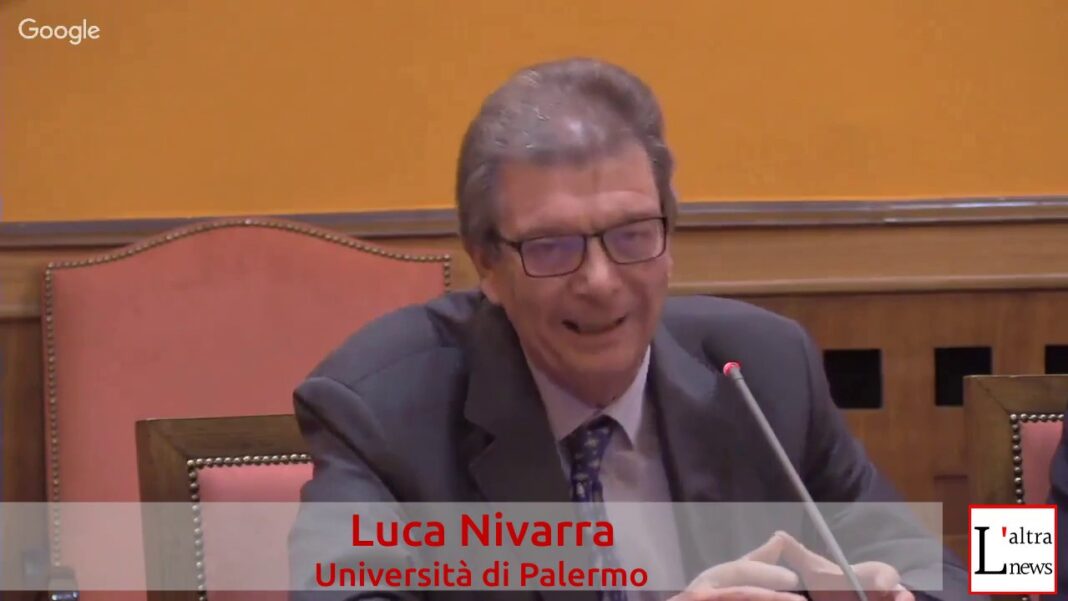
The University of Palermo in Sicily is under mounting scrutiny after one of its law professors, Luca Nivarra, used social media to encourage users to sever ties with Jews on Facebook in what he described as a protest against Israel’s actions in Gaza. The remarks, condemned by Italian officials and Jewish leaders alike, have sparked outrage across Italy’s academic and civic landscape, intensifying broader concerns about the rise of antisemitism in Europe.
According to report that appeared on Thursday on The Jewish News Syndicate (JNS) website, Nivarra’s post instructed readers to “unfriend your Jewish ‘friends’ on Facebook, even the ‘good’ ones,” arguing that even Jews critical of Israel were complicit in “covering up the horror” of what he described as a “Palestinian Holocaust.” His statement added: “It’s a small, tiny thing, but let’s start making them feel alone, face to face with the monstrosity to which they are complicit.”
The university’s rector, Massimo Midiri, issued a public statement distancing the institution from Nivarra’s remarks. Quoted in Il Fatto Quotidiano, Midiri described the professor’s post as “culturally dangerous,” stressing that “on complex issues such as the conflict in the Middle East, the path forward must be one of dialogue and critical discussion, not isolation and what approaches ideological censorship.”
Yet, as the JNS report observed, Midiri refrained from announcing any disciplinary measures against Nivarra, a decision that has fueled frustration among Italy’s Jewish community and beyond. Critics argue that the absence of concrete action sends a troubling signal that academic figures can promote overt antisemitism under the guise of political commentary without consequence.
This was not the first time Professor Nivarra had used social media to direct venom at Israel and its supporters. In previous posts, he declared that “there are no good Israelis” and accused Israeli society of being “morally rotten.” Perhaps most shocking, Nivarra compared the Israel Defense Forces (IDF) to Adolf Eichmann, the Nazi bureaucrat who coordinated the logistics of the Holocaust. In Nivarra’s words, the difference was that Eichmann “claimed to be following orders, whereas the IDF soldiers are happy to do what they do.”
Such comparisons, as noted in the JNS report, represent a particularly insidious form of Holocaust inversion: equating the Jewish state and its defenders with the perpetrators of Nazi atrocities. This rhetorical tactic, widely condemned by Jewish organizations, is considered not only historically perverse but also deeply antisemitic, as it exploits the memory of the Holocaust to vilify Jews collectively.
Italy’s minister of university and research, Anna Maria Bernini, swiftly denounced Nivarra’s post. Writing on X (formerly Twitter), Bernini said his remarks “not only offend the Jewish people but also all those who identify with the values of respect and civil coexistence.”
Her intervention reflects a growing recognition among Italian policymakers that antisemitism, long thought to be a fringe problem in postwar Italy, has re-emerged with alarming intensity in the wake of the Israel–Hamas war. As JNS has repeatedly reported, the conflict in Gaza has been used by extremist groups and their sympathizers across Europe to justify acts of Jew-hatred.
Italy is home to a small but historic Jewish community, numbering roughly 27,000 according to demographic studies by Professor Sergio DellaPergola of the Hebrew University of Jerusalem. Despite its modest size, the community has increasingly found itself at the center of hostility and scapegoating.
The Foundation Contemporary Jewish Documentation Center (CDEC), based in Milan, recently recorded a dramatic spike in antisemitic incidents: 877 in 2024, compared with 454 in 2023. This represents nearly a doubling in the space of a year, a trend that Jewish leaders say is both alarming and unsustainable.
As the JNS report highlighted, these incidents have ranged from vandalism and online hate speech to physical intimidation at pro-Hamas demonstrations. The rise has coincided with a wave of pro-Hamas propaganda, particularly in academic and cultural spaces where antisemitic rhetoric is often masked as “criticism of Israel.”
Last month, Davide Romano, director of the Museum of the Jewish Brigade in Milan, told JNS that antisemitism in Italy has reached “the highest levels I’ve ever witnessed.” He pointed to the “insane” proliferation of pro-Hamas propaganda, which, in his view, has normalized anti-Jewish rhetoric and emboldened those inclined to spread hate.
Romano’s warning provides crucial context for understanding why Nivarra’s comments have caused such an uproar. For Italian Jews already navigating an atmosphere of hostility, seeing a law professor openly urge social isolation of Jews is not simply offensive—it is frightening. It raises fears that antisemitic rhetoric may soon harden into discrimination, harassment, and violence.
The Nivarra controversy has also reignited debate about the responsibilities of academics in a polarized climate. As the JNS report noted, universities are often regarded as incubators of ideas and dialogue, but they can also become breeding grounds for extremist narratives when institutions fail to enforce standards of civility and truth.
Midiri’s refusal to impose disciplinary measures, while couched in the language of academic freedom, has been interpreted by critics as a missed opportunity to draw a firm line between legitimate political debate and outright antisemitism. “Dialogue,” they argue, cannot be built on calls for isolating Jews or denying their place in civic life.
The controversy in Palermo is not isolated. Across Europe, Jewish communities have reported unprecedented spikes in antisemitism since October 2023, with universities frequently at the center of the storm. From London to Paris, campuses have seen pro-Palestinian demonstrations slide into expressions of anti-Jewish hostility, sometimes targeting individual Jewish students.
The reporting at JNS has repeatedly drawn attention to how the Gaza conflict is being used as a pretext for age-old antisemitic tropes. The invocation of terms such as “Palestinian Holocaust,” as used by Nivarra, illustrates how the discourse has shifted beyond criticism of Israeli policies to a wholesale demonization of Jews worldwide.
As of this writing, Nivarra has not retracted his remarks or issued an apology. His silence has only intensified criticism. For many Jewish observers, the lack of remorse underscores how normalized antisemitic discourse has become in certain intellectual circles.
The JNS report emphasized that the incident should serve as a wake-up call not only for Italian universities but for European society at large. If academics are permitted to advance discriminatory rhetoric under the protection of “free speech,” Jewish communities will be left more vulnerable than ever.
The incident at the University of Palermo is more than a scandal involving one professor’s Facebook post. It is a test of Italy’s commitment to democratic values, civil coexistence, and the protection of minorities. While Rector Midiri has condemned Nivarra’s remarks, his decision not to pursue disciplinary action leaves the impression that universities are unwilling to confront antisemitism when it manifests under the banner of political protest.
The fight against antisemitism requires moral clarity and institutional courage. Anything less risks emboldening those who would isolate, vilify, or expel Jews from public life.
For Italy’s Jewish community, already rattled by an unprecedented surge in hostility, the episode is a chilling reminder that antisemitism is no relic of the past but a living threat. And for European democracies at large, the controversy raises an uncomfortable question: if antisemitism can flourish unchallenged in lecture halls and faculty offices, what does that say about the health of civic life beyond the academy?
