



|
Getting your Trinity Audio player ready...
|
By: Fern Sidman
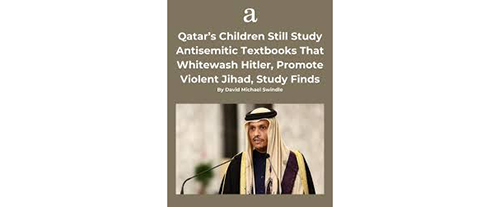
Beneath the polished rhetoric of diplomacy and the carefully curated image of moderation that Qatar projects onto the global stage, a far less edifying reality persists within the pages of its national school curriculum. A new and exhaustive study by the Institute for Monitoring Peace and Cultural Tolerance in School Education (IMPACT-se) has documented that Qatari textbooks approved for the 2025–2026 academic year continue to inculcate students with a worldview steeped in antisemitic tropes, religious intolerance, and the sanctification of violent jihad.
As The Algemeiner reported on Monday of the findings, the dissonance between Qatar’s outward posture as a mediator and patron of dialogue and the content it disseminates to its own children is no longer merely ironic; it is deeply consequential.
IMPACT-se’s review encompassed 52 textbooks across disciplines as varied as social studies, history, geography, Islamic education, Arabic language, and literature, applying standards derived from UNESCO’s guidelines on peace and tolerance in education. The Algemeiner report noted that the organization did not limit its inquiry to isolated passages but undertook a systematic comparison with earlier editions, seeking evidence of reform or recalibration. The conclusion was sobering: the patterns identified in the 2021–2022 curriculum remain largely intact. Antisemitic narratives persist, religious minorities are portrayed through a prism of disdain, and the legitimization of violence in the name of Islam continues to be woven into pedagogical instruction.
The persistence of these narratives matters not only for what they convey about Jews and non-Muslims but for the moral universe they construct for Qatari youth. As The Algemeiner report emphasized, the textbooks repeatedly traffic in stereotypes that depict Jews as duplicitous, materialistic, and inherently antagonistic toward Islam. Jews are portrayed as “spreading discord,” violating agreements, and clinging obsessively to wealth, an assemblage of tropes that echo medieval antisemitic calumnies. Such depictions do more than malign a people; they habituate students to the notion that mistrust and hostility toward Jews are not aberrations but naturalized responses.
In the historical sections addressing the Arab-Israeli conflict, the distortions become geopolitical as well as moral. The Algemeiner report has drawn attention to maps and narratives that deny Jewish historical connections to the Land of Israel, recasting the territory of Mandatory Palestine as a domain carved into “Palestinian territory” and “Israeli expansion.” The effect is to erase Jewish indigeneity while framing Israel’s existence as an act of colonial usurpation. T
he pedagogical implication is that compromise, coexistence, or mutual recognition are illegitimate, as the very premise of Jewish self-determination is rendered fraudulent. In such a framework, the rejection of a two-state solution and the portrayal of Hamas attacks as “military operations” appear less as extremist departures and more as logical corollaries of an education that denies the other side’s humanity and history.
Perhaps most disturbing is the curriculum’s overt valorization of violent jihad and martyrdom. In lessons presented to children as young as sixth grade, the texts extol figures who raised their offspring to “love jihad,” celebrating the deaths of their children as martyrs whose sacrifices secured divine reward. The language of pedagogy sanctifies the idea that a virtuous Muslim upbringing is one that prepares children for violent self-sacrifice.
For older students, Islamic education texts promise entry into Paradise for those who die in the service of Islam, without offering any interpretive nuance or ethical caution against conflating faith with violence. The absence of alternative theological perspectives effectively forecloses the possibility of reconciling religious devotion with peaceful coexistence.
These curricular choices are not accidental or incidental. They reflect an ideological architecture that privileges a particular reading of Islam and Arab nationalism while demonizing those who fall outside its bounds. Non-Muslims are routinely described as infidels, pagans, or polytheists, with scant effort to provide objective or respectful information about other faith traditions. Judaism, in particular, is misrepresented through a catalogue of theological falsehoods, portraying Jews as worshippers of the Golden Calf, venerators of a figure called Uzayr, and devotees of the Talmud over the Torah.
IMPACT-se has argued that these distortions are designed to construct Jews as uniquely arrogant and disloyal to God, traits that are framed as grave moral offenses within an Islamic worldview.
The consequences of such education extend beyond Qatar’s borders, not least because the country’s monarchy, the House of Thani, has pursued an expansive strategy of influence through foreign educational institutions. The Algemeiner has reported on recent judicial proceedings in the United States that compelled Carnegie Mellon University to disclose its extensive financial ties to Qatar, amounting to a relationship reportedly valued at approximately $1 billion.
The case emerged amid allegations that a senior diversity, equity, and inclusion official failed to respond adequately to antisemitism on campus, with Qatari funding implicated in the official’s remuneration. For critics, this episode crystallizes a broader concern: that foreign governments with problematic human rights records are underwriting the very offices tasked with safeguarding civil rights and combating discrimination within American academia.
The Algemeiner report also highlighted findings from the US Department of Education indicating that Qatar is the single largest foreign source of funding for American colleges and universities, with a staggering $6.6 billion in gifts and contracts. This financial largesse raises uncomfortable questions about the permeability of academic independence and the potential for subtle ideological influence.
While universities insist that such funding does not compromise academic freedom, the juxtaposition of Qatar’s domestic curriculum with its global educational patronage invites scrutiny. If a state that systematically inculcates antisemitic and violent narratives at home is simultaneously investing billions in Western educational institutions, the ethical dissonance becomes difficult to ignore.
This tension is not merely abstract. The Algemeiner has chronicled the growing unease among parents, policymakers, and civil rights advocates who fear that the influx of Qatari funds into American academia may complicate efforts to confront antisemitism on campus. Lawfare Project director Ziporah Reich’s warning, quoted by The Algemeiner, that foreign government funding may be “central to understanding how civil rights laws are applied on campus,” underscores the stakes of transparency and accountability.
When universities become financially entangled with regimes whose domestic policies contravene the values of tolerance and pluralism they profess, the risk is not only reputational but normative: the erosion of a moral clarity that is essential to combating prejudice.
Qatar’s defenders often point to its role as a mediator in regional conflicts and its public statements opposing hate as evidence of a progressive orientation. Such gestures ring hollow when set against the unvarnished content of the country’s educational materials. Education is not merely a reflection of societal values; it is one of their primary engines. The narratives embedded in textbooks shape the moral imaginations of future citizens, informing how they interpret difference, conflict, and the legitimacy of violence. To celebrate martyrdom while preaching peace, to demonize Jews while professing tolerance, is to cultivate a generation schooled in contradiction.
The broader implications of IMPACT-se’s findings extend to the international community’s approach to engagement with Qatar. Western governments and institutions have often treated educational reform as a technocratic issue, amenable to incremental change through dialogue and capacity-building. Yet the persistence of antisemitic and violent content across multiple curricular cycles suggests that the problem is not merely one of oversight but of ideological commitment.
Without sustained pressure and clear benchmarks for reform, calls for tolerance risk being absorbed into a public relations narrative that leaves the substance of education untouched.
Moreover, the normalization of such content within Qatar’s curriculum reverberates through the region, reinforcing narratives that legitimize hostility toward Israel and Jews. The portrayal of Hamas attacks as legitimate military operations not only sanitizes terrorism but embeds it within a broader moral logic that frames violence as an acceptable, even laudable, instrument of political struggle. In an era of globalized media and transnational radicalization, the pedagogical valorization of jihad cannot be contained within national borders. It contributes to an ideological ecosystem in which extremism finds fertile ground.
The challenge, then, is not merely to document these curricular deficiencies but to confront the dissonance between Qatar’s self-presentation and its educational practices. The Algemeiner report called attention to the necessity of linking international engagement with tangible demands for reform, particularly in the sphere of education. UNESCO-derived standards, which IMPACT-se employed in its analysis, provide a framework for what peace-oriented education might look like.
The failure of Qatari textbooks to meet these standards is not a technical oversight; it is a substantive deviation from norms that the international community has ostensibly embraced.
Ultimately, the story of Qatar’s textbooks is not just about what is taught in classrooms in Doha. It is about the global circulation of ideas, the responsibilities of states that seek international legitimacy, and the complicity of institutions that accept funding without rigorous scrutiny of its sources. The curriculum of a nation is a mirror of its moral commitments. When that mirror reflects contempt, intolerance, and the glorification of violence, the world cannot avert its gaze without acquiescing itself to the normalization of hatred.
If Qatar aspires to be taken seriously as a broker of peace and a partner in global education, the first and most consequential reform must occur at home, in the pages of the textbooks that shape the next generation’s understanding of the world. Until then, the contradiction between rhetoric and reality will continue to erode the credibility of its diplomatic overtures. The Algemeiner’s reporting on these issues serves as a reminder that peace is not proclaimed in conference halls alone; it is cultivated, or undermined, in classrooms.
