




|
Getting your Trinity Audio player ready...
|
By: Fern Sidman – Jewish Voice News
For more than a decade, foreign governments have poured staggering sums into America’s most prestigious universities. These “gifts,” disclosed—often reluctantly—under federal reporting laws, have come from a constellation of nations spanning the Gulf, East Asia, Europe, and beyond. Yet among this mosaic of contributors, one country towers over all others with a scale and persistence that now demands urgent scrutiny: Qatar.
According to the figures displayed in the accompanying data image, contributions from Doha exceed $3.28 billion since 2012—nearly double those from China, the second-largest foreign benefactor, and more than three times those of Saudi Arabia. While foreign gifts are not inherently problematic, Qatar’s unique ideological agenda, financial penetration, and documented efforts to weaponize influence in Washington make its academic underwriting far more consequential than the raw dollar totals suggest.
Indeed, the Wall Street Journal headline included in the reference image—“The New Lobbying: Qatar Targeted 250 Trump ‘Influencers’ to Change U.S. Policy”—reveals the breadth of Doha’s ambitions: to reshape American politics, public opinion, and elite institutions using soft power financed by its immense natural gas wealth. Nowhere has this strategy been more effective, more enduring, or more overlooked than on U.S. campuses, where Qatar’s money has helped seed a generation of students who have absorbed highly distilled anti-Israel and, increasingly, anti-American narratives.
This is not philanthropy. It is nation-state influence by unconventional means.
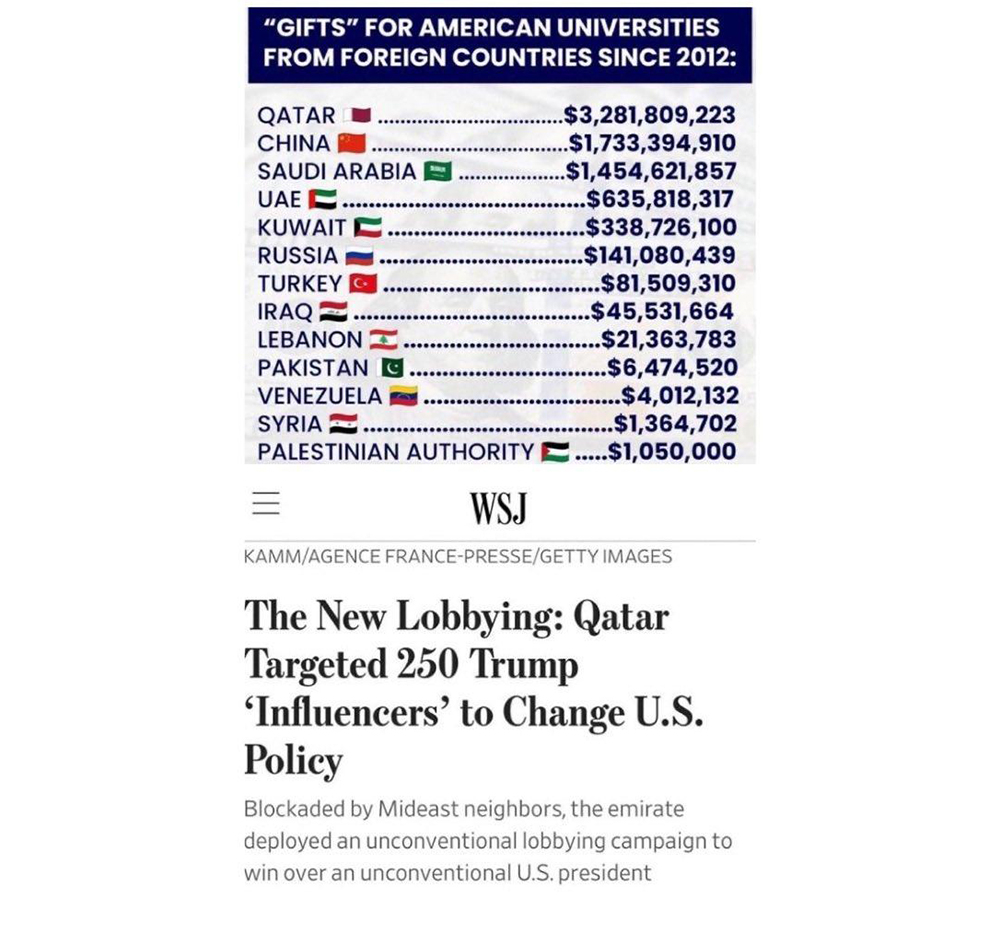
A Billion-Dollar Outlier in a Competitive Market for Influence
Foreign funding to U.S. universities is not inherently abnormal. China has used education as a diplomatic channel for years. Gulf monarchies, flush with petro-capital, have endowed engineering centers, Middle East studies programs, and business schools, seeking prestige, knowledge exchange, and favorable bilateral relationships.
But the scale and nature of Qatar’s academic patronage are qualitatively different.
Top foreign contributors since 2012:
Qatar – $3,281,809,223
China – $1,733,394,910
Saudi Arabia – $1,454,621,857
UAE – $635,818,317
Kuwait – $338,726,100
Russia – $141,080,439
Turkey – $81,509,310
Iraq – $45,531,664
Lebanon – $21,363,783
Pakistan – $6,474,520
Venezuela – $4,012,132
Syria – $1,364,702
Palestinian Authority – $1,050,000
While China’s investments often align with industrial goals and technology acquisition, and Saudi Arabia’s reflect a broad modernization campaign, Qatar’s billions overwhelmingly flow into programs that shape political narratives: Middle Eastern studies departments, Islamic studies centers, humanities programs with ideological focus, and, most significantly, the satellite campuses of top-tier American universities located in Doha’s Education City.
This kind of influence building is slow, strategic, and aimed at worldview transformation—not simply economic partnership.
Unlike other donor governments, Qatar has openly pursued a doctrine aimed at amplifying its ideological preferences abroad, particularly regarding the Israeli–Palestinian conflict and the legitimacy of Islamism as a political movement. Through state-backed institutions such as the Qatar Foundation and Qatar Charity—both notorious for their associations with Islamist networks—Doha channels immense resources into education with one goal: shaping the consciousness of the next generation of American elites.
While Saudi Arabia once exported Wahhabism and Iran spreads Shi’a revolutionary ideology, Qatar exports a far more potent and modernized product: political narratives.
These narratives include Israel as a colonial enterprise, Zionism as oppression, Western power as inherently racist, Islamism as resistance, and America as an imperial aggressor
These narratives then ricochet across U.S. campuses, amplified by student groups, social justice coalitions, activist faculty, and sympathetic administrators who have absorbed the intellectual frameworks that Doha has spent years cultivating.
The result? As seen throughout 2023 and 2024, American universities became epicenters of some of the most virulent anti-Israel and anti-Jewish protests in modern U.S. history. And the nation that has invested more in those same campuses than any other foreign player was—and remains—Qatar.
Education City in Doha hosts branches of Georgetown University, Northwestern University, Virginia Commonwealth University, Cornell’s Weill Medical College, Carnegie Mellon University, Texas A&M University, and University College London.
Each of these universities operates full-scale academic programs in Qatar, funded by contracts that often exceed $300–$500 million per school, according to public disclosures and federal investigations.
In exchange for such extraordinary sums, American universities legitimize Qatar as a progressive, humanitarian partner, despite its record of supporting Hamas, hosting Taliban leaders, and maintaining deeply illiberal internal policies.
They also adopt academic frameworks and personnel that align with Qatar’s ideological worldview, including faculty hired in Doha who later rotate through U.S. campuses.
They normalize political positions hostile to Israel and, increasingly, skeptical of American foreign policy, particularly those involving the Middle East.
Education City is not merely a group of campuses. It is Doha’s soft-power superproject—its intellectual base of operations.
The cumulative effect of Qatar’s investments is now visible across the American educational landscape:
- The Rise of Anti-Israel Radicalism on Campus
Students who blockaded libraries, shouted for “globalizing the intifada,” and chased Jewish students from study halls often cited rhetoric traceable to Middle East Studies programs funded directly or indirectly by Qatari philanthropy.
- The Normalization of Anti-American Sentiment
Qatar’s education model frames the U.S. as morally compromised, structurally racist, and globally destructive—a worldview now deeply embedded in social justice discourse across major universities.
- The Institutional Protection of Extremist Campus Groups
Groups such as Students for Justice in Palestine (SJP) and Jewish Voice for Peace (JVP) frequently rely on faculty mentors or departmental allies linked to Qatar-funded programs.
- The Production of Future Policymakers Indoctrinated in Qatar’s Vision
Georgetown’s School of Foreign Service and Northwestern’s journalism school in Doha graduate hundreds of students yearly—students trained in environments where Qatar sets the ideological perimeter.
The image referenced includes a critical headline from The Wall Street Journal: “The New Lobbying: Qatar Targeted 250 Trump ‘Influencers’ to Change U.S. Policy.”
This investigation revealed that Doha used unconventional lobbying—including outreach to those close to President Trump—to reshape U.S. foreign policy toward Qatar during the diplomatic blockade imposed by Saudi Arabia, Egypt, and the UAE.
That effort involved media personalities, think-tank figures, academic experts, lobbying firms, and social media influencers.
The campaign succeeded. Within two years, the Trump administration shifted its posture from critical to cooperative. If Qatar was willing to target political actors at the highest levels of U.S. governance, its influence campaign within universities—where students’ worldviews are more malleable, and institutional oversight weaker—is even more significant.
While China aims to dominate manufacturing and technology, and Russia seeks geopolitical leverage, Qatar is playing a more subtle game: ideological realignment.
Its vast contributions to U.S. universities allow it to shape curricula, influence faculty hiring, sponsor research that echoes its positions, host academic conferences featuring Islamist thinkers, build networks of intellectuals sympathetic to Doha’s policies, and embed long-term academic partnerships that cannot be easily severed.
Doha’s goal is not merely public relations. It is the construction of a sympathetic intellectual class inside the United States.
Despite billions flowing into academia, federal oversight has been lax.
Many universities failed to properly disclose foreign funding. The Department of Education repeatedly warned institutions about noncompliance. Investigations often found not negligence, but deliberate opacity. Universities accepted Qatar’s money because it was abundant, unconditional on paper, and came with few financial risks. But now the ideological costs are becoming clear.
The overwhelming foreign donor to America’s universities over the past decade was not a democratic ally, not a scientific collaborator, not a cultural partner—but Qatar, a nation that houses Hamas leadership, funds Islamist movements, and invests heavily in shaping global narratives hostile to Israel and skeptical of the United States.
This is not an accident. It is a strategy. American higher education has long prided itself on independence and intellectual rigor. Yet the evidence paints a different picture: one in which universities were quietly transformed into ideological battlegrounds financed by a foreign state with a clear agenda.
The numbers in the image are not just statistics. They are a map of influence. And Qatar’s footprint is by far the deepest. The question now is whether the United States has the courage—and the political will—to confront the consequences.