



|
Getting your Trinity Audio player ready...
|
By: Fern Sidman
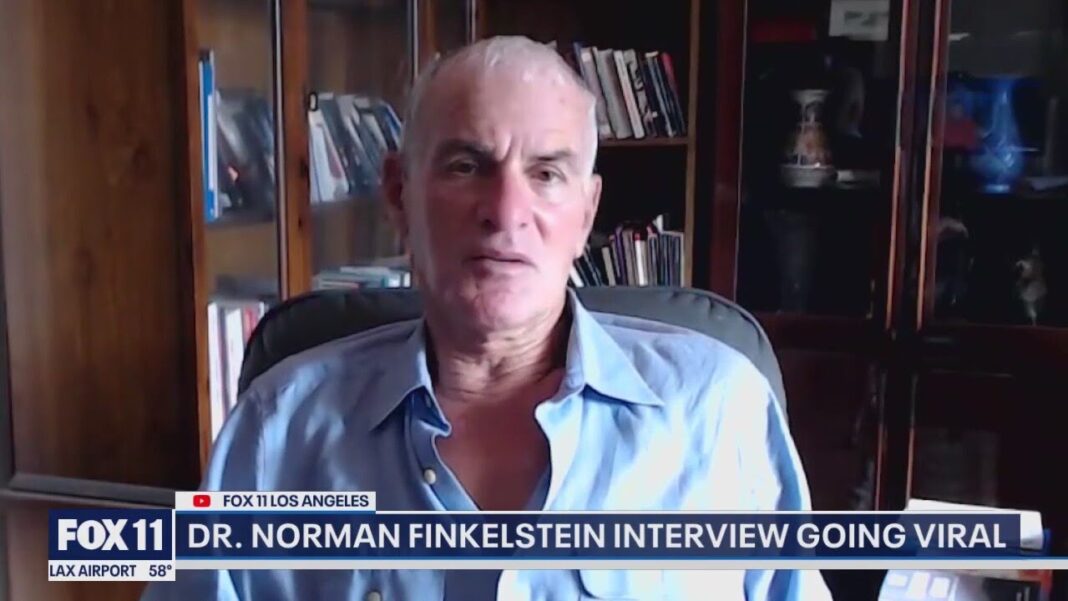
The abrupt cancellation of an annual lecture by Norman Finkelstein at Princeton University might, in another institutional setting, have passed as a minor scheduling adjustment, an administrative inconvenience dressed in polite language. Yet within the charged ecosystem of contemporary campus politics, the decision has acquired a significance far exceeding the procedural explanation offered by the student organizers. As The Algemeiner reported on Friday, Princeton’s Students for Justice in Palestine chapter announced this week that it had canceled Finkelstein’s appearance, citing “unforeseen circumstances involving new university policy.”
The statement, laconic and carefully worded, did not signal a moral or political reconsideration of Finkelstein’s record. Rather, it hinted at a logistical impasse, a bureaucratic misstep that, in the group’s telling, forestalled what has become a ritualized provocation on campus.
The Algemeiner’s coverage situated the cancellation within a long and contentious history of Finkelstein’s presence at Princeton, where he has been a recurring guest of SJP despite a record of incendiary rhetoric that critics argue crosses from polemic into the reproduction of antisemitic tropes. Over the years, Finkelstein, a political scientist born to Jewish Holocaust survivors, has fashioned himself as one of the Western academy’s most strident critics of Israel. His notoriety has not been confined to academic critique; it has been amplified by language that many Jewish students and faculty regard as dehumanizing and historically corrosive. The Algemeiner has documented how Finkelstein’s statements have invoked conspiratorial narratives of Jewish power, recast Holocaust remembrance as cynical exploitation, and employed metaphors that echo medieval blood libels.
The Students for Justice in Palestine chapter at Princeton framed the cancellation as a consequence of new university policy requiring advance notice for events, a claim that Princeton University officials later clarified. Writing to The Algemeiner, a university spokesperson stated that the institution did not disinvite Finkelstein and that SJP remains “welcome” to host him in the future.
The event, according to the university, could not proceed because student organizers failed to register it with the required lead time necessary for logistical planning. This explanation, while administratively plausible, does little to resolve the deeper questions raised by the recurring platform afforded to a speaker whose rhetoric has repeatedly inflamed tensions on campus. The Algemeiner report noted that Princeton’s clarification underscores an institutional posture that privileges procedural neutrality over substantive engagement with the content and consequences of invited speech.
The broader context in which this episode unfolds is one of sustained controversy over antisemitism at Princeton. The Algemeiner has previously reported that SJP chapters across the United States have been implicated in incidents involving the harassment and assault of Jewish students, the stalking of Jewish and Israeli faculty, and the vandalism of university property during unauthorized occupations.
At Princeton, these patterns have intersected with a history of administrative decisions that have applied disciplinary measures unevenly, at times imposing severe sanctions on conservatives and Zionists while tolerating conduct by anti-Zionist activists that many view as hostile or threatening.
Finkelstein’s own record at Princeton has been a recurring flashpoint. According to the information provided in The Algemeiner report and contemporaneous reporting by The Princeton Tory, he has likened Israeli soldiers to “concentration camp guards” in exchanges with students who served in the Israel Defense Forces, an analogy that collapses the moral distinction between a democratic state’s military and the genocidal apparatus of Nazi Germany.
In other campus appearances, Finkelstein has been quoted as saying that it is acceptable to “shoot them dead,” referring to Israelis, and as accusing Israeli Jews of “drinking the blood of those children,” language that unmistakably echoes antisemitic blood libels. The Algemeiner report emphasized that such rhetoric does not merely offend sensibilities; it activates a repertoire of historical demonization that has long underwritten violence against Jews.
The intellectual lineage of these statements can be traced to Finkelstein’s writings from decades earlier. In 2000, he characterized Holocaust remembrance as an “industry” manipulated by a “handful of American Jews” to “blackmail Europe” and divert attention from Palestinian suffering, language that The Algemeiner has described as a recycling of conspiratorial narratives of Jewish influence.
His portrayal of advocates of Holocaust commemoration as a “repellant gang of plutocrats, hoodlums, and hucksters” further illustrates a rhetorical register that collapses critique of Israeli policy into wholesale vilification of Jewish communal institutions. For many Jewish students at Princeton, the annual invitation of such a figure by SJP is experienced not as an exercise in pluralistic debate but as a ritualized affront to their identity and historical memory.
Princeton University’s response to controversies of this kind has been framed by its leadership as a principled defense of academic freedom. The Algemeiner report recalled that in 2023, on the eve of Hamas’s Oct. 7 massacre in southern Israel, Princeton appeared to defend a professor’s assignment of a book accusing the Israel Defense Forces of “maiming” Palestinians and harvesting their organs. The book, ‘The Right to Maim” by Rutgers University professor Jasbir Puar, has been widely denounced as pseudo-scholarship that traffics in antisemitic blood libels.
Princeton President Christopher L. Eisgruber addressed the ensuing backlash at a faculty meeting, asserting that academic freedom protects the right of instructors to assign controversial materials without institutional interference. “We, of course, will not do that,” Eisgruber said of calls to ban or condemn such works, according to remarks cited in The Algemeiner report. His defense of broad pedagogical autonomy, while consistent with liberal academic norms, has been criticized by Jewish advocacy groups as insufficiently attentive to the cumulative impact of such materials on campus climate.
The persistence of these controversies has not been confined to the classroom. One year after the Oct. 7 massacre, students marked the anniversary by vandalizing the Princeton University Investment Company building, splattering red paint on the entrance and graffiting the slogan “$4genocide” along the perimeter. The Algemeiner reported that such acts have contributed to an atmosphere in which Jewish students perceive hostility not merely as rhetorical but as spatially inscribed on campus.
Since March 2025, Princeton has been under federal investigation for failing to address antisemitism adequately, a development that situates the Finkelstein cancellation within a broader regulatory and reputational crisis.
The cancellation of the lecture, then, is less a resolution than a symptom. It exposes the tension between procedural governance and substantive moral accountability. Princeton’s institutional reflex has been to retreat into neutrality, invoking policies of advance notice and academic freedom as shields against the charge that it is tacitly endorsing the rhetoric of invited speakers. Yet neutrality, critics argue, is not morally neutral when it consistently enables the repetition of speech that dehumanizes a particular community.
The question confronting Princeton is not whether it should censor controversial views, but whether it has an obligation to reckon with the cumulative effects of repeatedly legitimizing voices that many on campus experience as threatening.
For SJP, the cancellation appears to be a tactical setback rather than an ideological pivot. The group’s statement to attendees did not disavow Finkelstein’s views or suggest a reassessment of its programming choices. The Algemeiner report noted that the university’s assurance that SJP remains welcome to host Finkelstein in the future reinforces the likelihood that the cancellation is temporary, a pause imposed by bureaucratic requirements rather than by ethical reconsideration. In this sense, the episode illustrates the durability of campus polarizations that procedural hiccups alone cannot resolve.
As Princeton navigates federal scrutiny and internal dissent, the canceled lecture stands as a parable of unresolved tensions. The Algemeiner report reveals an institution caught between its commitment to academic freedom and its obligation to ensure that Jewish students are not subjected to a climate of vilification and intimidation.
The challenge is not merely administrative but moral: to articulate a conception of academic freedom that does not become a license for the reiteration of tropes that history has rendered toxic. Until that reckoning occurs, cancellations and reinstatements will continue to oscillate, and the deeper fault lines exposed by Finkelstein’s repeated invitations will remain unaddressed, an unfinished reckoning inscribed in the rhythms of campus life.
