



|
Getting your Trinity Audio player ready...
|
By: Fern Sidman
A newly published legal study is reigniting debate over the legality of campus campaigns that call for universities and public institutions to sever financial ties with Israel. According to a detailed analysis by two prominent American legal scholars, the growing wave of divestment initiatives targeting Israeli companies and institutions may raise serious concerns under U.S. anti-discrimination statutes and state laws designed to counter economic boycotts against the Jewish state.
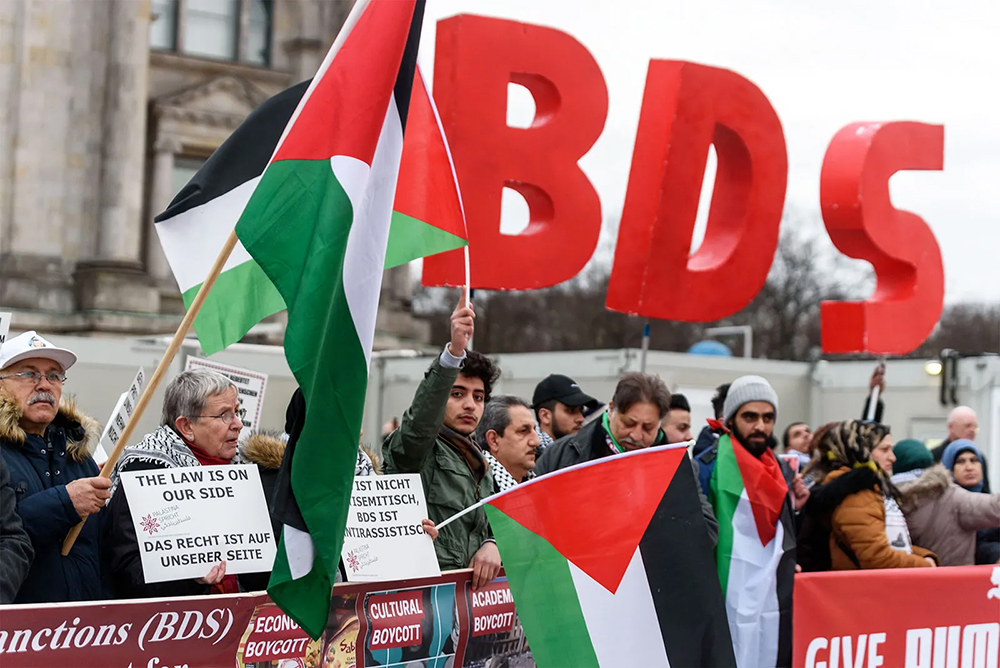
The report, authored by Northwestern University School of Law professor Max M. Schanzenbach and Harvard Law School professor Robert H. Sitkoff, examines the legal implications of the global boycott, divestment, and sanctions movement, commonly known as BDS. As reported on Friday by The Algemeiner, the movement has gained renewed visibility in recent years, particularly on university campuses, where activists have urged academic institutions to divest endowment holdings from companies linked to Israel.
While proponents of the BDS campaign portray it as a form of political advocacy intended to influence Israeli policy, the new legal paper suggests that the implementation of such initiatives by public institutions could expose universities and government bodies to potential legal challenges. According to the authors, policies that single out Israeli businesses or institutions for economic exclusion could conflict with laws that prohibit discrimination based on national origin.
The study arrives at a time when debates over Israel and antisemitism have become increasingly prominent across American campuses. As The Algemeiner has frequently reported, student organizations and activist coalitions have intensified their calls for universities to sever economic relationships with Israeli companies following the Hamas-led massacre of Oct. 7, 2023, which left approximately 1,200 people dead and resulted in the kidnapping of 251 hostages in southern Israel. In the aftermath of that attack and the subsequent war in Gaza, pro-BDS activists have redoubled efforts to pressure academic institutions into adopting divestment policies.
However, the legal analysis by Schanzenbach and Sitkoff contends that the constitutional arguments frequently invoked by BDS supporters may not provide the sweeping protections many assume. Advocates often assert that boycotts of Israel fall under the umbrella of political speech safeguarded by the First Amendment. Yet the authors argue that while individuals may certainly advocate for boycotts as a form of expression, the situation becomes more complicated when government bodies or public universities adopt such policies as institutional practice.
According to the study, official decisions by public institutions to divest from Israeli companies could potentially violate federal civil rights statutes or state procurement laws if those decisions are based primarily on the national origin of the targeted entities rather than on specific corporate conduct. In that scenario, the authors suggest, affected companies or investors might plausibly claim that they have been subjected to discriminatory treatment.
This legal argument centers on the principle that discrimination based on national origin is prohibited under several U.S. statutes governing public institutions and government contracting. If an investment policy explicitly excludes companies because they are Israeli—or because they conduct business with Israel—such a policy could theoretically be interpreted as discriminatory.
As The Algemeiner has noted in its coverage of campus activism, the BDS movement frequently calls for broad economic disengagement from Israeli businesses, academic institutions, and cultural organizations. Critics argue that these sweeping demands blur the line between political advocacy and discrimination against Israeli nationals or institutions.
The legal scholars’ analysis suggests that divestment proposals framed in broad terms—such as excluding companies simply for having ties to Israel—could create significant legal vulnerabilities for universities. In contrast, the authors indicate that policies tied to specific corporate behavior might present fewer legal risks.
Another key aspect of the report involves the comparison between contemporary BDS campaigns and the anti-apartheid divestment movement directed against South Africa during the 1980s. BDS activists frequently cite the anti-apartheid campaign as a precedent for their own strategy, arguing that economic pressure helped dismantle the apartheid system.
However, the authors of the new paper challenge that analogy. According to their analysis, many university divestment initiatives targeting South Africa were carefully tailored to address companies directly involved in enforcing apartheid policies. Those restrictions were often consistent with international sanctions and corporate conduct guidelines.
In contrast, the scholars argue that contemporary BDS campaigns frequently advocate broader economic boycotts based on a company’s connection to Israel itself rather than on particular activities. Such distinctions, they contend, could have important legal implications when evaluated under U.S. anti-discrimination frameworks.
As The Algemeiner has reported, more than half of U.S. states have already enacted legislation aimed at limiting participation in boycotts of Israel. These laws generally require government contractors to certify that they are not engaged in BDS-related boycotts or restrict the allocation of public funds to organizations that participate in such campaigns.
Some states have gone even further by incorporating anti-BDS provisions into procurement policies governing public institutions. In states such as California, public agencies may face limitations on awarding contracts or grants to entities that participate in boycotts targeting Israel.
These legislative efforts reflect growing concern among policymakers that BDS initiatives may cross the line from political protest into discriminatory economic practices. Supporters of anti-BDS legislation argue that singling out Israel—the world’s only Jewish-majority state—raises troubling questions about unequal treatment.
Nevertheless, BDS proponents strongly dispute that characterization. They insist that the movement constitutes a legitimate form of political activism designed to pressure Israel to change its policies toward Palestinians. Advocates often frame their campaign as part of a broader global human rights movement.
The legal debate surrounding these issues has increasingly migrated from the political arena into the courts. Several lawsuits challenging state anti-BDS laws have already been filed in federal courts, with plaintiffs arguing that such measures infringe upon free speech rights.
The outcome of those cases has been mixed. Some courts have ruled that certain anti-BDS provisions violated First Amendment protections, while others have upheld modified versions of the laws that focus specifically on commercial conduct rather than political expression.
The new research paper adds another layer to this already complex legal landscape. By suggesting that institutional divestment policies targeting Israeli companies could themselves violate anti-discrimination laws, the authors introduce a potentially powerful argument for opponents of BDS.
The issue is particularly relevant in the context of American higher education, where student-led divestment campaigns have become increasingly visible. On numerous campuses, activists have organized demonstrations, petitions, and sit-ins demanding that universities withdraw investments from companies associated with Israel or its military.
Despite this activism, most universities have resisted implementing formal divestment policies. Administrators have often cited concerns about academic neutrality, financial stewardship, and institutional governance as reasons for rejecting the proposals.
According to The Algemeiner report, federal lawmakers have also begun considering legislative responses to the issue. In 2024, members of Congress introduced the Protect Economic Freedom Act, a measure designed to discourage universities from participating in BDS initiatives.
Under the proposed legislation, colleges and universities that engage in commercial boycotts of Israel could lose eligibility for federal funding under Title IV of the Higher Education Act, which governs federal student aid programs. The bill would also require institutions to certify that they are not participating in such boycotts as a condition of receiving federal support.
Supporters of the legislation argue that taxpayer-funded institutions should not engage in discriminatory economic practices. Critics, however, contend that the measure could restrict academic institutions’ ability to make independent investment decisions.
The legal analysis by Schanzenbach and Sitkoff does not take a political stance on the BDS movement itself. Instead, the paper focuses on the potential legal consequences that universities and public institutions might face if they adopt divestment policies targeting Israeli companies.
Still, the findings are likely to fuel ongoing debates about the intersection of activism, free speech, and anti-discrimination law. As The Algemeiner report observed, these debates have intensified dramatically in the years since the October 2023 Hamas attacks and the subsequent surge in antisemitic incidents worldwide.
For many Jewish students and community leaders, the question of divestment is not merely an abstract policy dispute but part of a broader struggle over antisemitism and the legitimacy of Israel’s existence. Critics of the BDS movement argue that its ultimate objective—the dismantling of Israel as a Jewish state—reveals an ideological agenda that goes far beyond criticism of specific policies.
Whether courts will ultimately adopt the legal reasoning outlined in the new study remains uncertain. What is clear, however, is that the issue of divestment is likely to remain a central flashpoint in the ongoing struggle over Israel, antisemitism, and free expression in American public life.
As the legal, political, and moral dimensions of the debate continue to unfold, universities, lawmakers, and courts will increasingly find themselves navigating a complex terrain where activism, constitutional rights, and anti-discrimination principles intersect. For now, the new research ensures that the legal implications of campus divestment campaigns will remain a subject of intense scrutiny in the months and years ahead.
