



|
Getting your Trinity Audio player ready...
|
By: Fern Sidman
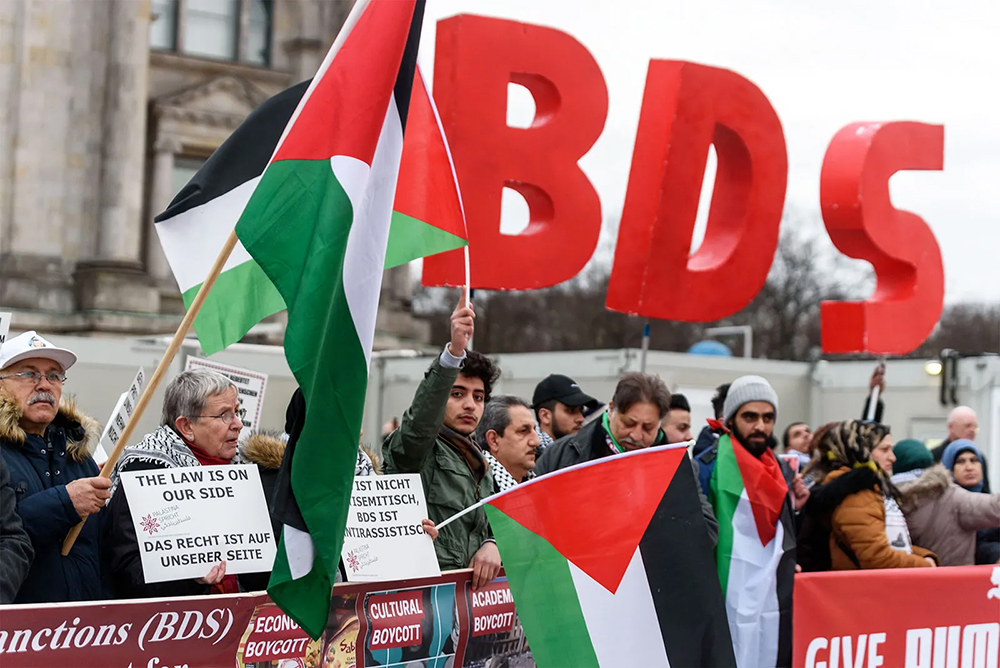
The University of Maryland’s Student Government Association (SGA) set off one of the sharpest controversies in recent campus memory last week, after overwhelmingly passing a boycott, divestment, and sanctions (BDS) resolution that calls on the institution and its foundation to sever ties with companies and entities linked to Israel. The move, reported extensively by The Diamondback (dbknews.com) on Thursday, has not only reignited the campus debate over Israel and Palestine but also drawn sharp criticism for the timing of the vote — which took place on Yom Kippur, the holiest day of the Jewish calendar.
The resolution, which passed by a lopsided 29-0-1 vote, urges the university and the University of Maryland College Park Foundation to pursue BDS-aligned policies targeting companies that provide weapons, surveillance technologies, or infrastructure supporting what the measure calls “Israeli occupation, apartheid, and settler-colonialism.” For proponents, the legislation represents a moral stand and an overdue alignment with global justice movements. For critics, the unanimous tally belies an atmosphere in which Jewish voices were systematically sidelined — not least because the scheduling of the vote ensured that many Jewish students and organizations could not participate.
As The Diamondback (dbknews.com) emphasized in its detailed coverage, the BDS resolution represents the first time in recent years that Maryland’s SGA has adopted a formal divestment measure, after similar resolutions failed in 2017, 2019, and 2024. Its passage, however, was overshadowed by accusations that the scheduling of the vote itself was discriminatory and exclusionary.
The timing of the vote proved to be one of its most incendiary aspects. Yom Kippur — a solemn 25-hour fast day marked by intensive prayer and reflection — is widely recognized as the day when Jewish students are least likely to engage in ordinary university affairs. For many, the SGA’s decision to hold its BDS vote that evening amounted to disenfranchisement.
“Holding a vote that seeks to demonize the Jewish homeland on a day when Jewish students will not be able to participate is exclusionary, biased, and flat-out wrong,” wrote Ari Israel, executive director of Maryland Hillel, in a statement posted on the Campus for All Instagram page ahead of the vote. His remarks, quoted in The Diamondback report crystallized a sentiment echoed by more than a dozen Jewish student organizations.
Those organizations had already released a joint statement on Sept. 18 announcing they would boycott future SGA deliberations on the resolution, after it was originally scheduled for Rosh Hashanah, another major Jewish holiday. For them, the double scheduling — first Rosh Hashanah, then Yom Kippur — amounted to a pattern of disregard.
Jewish Insider, advocacy group Jewish on Campus, and the watchdog account Stop Antisemitism all drew attention to the timing, with Stop Antisemitism even circulating names and photos of key SGA leaders involved in the decision. That social media escalation rattled student government officials.
Dhruvak Mirani, SGA president, told The Diamondback (dbknews.com) he feared for the safety of his colleagues after the online posts. He also admitted that he supported delaying the resolution until after the holidays. “I think the bill should have been tabled until after the Jewish holidays,” he said, though he added that such a delay would not have changed the ultimate result.
Indeed, a motion to table the resolution at Wednesday’s meeting was raised — and failed, with only two legislators supporting it.
The session itself reflected the polarized climate that The Diamondback (dbknews.com) has chronicled in detail. Supporters of the resolution insisted that student government had provided adequate accommodations, pointing to proxy voting and online forms where absent students could register concerns. Resolution sponsor Zyad Khan, a senior representing the College of Computer, Mathematical and Natural Sciences, argued that these measures ensured participation.
“The priority for us was to make sure that there was accommodations, and I believe SGA did provide them,” Khan said, according to the information provided in The Diamondback report.
Yet detractors countered that proxy voting could not replicate the experience of being present, speaking in real time, and lobbying peers. For them, the resolution was not only substantively hostile to Israel but also procedurally tainted.
At the meeting, senior economics and physics major Abel Amene underscored the pro-BDS case with rhetoric that critics viewed as inflammatory. “I know some Zionists and Jewish exceptionalists have claimed that today is not the day to bring this resolution to a vote,” he declared. “But I ask you this simple question, if the genocide is occurring on a Jewish holiday … should we wait until tomorrow or the next day to do the little work we can do in our power to stop that genocide?” His words, reported by The Diamondback (dbknews.com), were met with applause from some attendees but dismay from Jewish observers, who saw them as an attack on their identity.
This was not the first time divestment has surfaced at Maryland. In April 2024, students voted in a campus-wide referendum in favor of divestment, though the referendum was nonbinding. Previous BDS resolutions in SGA — in 2017 and 2019 — failed amid significant lobbying by Jewish organizations and pro-Israel student groups.
As The Diamondback (dbknews.com) has documented, each round has left scars in the student body, particularly among Jewish students who view BDS as a campaign aimed not just at Israeli policies but at delegitimizing the existence of the Jewish state. To many, the passage of the latest resolution represents the culmination of a years-long push that has now overridden Jewish opposition at a moment when their participation was hampered.
University President Darryll Pines has adopted a posture of cautious neutrality. In an interview with The Diamondback (dbknews.com) prior to the vote, he reiterated the university’s support for student dialogue, but only so long as the process was “open and fair and has dialogue from all parties of our broad student body.” After Wednesday’s outcome, the administration did not issue an immediate comment, directing inquiries to the College Park Foundation, which in turn referred reporters back to the university.
For Jewish leaders, such neutrality is insufficient. They argue that the university has a responsibility not only to allow dialogue but also to protect against discriminatory scheduling and to safeguard an environment where Jewish students feel included.
The rhetoric surrounding the resolution has deepened the divide. In social media posts, resolution supporters framed the measure as a moral obligation to oppose “genocide” and “apartheid.” Opponents called those characterizations slanderous and antisemitic.
Particularly controversial was the invocation of Marwan Barghouti and other Palestinian figures by student activists, echoing rhetoric used by Palestinian diplomats at the United Nations. That global connection has reinforced Jewish students’ fears that campus politics are increasingly mirroring international anti-Israel campaigns — with their voices drowned out.
The targeting of SGA leaders on social media has heightened tensions. While the Stop Antisemitism account aimed to highlight alleged insensitivity toward Jewish students, Mirani and other SGA executives said the tactic endangered their safety. The incident has highlighted how debates on Israel and Palestine can rapidly metastasize into personal vilification.
At the same time, Jewish students have voiced their own safety concerns. Some noted that rhetoric equating Zionism with racism, or accusing Israel of genocide, has emboldened hostility on campus. Posters of kidnapped Israelis taken by Hamas on October 7 have been torn down in recent months — part of a broader trend reported by The Diamondback (dbknews.com) in its coverage of rising antisemitism at College Park.
The Maryland vote is not occurring in a vacuum. Across the United States, universities have been engulfed in debates over Israel since Hamas’s October 7 attacks and Israel’s subsequent military campaign in Gaza. As The Diamondback report has emphasized, these debates have placed particular strain on Jewish students, who feel that their identities are being politicized in ways that deny them equal participation in campus life.
At Columbia, Harvard, and other elite institutions, pro-BDS activism has clashed with administrations seeking to preserve donor relationships and prevent antisemitic incidents. The University of Maryland now finds itself squarely in this national spotlight.
Practically speaking, the resolution is not binding. The SGA can only urge the university and its foundation to divest; it cannot compel them. Yet as the report in The Diamondback (dbknews.com) observed, the symbolism of the vote carries significant weight. For pro-BDS activists, it signals that the student government of a major public university has aligned itself with the movement. For Jewish students, it represents a painful exclusion — made worse by the timing that ensured their absence.
The clash is likely to reverberate long after the vote itself. Jewish organizations have vowed to escalate their advocacy, pressing both university leaders and external watchdogs to condemn the process. Pro-BDS activists, meanwhile, are likely to demand that the administration act on the resolution, even if doing so would risk alienating donors and alumni.
The University of Maryland’s SGA may have cast its 29-0-1 vote in the space of a single evening, but the ramifications will be felt for months, if not years. By scheduling the measure on Yom Kippur, the student government created an enduring perception among Jewish students that their voices did not matter.
As The Diamondback report emphasized, the university now faces a test of leadership. President Pines has promised open and fair dialogue, but the question remains whether such dialogue is possible when one side feels systematically excluded.
For Jewish students, the episode represents not only a policy dispute but an existential question about belonging on campus. For pro-BDS activists, it marks a milestone in a long-running campaign.
Caught between them is the University of Maryland itself — an institution that must now decide how to navigate the line between free expression and inclusivity, between student activism and community trust.
What is certain is that the controversy has left the campus more divided than before. On Yom Kippur, the day of atonement, Maryland’s SGA chose confrontation over consensus. Whether the university can heal from that choice remains to be seen.
