



|
Getting your Trinity Audio player ready...
|
By: Fern Sidman
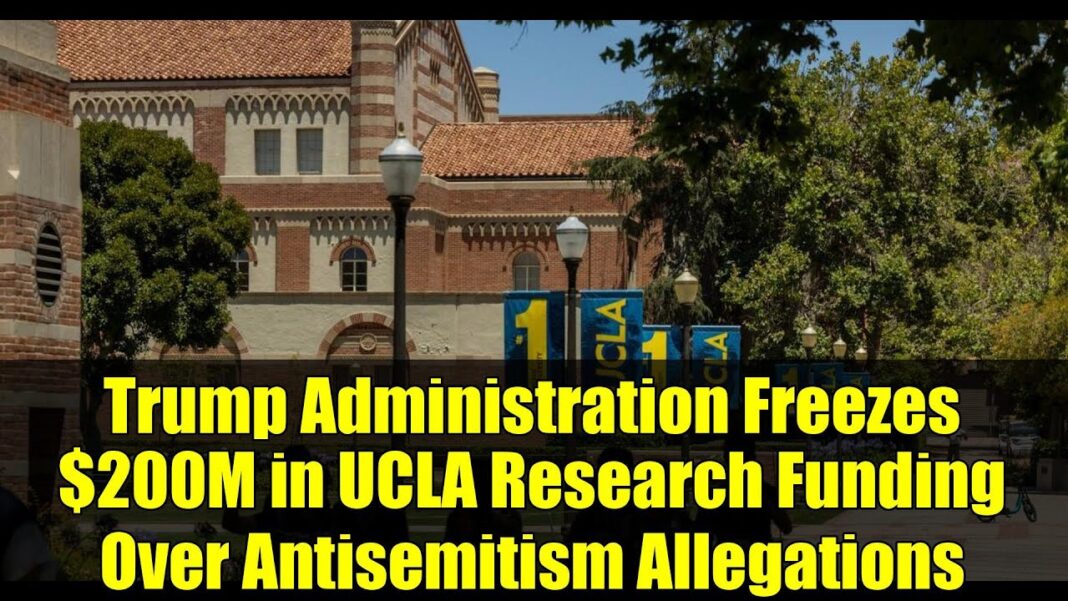
The U.S. Justice Department has moved to suspend significant streams of federal research funding to the University of California, Los Angeles (UCLA), citing findings of systemic antisemitism on the public campus. The unprecedented step, disclosed by UCLA on Thursday, threatens hundreds of research projects funded through the National Science Foundation (NSF) and the National Institutes of Health (NIH), institutions central to American scientific advancement.
According to a report that appeared on Friday at The Jewish News Syndicate (JNS), UCLA Chancellor Julio Frenk confirmed that the federal government’s decision will impact roughly $200 million in grants. The move, which stems from a Justice Department investigation into antisemitic activity on campus, underscores what officials described as UCLA’s “deliberate indifference” to threats against Jewish students during a pro-Palestinian encampment in the spring of 2024.
“This is not only a loss to the researchers who rely on critical grants,” Frenk stated in remarks reported by JNS. “It is a loss for Americans across the nation whose work, health and future depend on the groundbreaking work we do.”
Federal research grants at UCLA fund projects ranging from cancer therapies to environmental sustainability. By suspending support, the Justice Department is effectively halting initiatives the government itself had previously deemed essential for national health, safety, and security. As Frenk emphasized, “Federal research grants are not handouts. Our researchers compete fiercely for these grants, proposing work that the government itself deems vital to the country’s health, safety and economic future.”
The Justice Department’s decision followed a formal investigation into the University of California system, with UCLA singled out for what Attorney General Pamela Bondi described as a failure to safeguard Jewish students. In a statement on July 29, Bondi said: “Our investigation into the University of California system has found concerning evidence of systemic antisemitism at UCLA that demands severe accountability from the institution.”
According to the information provided in the JNS report, the findings pointed to UCLA’s alleged mishandling of a large encampment protest in spring 2024, where Jewish students reported threats, harassment, and a hostile climate. The Justice Department concluded that UCLA violated federal civil rights protections by allowing antisemitic activity to escalate without sufficient intervention.
Bondi emphasized the seriousness of the matter: “The Justice Department will force UCLA to pay a heavy price for putting Jewish Americans at risk and continue our ongoing investigations into other campuses in the UC system.”
Chancellor Frenk, in defending the university’s record, acknowledged that UCLA could “improve” but stressed that the institution has taken “robust actions” to combat antisemitism. Among these efforts, he cited the creation of an Initiative to Combat Antisemitism, designed to foster a safer and more inclusive environment on campus.
“These initiatives are deeply personal to me,” Frenk said, in remarks highlighted by JNS. He traced his own family’s history of fleeing Nazi Germany in the 1930s, noting that his paternal grandparents brought his father and aunt to safety while others perished in the Holocaust. His wife, he added, is the daughter of a Holocaust survivor. “Antisemitism has no place on our campus, nor does any form of discrimination,” he said.
The suspension of federal research grants at UCLA may serve as a broader warning to universities nationwide, particularly those grappling with antisemitism complaints tied to campus protests over the war in Gaza. The JNS report observed that the Justice Department’s action is one of the most aggressive federal responses yet to accusations that universities have failed to protect Jewish students.
With investigations reportedly ongoing at other University of California campuses, including Berkeley, Davis, and Santa Cruz, the UCLA decision could mark the beginning of a wider federal crackdown.
For researchers, faculty, and students at UCLA, the loss of $200 million in federal support jeopardizes not only careers but also medical and technological projects with national implications. Frenk warned that “grants lead to medical breakthroughs, economic advancement, improved national security and global competitiveness,” adding that these are “national priorities” now placed in jeopardy.
As JNS reported, the Justice Department’s move illustrates a growing willingness in Washington to link civil rights enforcement with the funding lifelines that sustain American research universities. It is a development that blends questions of constitutional rights, academic freedom, and scientific innovation into a single, highly charged policy debate.
While UCLA has pledged to strengthen its efforts against antisemitism, the Justice Department has made clear that it expects accountability not just in words but in demonstrable institutional change. With hundreds of millions of dollars and the credibility of a flagship public university at stake, the clash between UCLA and the federal government is poised to have lasting repercussions for higher education across the United States.
