




|
Getting your Trinity Audio player ready...
|
By: Fern Sidman
In a moment of institutional reckoning at Columbia University, acting president Claire Shipman issued a private apology to members of the university community on Wednesday for leaked text messages in which she disparaged a Jewish trustee for her outspoken pro-Israel views. The texts, dating back to 2023 and early 2024, have triggered a political firestorm and renewed scrutiny from federal investigators over the school’s handling of antisemitism on campus.
According to a report on Wednesday at The Jewish Insider, (which first obtained Shipman’s apology email), the embattled university leader admitted her remarks were “wrong” and said they “do not reflect how I feel.” The messages, made public by the House Committee on Education and the Workforce, suggested that Shipman—then serving as co-chair of Columbia’s board of trustees—believed trustee Shoshana Shendelman, a prominent Jewish voice within the university’s leadership, should be removed from her role due to her pro-Israel advocacy.

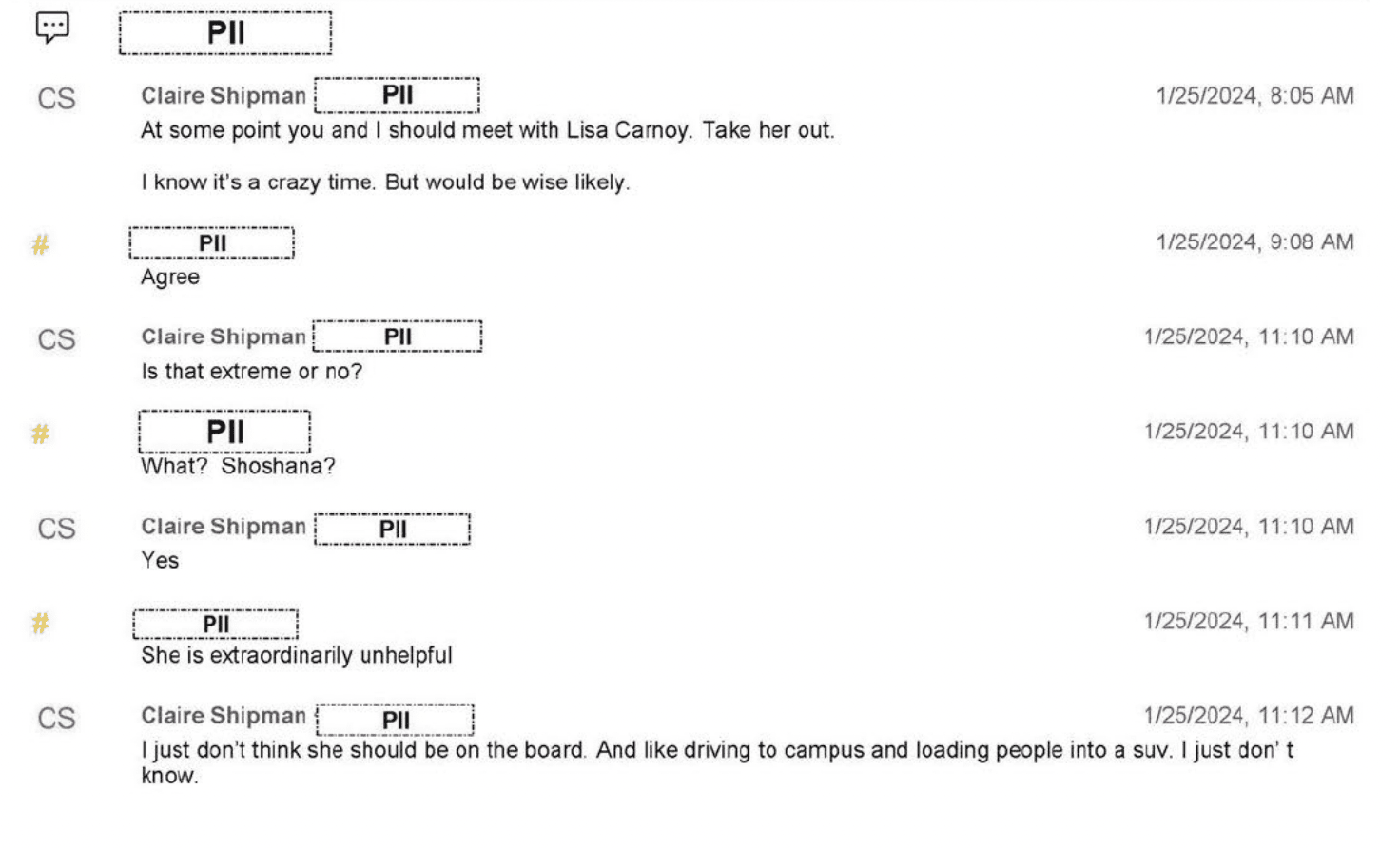
“I have apologized directly to the person named in my texts, and I am apologizing now to you,” Shipman wrote in the email to what she described as “some trusted groups of friends and colleagues, with whom I’ve talked regularly over the last few months.” She continued: “I have tremendous respect and appreciation for that board member, whose voice on behalf of Columbia’s Jewish community is critically important.”
The apology, which The Jewish Insider report described as contrite yet fraught with defensive undertones, is unlikely to quell the broader concerns now engulfing Columbia. The House committee’s letter, released Tuesday by Chairman Tim Walberg (R-MI) and Rep. Elise Stefanik (R-NY), detailed communications that allegedly reveal discriminatory intent and potential violations of Title VI of the Civil Rights Act, which prohibits discrimination on the basis of race, color, or national origin in federally funded programs.
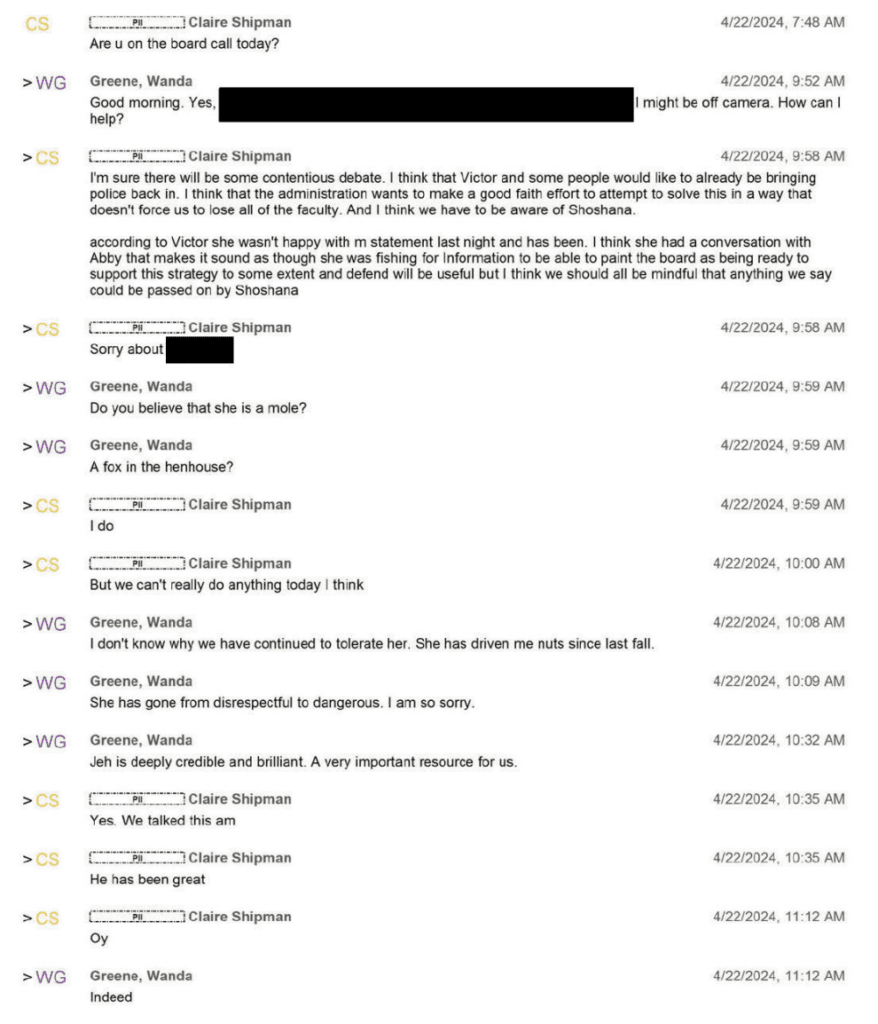
In one particularly controversial message dated January 17, 2024, Shipman wrote to the board’s vice chair, “We need to get somebody from the middle east [sic] or who is Arab on our board,” according to the congressional letter. Just days later, she described Shendelman as “extraordinarily unhelpful” and concluded, “I just don’t think she should be on the board.” In yet another exchange, dated April 22, 2024, Shipman speculated that Shendelman was a “mole,” further inflaming concerns that her judgment was clouded by biases rather than governance priorities.
The Jewish Insider report noted that Shipman’s apology was carefully calibrated. She repeatedly emphasized that the messages were composed “in a moment of immense pressure” and that they stemmed from internal debates during what she called “deeply turbulent times.” Yet she acknowledged, “That doesn’t change the fact that I made a mistake. I promise to do better.”
The fallout from the texts is not limited to personal reputations. As The Jewish Insider reported, the revelations come at a time when Columbia is under intense federal scrutiny. In March, the Trump administration canceled approximately $400 million in grants and contracts with the university, citing concerns over the institution’s alleged tolerance of antisemitic behavior and failure to safeguard Jewish students. Since then, the university has entered into negotiations with federal officials to restore the flow of funding and repair its damaged standing.
In her apology, Shipman emphasized her ongoing commitment to that effort. “One thing I hope salacious headlines will not obscure—my deep commitment to fighting antisemitism and protecting our Jewish students and faculty,” she wrote. “Board members who have worked with me for more than a decade know that antisemitism, and the culture on our campus, was a priority well before October 7th.”
Shipman also included a link to a list of steps the university has pledged to take to combat antisemitism—measures that, according to the report at The Jewish Insider, were hastily unveiled in response to congressional pressure and mounting donor dissatisfaction. Among these are increased funding for security at Jewish campus institutions, expanded bias training, and the establishment of an antisemitism advisory committee.
Nevertheless, critics argue that apologies and policy proposals may be too little, too late. “This is not just about bad judgment in a few text messages,” one former Columbia trustee told The Jewish Insider under condition of anonymity. “It reflects a mindset that sees Jewish advocacy as something to be distrusted or excluded from leadership. That’s a much deeper problem.”
Rep. Stefanik, who has emerged as one of the most vocal advocates for Jewish students on U.S. campuses, echoed that concern in a press statement following the release of the texts. “These messages reveal a culture of exclusion and hostility toward pro-Israel voices, even at the highest levels of university leadership,” she said. “Columbia must be held accountable.”
Shoshana Shendelman, the trustee at the center of the controversy, has not issued a public statement. However, The Jewish Insider reported that several of her allies within the university have expressed dismay at the incident and characterized Shipman’s comments as emblematic of a broader intolerance toward Zionist perspectives on campus.
As Columbia continues to navigate what The Jewish Insider has described as “one of the most consequential governance crises in its recent history,” the questions now facing the university are not only about restoring federal funding or salvaging leadership reputations—but about whether its elite status can withstand mounting allegations of bias and institutional betrayal.
In the meantime, Shipman’s promise to “do better” may provide a temporary salve, but it remains to be seen whether the apology will serve as a turning point—or simply a footnote in a deeper institutional unraveling.

When someone apologizes when their biases are outed – the apology is essentially worthless. It carries as much weight as someone saying ” some of my friends are Black ” when trying to prove they aren’t racist. More and more of the underlying anti-Semitism of members of the board of universities and larger institutions has been uncovered as hate language has been permitted and encouraged.
We are currently reading and watching online hate speech addressed to immigrants, Jews, gays, and transgender individuals. Do Blacks think that they are protected from this hate filled dialogue. Its only a matter of time before we all turn on each other. Our Democracy has been far from perfect but step by step we are losing our rights to feel safe, to due process, to work towards a better future for our families.
There has always been intolerance on many levels – but when leaders and educators espouse that intolerance we are truly in danger.
Universities are doubling down on their war against Israel. Nowhere is safe to send your children. Jews suicidally remain Democrats.