



|
Getting your Trinity Audio player ready...
|
By: Fern Sidman
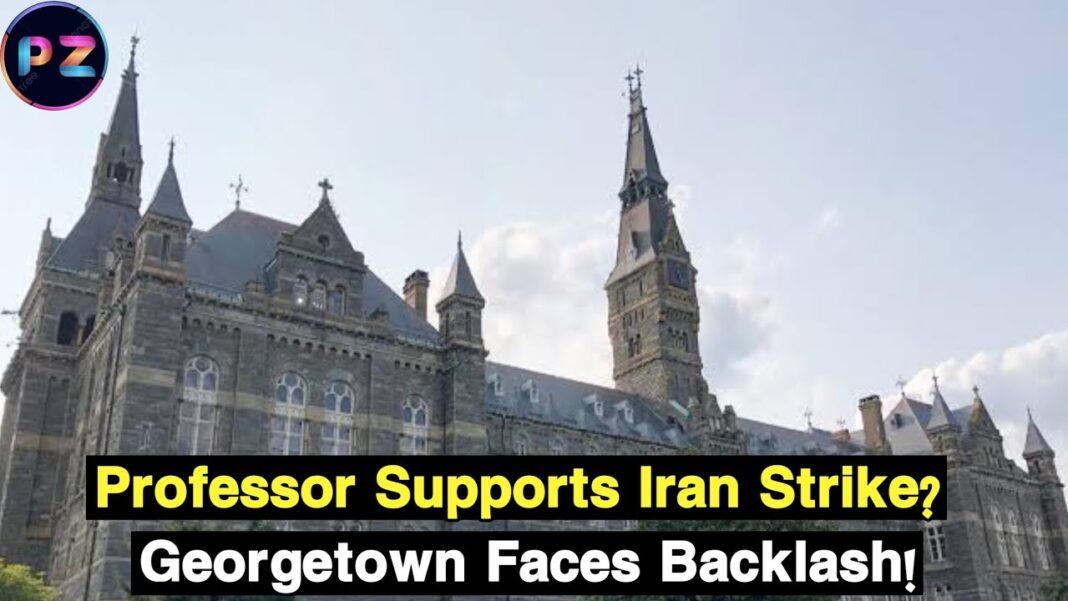
In testimony on Tuesday, before the House Committee on Education and Workforce this week, Georgetown University interim president Robert Groves confirmed that Professor Jonathan Brown, a controversial academic at the institution, has been removed as chair of the university’s Arabic and Islamic Studies Department. As The Jewish News Syndicate (JNS) reported, the move follows Brown’s social media post appearing to encourage Iranian military action against U.S. bases in the Middle East—a statement that drew swift backlash from lawmakers and advocacy groups.
According to the information provided in the JNS report, Groves told lawmakers that Georgetown acted quickly after learning of the post, which came in the wake of U.S. airstrikes on Iranian targets this past June. “Within minutes of our learning of that tweet, the dean contacted Professor Brown. The tweet was removed,” Groves said. He added that Georgetown publicly condemned the statement, removed Brown from his departmental chair position, and placed him on leave pending a formal review.
However, Brown remains employed by the university in his role as the Prince Alwaleed bin Talal Chair of Islamic Civilization within the School of Foreign Service. A Georgetown spokesperson confirmed to JNS that his faculty appointment remains intact.
The since-deleted post had expressed hope that Iran would retaliate symbolically against U.S. military targets, a stance that fueled widespread concern. As the JNS report observed, Brown has a history of courting controversy, not only for his political commentary but also for his academic lectures, including a 2017 presentation in which he argued that slavery, in certain historical contexts, was not inherently immoral.
During the same lecture, Brown—an American convert to Islam—cited the Prophet Muhammad’s ownership of slaves as a defense against applying contemporary moral judgments to historical figures. His statements sparked significant criticism at the time, forcing him to issue a clarification. Adding another layer of scrutiny, JNS highlighted that Brown is the son-in-law of Sami al-Arian, a former professor who pleaded guilty in 2006 to conspiracy charges related to his support for the Palestinian Islamic Jihad, a U.S.-designated terrorist organization.
During the hearing, lawmakers pressed Groves on Georgetown’s broader policies, particularly regarding faculty ties to contentious figures and foreign influence. The JNS report noted that Georgetown’s long-standing relationship with Qatar—home to a satellite campus of the university—drew pointed questions from committee members.
Rep. Mark Harris (R-N.C.) focused his inquiry on the university’s decision to award a humanitarian medal to Sheikha Moza bint Nasser, the mother of Qatar’s emir. Harris referenced a social media post by Sheikha Moza praising Hamas leader Yahya Sinwar in the wake of the Oct. 7 terrorist attacks on Israel. “Why did you give a medal to someone who had made such antisemitic comments?” Harris asked.
Groves acknowledged that the comments made by Sheikha Moza were inconsistent with Georgetown’s values but stated that the award, granted in recognition of her philanthropic work in education, would not be rescinded.
This exchange was part of a broader inquiry by the committee into how American universities handle antisemitism, foreign influence, and controversial faculty actions, according to the information in the JNS report. Tuesday’s hearing marked the ninth session focused on campus antisemitism held by the committee.
The hearing featured testimony from CUNY Chancellor Félix Matos Rodríguez and University of California, Berkeley Chancellor Rich Lyons. While Republicans pressed the witnesses on issues relating to antisemitic incidents, faculty advocacy, and student activism hostile to Israel, Democratic members focused on concerns about prior cuts to the Department of Education’s Office for Civil Rights under the Trump administration.
Rep. Summer Lee (D-Pa.) criticized the hearing as a partisan attack, claiming it was designed to pit Jewish Americans against Muslim Americans and to stifle Palestinian advocacy. “This is yet another hearing to demonize Muslims and their religion… and particularly, the young student activists and faculty who are determined to stand up against human rights violations,” Lee said.
At Berkeley, lawmakers questioned Chancellor Lyons regarding Professor Ussama Makdisi, appointed last fall as the inaugural chair of a newly endowed program in Palestinian Arab studies. The JNS report indicated that Rep. Randy Fine (R-Fla.) challenged Lyons on Makdisi’s description of the Oct. 7 Hamas attack on Israel as “resistance.” Lyons responded that Makdisi was selected by faculty based on academic merit, a statement that drew criticism from committee members, including Chairman Tim Walberg (R-Mich.), who expressed disappointment in the lack of administrative action.
Walberg used his closing remarks to summarize concerns over perceived administrative inaction across multiple universities. “Berkeley admits abhorrence of the views of the professor rewarded with his own program, but won’t do anything about it,” Walberg said, referencing Lyons’s defense of Makdisi. Walberg also criticized Georgetown and CUNY’s handling of their respective antisemitism controversies.
The committee’s concerns extended to transparency over foreign funding, faculty hiring practices, and the universities’ responses to campus incidents of antisemitism and extremist rhetoric, as was reported by JNS. Lawmakers raised questions about whether institutions were adequately protecting Jewish students and addressing rising campus antisemitism in the context of the Israel-Hamas conflict.
Throughout the hearing university leaders maintained that they opposed antisemitism and were committed to ensuring safe and inclusive environments for all students. However, many lawmakers expressed skepticism, suggesting that universities had failed to translate words into meaningful action.
The hearing reflected growing congressional scrutiny of American higher education institutions’ responses to antisemitism and highlighted ongoing concerns about faculty members’ political activism, ties to controversial figures, and the impact of foreign funding on academic integrity, as was observed in the JNS report.
With multiple high-profile incidents involving faculty and administrative decisions at leading universities now under the congressional spotlight, Tuesday’s hearing signaled continued bipartisan interest in examining how universities balance academic freedom with their responsibility to prevent hate and protect students from harassment.
