



|
Getting your Trinity Audio player ready...
|
By A.J. Caschetta, Middle East Forum
Before October 7, 2023, most Americans had never heard of Students for Justice in Palestine (SJP).
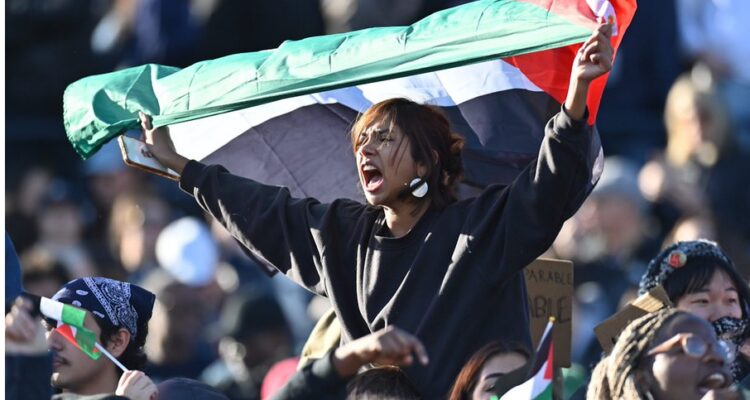
After nearly 2 years of anti-Israel, pro-Hamas protests and encampments, most people are all too familiar with the privileged undergraduates who masquerade in Covid-Hamas garb, chanting “Free, Free Palestine” and calling for an “Intifada in America.”
Now it’s time to meet their teachers, the Faculty for Justice in Palestine.
Campuses with SJP chapters are troubled campuses. Campuses with Faculty for Justice in Palestine (FJP) chapters are even worse off because the professors who operate these quasi-official organizations with impunity will always foment new troubles, spawn new anti-Israel clubs, and wield antisemitism in the name of academic freedom.
They will be even harder to bring under control than their students.
What is FJP?
Hatem Bazian founded the first SJP chapter in 1993 at the University of California, Berkeley, where he is a continuing lecturer at the department of ethnic studies.
Over the years, hundreds of schools formed chapters, and a leadership organization called National Students for Justice in Palestine (NSJP) appeared in 2010.
Faculty for Justice in Palestine, on the other hand, is a new phenomenon, arising only after October 7, 2023. There are currently between 130 and 170 faculty chapters.
Records for individual FJP chapters are often sketchy, making precise founding dates difficult to determine. At some schools, like Rutgers University, faculty are open about their membership and sign their chapters’ letters and statements, but members at most schools prefer anonymity.
At some schools, membership is extended to staff members, thus Faculty and Staff for Justice in Palestine (FSJP). Yale University has both.
Others are even more inclusive. At the University of Minnesota, Twin Cities, there is a Faculty, Librarians, Alumni, Graduate Students, and Staff for Justice in Palestine that uses the quasi-acronym FLAGSJP.
At Duke University, members quibble over the word “faculty,” hence the “Duke Academics and Staff for Justice in Palestine.” The University of San Francisco has “Educators for Justice in Palestine.”
National Leadership
By late 2023, a leadership entity appeared, calling itself National FSJP. As its Spring 2025 “Communiqué” explains, “The National FSJP network of chapters emerged to stand by students as they opposed pro-Israeli policies during a Democrat-led federal government.”
Just as the NSJP controls the messaging and tactics of every campus SJP chapter, so too the anonymous “Steering Committee” of the National FSJP appears to control each of the Network Chapters it lists on its website.
The committee’s first of six “Principles of Unity” asserts that “FSJP supports and amplifies the work of Students for Justice in Palestine and other pro-Palestinian student groups and campus unions.”
As though reciting a loyalty oath, the anti-Israel, groupthink copy-and-paste professorate at each university dutifully repeats the mantra, as per FJP-Yale: “We support and amplify the work of SJP and other pro-Palestinian student groups.”
The only variations in their statements are the “other pro-Palestinian student groups.” Duke University ASJP “amplifies the work of Students for Justice in Palestine (SJP) and other student groups at Duke and in the broader Triangle area.”
The Pratt Institute FSJP “supports SJP and JVP (Jewish Voice for Peace).”
Portland State University FJP “supports SJP and Students United for Palestinian Rights (SUPER).”
At Brown University, one group calls itself the Brown Faculty Coalition for Justice in Palestine and another calls itself the Brown Academics for Justice in Palestine.
SJP’s “Towfan Al-Aqsa Statement” claims that “Resistance comes in all forms – armed struggle, general strikes, and popular demonstrations.
All of it is legitimate, and all of it is necessary,” and NSJP’s “Day of Resistance Toolkit” proclaims that SJP is not merely “in solidarity with this movement” but rather is “PART of this movement.”
