



|
Getting your Trinity Audio player ready...
|
By: Fern Sidman
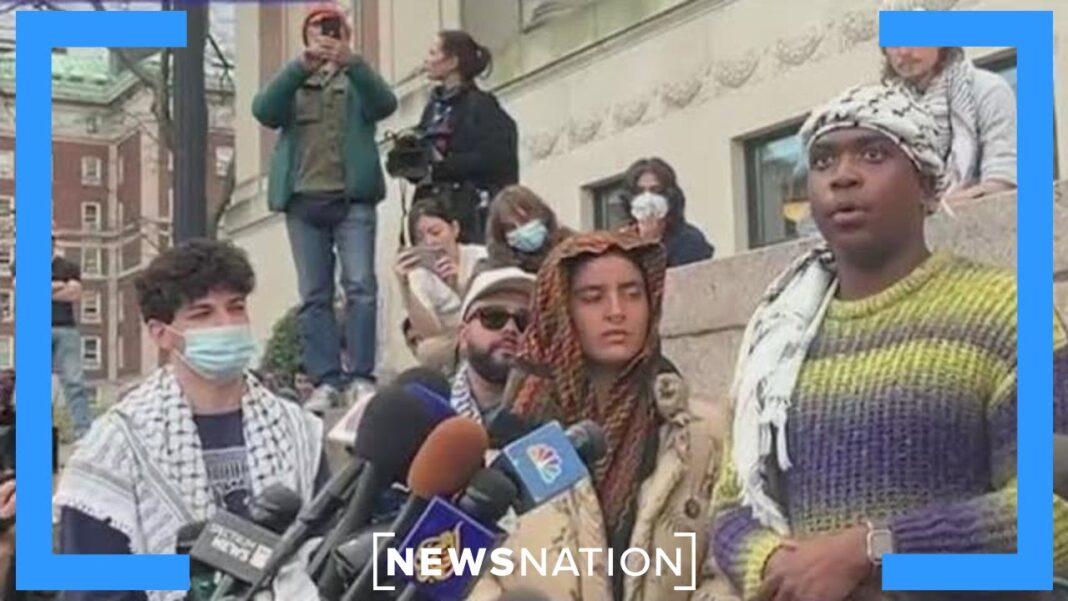
The collision between campus activism and federal oversight has erupted into a new and volatile legal confrontation, as a former Columbia University student who once stood at the forefront of anti-Israel encampments now seeks to recast himself not as a provocateur, but as a victim of political persecution. In a lawsuit filed in Manhattan federal court, Khymani James, 22, has accused North Carolina Congresswoman Virginia Foxx, the Republican chair of the House Committee on Education and the Workforce, of orchestrating what he describes as a punitive campaign that culminated in his removal from the Ivy League institution.
According to a report that appeared on Saturday in The New York Post, James, a Boston native, was suspended by Columbia University in April 2024 for one year after a series of incendiary remarks in which he declared that “Zionists don’t deserve to live,” a phrase that reverberated across social media and cable news and drew swift condemnation from Jewish organizations, civil liberties advocates, and lawmakers.
When the university later declined his attempt to re-enroll, the episode hardened into a broader political spectacle, one that has been chronicled in The New York Post, which framed the saga as emblematic of a campus culture spiraling into open ideological extremism.
At the center of James’s legal argument is the claim that Foxx exceeded her constitutional authority by demanding his ouster and by pressuring Columbia to take punitive action. According to the complaint, Foxx “abused her role and authority as Chairperson and member of the House Committee on Education and the Workforce” in 2024, allegedly weaponizing congressional oversight to interfere directly in the educational trajectory of a single student. The New York Post reported that the suit contends that her public condemnation of Columbia’s handling of the case, coupled with broader committee actions aimed at scrutinizing antisemitism on campus, amounted to an impermissible intrusion upon the First Amendment rights of students and universities alike.
The controversy gained further oxygen in September, when Foxx posted on X that Columbia leadership had told her James had been removed “for his antisemitic rhetoric.” When the student was not formally expelled, Foxx publicly rebuked the university. “He was not expelled. Nothing was done. @Columbia, you have failed again, again, and again,” she wrote. The exchange, reported by The New York Post, transformed what might have remained an internal disciplinary matter into a national political flashpoint, illustrating the fraught interplay between congressional scrutiny and academic autonomy.
In his court filings, James casts Foxx’s actions in apocalyptic historical terms, accusing her committee of reviving the spirit of the McCarthy era House Un-American Activities Committee. He claims that the investigation into antisemitism on college campuses constituted a modern-day inquisition, one that “resulted in suspension and expulsion of students, the termination of professors, and the bludgeoning of universities by funding cut-offs and other sanctions.” The language of the complaint suggests not merely a personal grievance but a sweeping indictment of congressional oversight itself, portraying the committee’s work as an existential threat to free expression within higher education.
Yet the narrative advanced by James is complicated by his own record of statements, which he has neither disavowed nor softened. In 2024, amid the furor surrounding his comments, he posted defiantly on social media, “I will not allow anyone to shame me for my politics. Anything I said, I meant it.” In the same period, he also acknowledged having declared that he “hate[d] white people,” remarks that further entrenched perceptions of ideological extremism.
Despite these admissions, James now insists in his lawsuit that he “is not an antisemite,” arguing instead that Foxx and her committee deliberately conflated anti-Zionism with antisemitism in order to delegitimize dissenting political views.
This semantic battle lies at the heart of the case. James’s argument hinges on the proposition that criticism of Zionism, even when expressed in caustic or inflammatory terms, falls within the protective ambit of the First Amendment. Foxx, by contrast, has framed her intervention as a necessary defense of Jewish students against what she and others view as a climate of escalating hostility on campus.
In a statement responding to the lawsuit, Foxx dismissed the claims as baseless. “This lawsuit’s lack of credibility and factual basis speaks for itself,” she said. “I stand behind the Committee’s antisemitism investigation and won’t be deterred from my fight to protect Jewish students from discrimination on campuses across the nation.”
The clash reflects a broader national reckoning over the boundaries of political speech in academic spaces, a reckoning that has been reported by The New York Post, which has repeatedly framed the Columbia controversy as a cautionary tale about institutional permissiveness toward radical rhetoric. The Post’s coverage has emphasized the visceral impact of James’s remarks on Jewish students and faculty, situating the episode within a wider pattern of campus unrest linked to the war in the Middle East.
From a legal standpoint, James faces formidable obstacles. The doctrine of qualified immunity, the broad leeway afforded to lawmakers in the conduct of their official duties, and the well-established principle that congressional oversight can extend to inquiries into federally funded institutions all complicate his claim that Foxx personally violated his rights. Moreover, Columbia University’s disciplinary authority over its students, particularly in cases involving speech deemed to contravene institutional policies on harassment or discrimination, introduces an additional layer of autonomy that may insulate the congresswoman from direct liability.
The New York Post reported that the court will be asked to parse not only the content of Foxx’s statements but also the causal chain between her public criticism and Columbia’s decision to suspend and later bar James from re-enrollment.
Beyond the courtroom, the episode underscores a deeper anxiety roiling American higher education. Universities have long presented themselves as sanctuaries of free inquiry, yet they are increasingly enmeshed in the partisan battles of a polarized nation. Congressional hearings, social media denunciations, and hard-hitting exposés, including those published by The New York Post, have rendered campus governance a matter of national spectacle. For students like James, whose activism pushes the boundaries of acceptable discourse, the consequences can be swift and severe. For lawmakers like Foxx, the imperative to confront discrimination collides with accusations of overreach and censorship.
As the lawsuit unfolds, it will likely be less a referendum on the character of a single student or the intentions of a single congresswoman than a test of how far the federal government may go in policing the moral climate of America’s universities. The outcome may clarify whether the rhetoric of oversight can be disentangled from the reality of pressure, and whether the First Amendment’s broad shelter extends even to speech that many find morally repugnant.
