



|
Getting your Trinity Audio player ready...
|
By: Fern Sidman
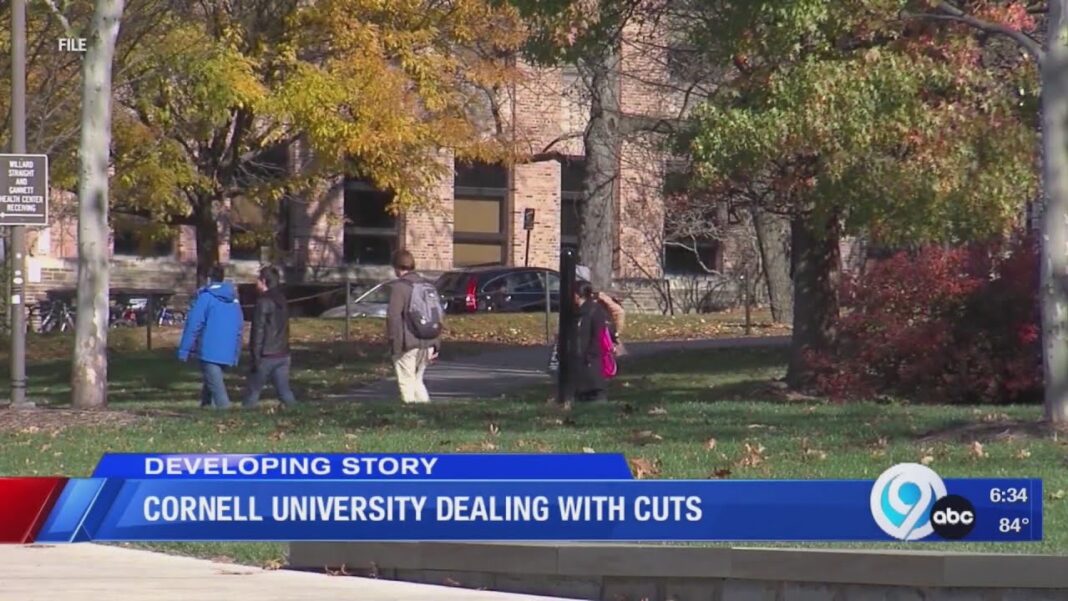
Cornell University, one of the nation’s most prestigious Ivy League institutions, has been thrust into financial and reputational crisis after the Trump administration impounded $1 billion in federal research grants and contracts as punishment for what federal investigators determined was the university’s deliberate indifference to campus antisemitism. The decision has left Cornell scrambling to fill a gaping hole in its budget, prompting sweeping austerity measures and raising urgent questions about whether the academy as a whole can continue to insulate itself from accountability when Jewish students face harassment and intimidation.
As The Algemeiner reported on Monday, the fallout from antisemitism scandals on American campuses is rapidly reshaping the higher education landscape. Cornell’s predicament represents perhaps the starkest example yet of what universities face when years of equivocation collide with an administration willing to enforce federal civil rights law with unprecedented vigor.
In a letter to the campus community, Cornell President Michael Kotlikoff outlined drastic cost-cutting measures to address what he called a “contraction” in government funding.
“Urgent action is necessary, both to reduce costs immediately and to correct our course over time—achieving an institutional structure that enables us to balance our budgets over the long term,” Kotlikoff wrote. He confirmed that the cuts will extend across all Cornell campuses—Ithaca, Cornell AgriTech, Weill Cornell Medicine, and Cornell Tech in New York City.
Among the measures announced:
Indefinite hiring restrictions across the institution, with only rare exceptions.
Immediate budget reductions for the current fiscal year.
The likelihood of deeper restructuring in the coming months to align Cornell’s finances with diminished federal support.
Cornell, meanwhile, has already resorted to borrowing heavily, issuing more than $1 billion in bonds since April, according to Bloomberg, in an attempt to stabilize cash flow. Yet, as The Algemeiner report noted, the university is simultaneously negotiating what is believed to be a $100 million settlement with the federal government—an agreement that could restore access to federal funding but would come at the cost of painful reforms and oversight.
The sanctions stem directly from a string of high-profile antisemitic incidents on Cornell’s campus since the Hamas-led massacre of Oct. 7, 2023. The atrocities in Israel, in which more than 1,200 Jews were murdered and hundreds taken hostage, ignited an unprecedented wave of antisemitism on U.S. campuses, with Cornell frequently cited as one of the most hostile environments.
Three weeks after the Oct. 7 massacre, Cornell student Patrick Dai posted chilling threats online, vowing to murder and rape Jewish students. The threats specifically targeted the campus kosher dining hall, terrifying the Jewish community. Dai was arrested and ultimately sentenced to 21 months in federal prison, but Jewish students reported that the administration’s initial response was sluggish and insufficiently protective.
The atmosphere was further poisoned when Cornell history professor Russell Rickford addressed a pro-Palestinian rally and described Hamas’s barbarity on Oct. 7 as “exhilarating” and “energizing.” His remarks, widely condemned in the media and by Jewish organizations, epitomized a climate in which faculty themselves were perceived as instigators of hostility.
Radical anti-Israel activism surged throughout the academic year. Students for Justice in Palestine (SJP) staged disruptive protests, including the occupation of an administrative building where activists held a “mock trial” of then-President Martha Pollack, convicting her of complicity in “apartheid” and “genocide.”
In September, SJP-affiliated students physically disrupted a career fair, reportedly pushing police officers aside to gain entry. The students were initially suspended but later granted amnesty through “alternate resolutions,” leading critics to accuse the administration of capitulating to agitators rather than enforcing order.
In January, anti-Zionist vandals launched the spring semester by defacing university property with graffiti denouncing Israel as an “occupier” and “apartheid state.” President Kotlikoff condemned the acts, warning that graffiti, violence, and occupations would not be tolerated. Yet by February, administrators admitted they had identified at least one culprit but refused to disclose disciplinary measures, leaving Jewish students disillusioned with what they saw as toothless rhetoric.
The Trump administration’s decision to impound Cornell’s funding was rooted in a finding that the university’s responses to antisemitism were systematically inadequate. The Department of Justice concluded that Cornell had violated Title VI of the Civil Rights Act, which prohibits discrimination based on race, color, or national origin in federally funded programs.
“Cornell University responded to mounting antisemitism on its campus with deliberate indifference, thereby depriving Jewish students of equal access to education,” the DOJ charged. “The Trump administration will not allow universities to ignore antisemitic harassment.”
As The Algemeiner report highlighted, Cornell’s case is now a litmus test: if even an Ivy League school can be stripped of billions in federal support for failing to protect Jewish students, no institution of higher education is immune.
Cornell is not alone in facing scrutiny. Just last week, the Department of Education opened an investigation into Haverford College over alleged civil rights violations stemming from antisemitism.
“Like many other institutions of higher education, Haverford College is alleged to have ignored antisemitic harassment on its campus,” acting civil rights secretary Craig Trainor said. “The Trump administration will not allow Jewish life to be pushed into the shadows because college leaders are too craven to respond appropriately.”
This reflects a broader wave of accountability. Columbia, Harvard, and Brown have already faced penalties, while other institutions brace for similar probes.
Jewish civil rights groups have mobilized to push universities toward systemic change. Earlier this month, the Anti-Defamation League (ADL), Jewish Federations of North America, Hillel International, and the Conference of Presidents of Major American Jewish Organizations issued a joint policy framework demanding universities prioritize combating antisemitism.
The proposals include:
Enhanced policy enforcement and clear communication.
Dedicated administrative oversight of antisemitism complaints.
Accountability for faculty who incite discrimination.
“These recommendations aren’t just suggestions; they’re essential steps universities need to take to ensure Jewish students can learn without fear,” said ADL CEO Jonathan Greenblatt. “Jewish students are being forced to hide who they are, and that’s unacceptable.”
As The Algemeiner report stressed, the failure to act decisively has left Jewish students feeling abandoned, and Jewish life on campus increasingly precarious.
Cornell’s crisis is emblematic of a broader national phenomenon. Since Oct. 7, campuses across the United States have erupted with anti-Israel protests, often veering into overt antisemitism.
At UCLA, protesters chanted “Itbah El Yahud”—“slaughter the Jews” in Arabic.
At Columbia University, Jewish students were physically assaulted and administrators were caught in group chats sharing antisemitic tropes about Jewish privilege.
At Harvard University, a Jewish student was surrounded by a mob shouting “Shame!” after being identified as a Zionist.
At Florida State University, a Jewish student was assaulted at a recreation center after being recognized for wearing Israel Defense Forces apparel.
As The Algemeiner has documented, the scale and ferocity of these incidents are unprecedented in recent American history, making antisemitism the defining civil rights issue now confronting higher education.
Cornell’s financial hemorrhaging illustrates the stakes. The loss of $1 billion in federal funds has not only forced budget cuts and hiring freezes but also compelled the university to borrow heavily, jeopardizing its long-term fiscal stability.
The prospect of a $100 million settlement offers a path to restored funding but would likely entail extensive federal oversight, binding Cornell to reforms that could reshape its governance.
For other elite schools, Cornell serves as a cautionary tale: indifference to antisemitism now carries real and potentially devastating consequences. As The Algemeiner report pointed out, the old paradigm of platitudes without enforcement is collapsing under federal scrutiny.
Cornell University’s sweeping budget cuts and the Trump administration’s unprecedented sanctions mark a turning point in the battle against campus antisemitism. Once insulated by prestige and tradition, even an Ivy League institution is now facing existential consequences for its failure to protect Jewish students.
The question confronting higher education is no longer whether antisemitism will be addressed, but how decisively. Will universities embrace reform, enforcing accountability and safeguarding Jewish life, or will they continue to indulge radical activism at the expense of civil rights?
For Cornell, the stakes are immediate and severe: financial solvency, institutional credibility, and the trust of its Jewish students hang in the balance. For American academia more broadly, the message is unmistakable. In an era of heightened scrutiny, deliberate indifference is no longer an option.

These evil Democrat scum require financial punishment to behave like halfway decent human beings. I would let them stew in their own Nazi juices for at least a year to see if they have managed to clean out their nest of filthy antisemites.