



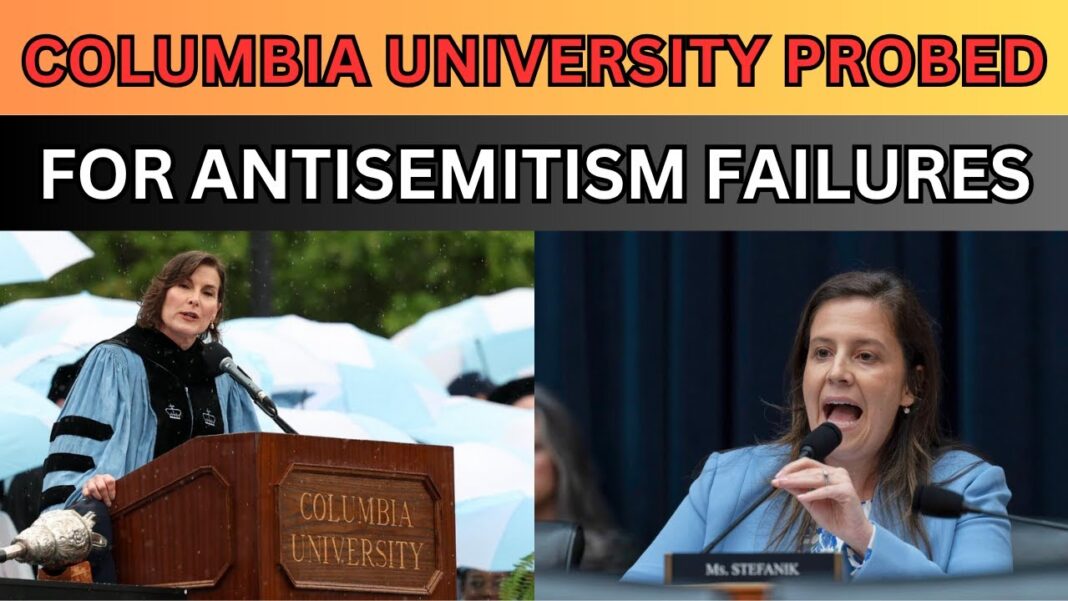
By: Fern Sidman
In a striking escalation of congressional scrutiny into antisemitism on college campuses, House Republican Conference Chairwoman Elise Stefanik (R-NY) and Education and Workforce Committee Chairman Tim Walberg (R-MI) issued a forceful letter Tuesday to Columbia University Acting President Claire Shipman, citing a “shocking” disregard for Jewish students’ safety and suggesting that the university may be in violation of federal civil rights law.
The letter, reviewed in full by this reporter, is part of an ongoing investigation by the House Education and Workforce Committee into a “pervasive culture of antisemitic harassment” on Columbia’s Ivy League campus. The correspondence calls into question a series of internal communications—emails and text messages—authored by Shipman, which Republican lawmakers argue reflect a dismissive and even contemptuous attitude toward Jewish concerns and toward congressional oversight efforts.
As emphasized in the letter, Columbia University is currently under three separate federal investigations by the Department of Education’s Office for Civil Rights (OCR) for its alleged failure to respond to antisemitic discrimination. In May, a joint determination by the Department of Health and Human Services and the Department of Education found that the university “acted with deliberate indifference” toward reports of harassment faced by Jewish students.
“The Committee is continuing to investigate antisemitism at Columbia University, including whether there was or is a hostile environment against Jewish students on Columbia’s campus,” Stefanik and Walberg wrote. “We are deeply concerned that Columbia’s leadership, including Acting President Shipman, may not understand or be willing to fulfill the university’s obligations under Title VI of the Civil Rights Act.”
Title VI prohibits discrimination on the basis of race, color, or national origin in any program or activity receiving federal financial assistance. With Jewish identity recognized under Title VI protections, lawmakers argue that Columbia’s inaction may have crossed a legal threshold.
The Committee’s letter cites a series of internal communications that it says exemplify institutional apathy, bias, and poor judgment at the university’s highest levels. One of the most incendiary excerpts comes from an October 30, 2023 message, in which Shipman wrote:
“People are really frustrated and scared about antisemitism on our campus and they feel somehow betrayed by it. Which is not necessarily a rational feeling but it’s deep and it is quite threatening.”
For Stefanik and Walberg, the phrasing—particularly the use of “not necessarily a rational feeling”—reveals a troubling minimization of real and growing fears among Jewish students in the aftermath of Hamas’s October 7 massacre in Israel, widely viewed as the deadliest attack on Jews since the Holocaust.
Another message, dated January 17, 2024, raises legal red flags. Shipman suggested that Columbia’s board should appoint someone “from the Middle East or who is Arab” in response to campus tensions. The lawmakers argue that such identity-based appointments could amount to a violation of Title VI if executed on the basis of national origin.
“This statement raises troubling questions regarding Columbia’s priorities,” the letter states, “particularly in the immediate aftermath of a terrorist massacre that claimed more than 1,200 Jewish lives.”
Perhaps most startling to lawmakers was a December 28, 2023 email in which Shipman referred to congressional scrutiny as “capital hill [sic] nonsense,” a phrase the Committee viewed as dismissive of Congress’s constitutional oversight responsibilities.
“Congress’s efforts to ensure the safety and security of Jewish students—who make up almost a quarter of your campus population—is not ‘nonsense,’” Stefanik and Walberg wrote.
The letter also accuses Shipman of harboring open animus toward Dr. Shoshana Shendelman, a Jewish trustee and one of Columbia’s most vocal internal critics regarding the administration’s handling of antisemitism.
In an April 2024 exchange with Wanda Greene, vice-chair of Columbia’s board, Shipman agreed with characterizing Shendelman as a “fox in the henhouse,” and expressed fatigue with her presence. “So, so tired,” Shipman replied.
The lawmakers argued that such messages suggest not only a lack of collegiality but a coordinated effort to silence dissent—particularly from Jewish advocates within the university’s own governance.
The letter marks a new phase of legislative scrutiny that could lead to potential changes in federal law governing university accountability. In its closing paragraphs, the letter signals that lawmakers are exploring legislation to increase institutional liability and potentially sanction federal funding to universities that fail to protect students from antisemitic abuse.
“The information gathered will also aid the Committee in considering whether potential legislative changes, including legislation to specifically address antisemitic discrimination, are needed,” the letter concludes.
Shipman, who assumed her role in March following the resignation of former President Minouche Shafik, has not yet publicly responded to the latest congressional inquiry. A Columbia spokesperson previously defended the acting president, stating that her remarks had been taken “out of context,” and that the university is “deeply committed to combating antisemitism.”
Yet, as The New York Post and other outlets have noted, Columbia has quickly become a national flashpoint in the broader battle over campus free speech, extremism, and the safety of Jewish students. From hostile encampments and building takeovers to masked demonstrators shouting antisemitic slogans, the university has seen a sustained eruption of unrest that many believe its administration failed to anticipate or contain.
While the political optics of this standoff are undeniable—Stefanik in particular has carved out a leading role as the GOP’s voice on campus antisemitism—the underlying legal questions may have deeper implications. Should Columbia be found in violation of Title VI, it risks not only reputational harm but the loss of millions in federal research and education grants.
Stefanik, who first gained national attention grilling Ivy League presidents over their failure to condemn antisemitic violence, has made clear that Columbia is only the beginning. “It is critical that our institutions of higher education have leaders who firmly understand and carry out their obligation to protect Jewish students,” she said.
With additional subpoenas and hearings expected in the fall, the battle over antisemitism on campus—and what accountability should look like—appears far from over.

Diaspora Affairs Ministry recommends barring five NGOs, 50 individuals from entry to Israel | JNS.org
https://www.jns.org/diaspora-affairs-ministry-recommends-barring-five-ngos-50-individuals-from-entry-to-israel/
Steve Witkoff and his terrorist partner Bishara Bahbah, was apparently a favorite at radical anti-Israel terrorist supporter Haaretz. Witkoff is poisoning the Trump administration with terrorists.
https://www.jcap.ngo/_files/ugd/7b9d8f_e1fa61a6648d438eaee069ec8ec04ff2.pdf
“You cannot be serious”