



|
Getting your Trinity Audio player ready...
|
Agreement Paves Way for Research Funding Restoration
By: Fern Sidman
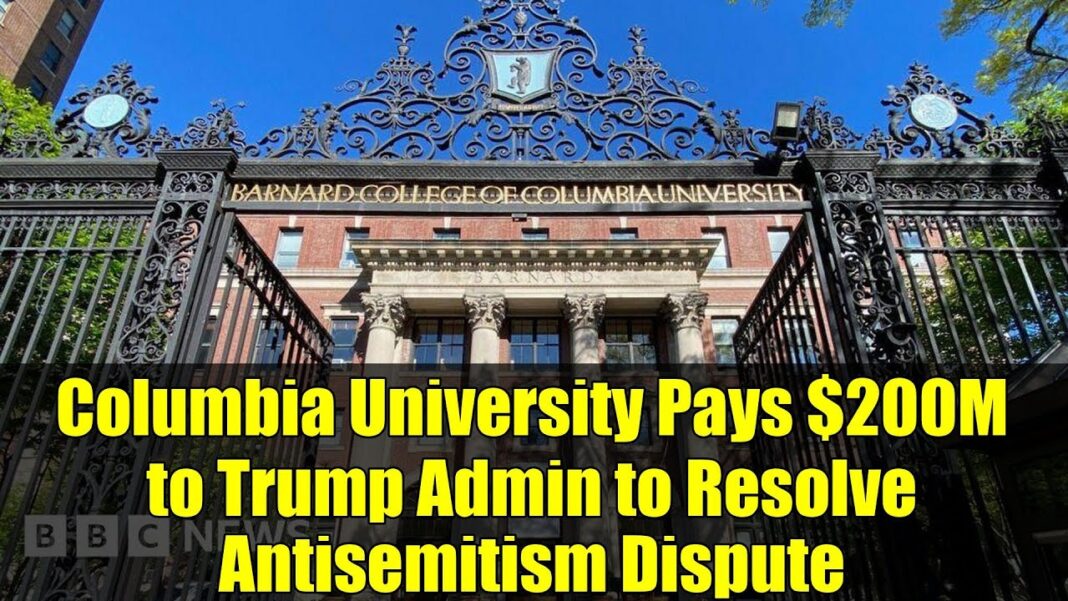
In an unprecedented and sweeping agreement with the Trump administration, Columbia University has agreed to pay $200 million to settle multiple civil rights investigations related to its handling of antisemitism on campus, according to a detailed report released by the university on Wednesday. As The New York Times reported, this landmark deal marks the first negotiated resolution between a university and the administration over claims of antisemitic harassment and signals a seismic shift in how elite institutions will be held accountable for campus climate and federal funding oversight.
The agreement, finalized between Columbia and several federal agencies—including the Departments of Justice and Education—clears the way for the restoration of hundreds of millions in research grants that had been frozen or revoked earlier this year. As The New York Times report indicated, the university will also pay $21 million to resolve parallel investigations initiated by the U.S. Equal Employment Opportunity Commission.
Columbia’s acting president, Claire Shipman, acknowledged the gravity of the deal in a formal statement, describing it as “an important step forward after a period of sustained federal scrutiny and institutional uncertainty.” Shipman added, “The settlement was carefully crafted to protect the values that define us and allow our essential research partnership with the federal government to get back on track.”
The terms of the settlement are expansive. Columbia has committed not only to the payment of financial penalties but also to a series of institutional reforms and ongoing monitoring. An independent monitor, approved by both the university and federal authorities, will issue biannual reports to track Columbia’s adherence to the agreement’s stipulations over a three-year period.
Crucially, the agreement reaffirms Columbia’s obligation to adhere to federal anti-discrimination laws and prohibits the use of race in admissions or hiring decisions—an element that aligns with broader policy shifts sought by the Trump administration. These reforms stem in part from a list of nine demands issued by a federal antisemitism task force shortly after funding was frozen in March, as The New York Times previously revealed.
According to the information provided in The New York Times report, the deal also affirms that Columbia will preserve its academic independence, explicitly stating that none of its provisions allow the federal government to dictate faculty hiring, admissions decisions, or academic content. This clause was reportedly a key negotiating point for the university, concerned about the precedent of government interference in academic governance.
The backdrop to this agreement was one of extraordinary federal action. On March 7, the Trump administration froze or canceled $400 million in research grants and contracts awarded to Columbia, citing the university’s alleged failure to protect Jewish students from antisemitic harassment amid months of campus unrest. According to the information contained in The New York Times report, this move made Columbia the first institution of higher learning in the country to face such a direct financial consequence from the federal government on the grounds of antisemitism.
But as the weeks unfolded, the full scope of financial impact became even more acute. The National Institutes of Health (NIH), the principal U.S. agency for biomedical and public health research, escalated the freeze to include nearly all active grants to Columbia. A research consortium known as Grant Watch, cited by The New York Times, estimated that as much as $1.2 billion in unspent NIH funding was affected.
Additional grant suspensions were later confirmed by other federal entities, including the National Science Foundation and the Department of Health and Human Services, raising the total at risk to an estimated $1.3 billion. The result, as described by Columbia officials to The New York Times, was a near collapse of its research enterprise—one that threatened decades of scientific advancement and thousands of faculty and graduate student positions.
“This agreement was the only viable path to preserve Columbia’s research leadership,” one senior administrator told The New York Times. “The entire infrastructure of our scientific departments was at a tipping point.”
The settlement includes multiple operational and policy commitments that Columbia had already begun to implement following the initial wave of federal scrutiny in March. These include the appointment of a senior vice provost tasked with oversight of the Middle Eastern studies department and other divisions where complaints of academic bias had proliferated.
The university has also pledged to maintain newly imposed restrictions on protests and to retain a newly expanded public safety force. As part of the agreement, Columbia will continue to employ three dozen public safety officers with full arrest powers, a measure designed to address growing concerns about campus unrest and physical safety.
Among the most significant institutional changes is the formalization of a campus-wide antisemitism response framework, which includes mandatory training, reporting protocols, and the establishment of an ombudsman’s office. These measures were cited as critical to satisfying the Trump administration’s expectations for resolution.
Columbia’s settlement is widely viewed by analysts and academic observers, including those interviewed by The New York Times, as a prototype for future federal enforcement actions at other elite institutions. Harvard University, which has sued the administration in federal court to challenge the legality of its funding freeze, is reportedly in advanced negotiations with the government to reach a similar accord.
Education Secretary Linda McMahon praised the agreement in a statement obtained by The New York Times, declaring it “a seismic shift in our nation’s fight to hold institutions that accept American taxpayer dollars accountable for antisemitic discrimination and harassment.” She described Columbia’s reforms as “a roadmap for elite universities that wish to regain the confidence of the American public by renewing their commitment to truth-seeking, merit, and civil debate.”
Critics of the administration’s strategy have argued that the use of research funding as leverage to enforce speech-related conduct standards treads dangerously close to infringing on academic freedom. However, Columbia was facing growing internal and external pressure to demonstrate that it could ensure both the physical safety and intellectual freedom of all students, particularly those from Jewish backgrounds who had reported increasing levels of harassment and isolation.
Additionally, Columbia will no longer maintain programs that promote what federal officials deem “unlawful efforts” related to diversity, equity, and inclusion. The university will also abide by recent court rulings that prohibit the use of affirmative action in admissions, and it has pledged to provide an independent monitor with internal admissions data to affirm its compliance.
The monitor, already selected and approved by both Columbia and the federal government, is Bart M. Schwartz, a prominent figure in legal and crisis management circles. Schwartz, co-founder and chairman of Guidepost Solutions and former chief of the criminal division at the U.S. Attorney’s Office for the Southern District of New York, will be responsible for biannual reports to federal agencies over the three-year life of the agreement. As The New York Times report noted, his oversight will include scrutiny of Columbia’s Middle Eastern Studies department and its admissions protocols.
As detailed in The New York Times report, Claire Shipman, the university’s acting president and a former broadcast journalist, led a months-long negotiation process to craft a resolution that preserved Columbia’s academic autonomy while satisfying the administration’s increasingly pointed demands.
Shipman assumed the presidency in March after serving as co-chair of the board of trustees. In an interview with The New York Times, she described the negotiations as intense and delicate, involving a small team of legal counsel, senior administrators, and trustees. “Ultimately, we had to make the decision that was the right decision for Columbia,” she said. “And I think we have made that decision. We weren’t reckless. In my view, it was important to slow things down and be extraordinarily deliberate, and that was actually quite hard to do.”
In addition to the restrictions on diversity and admissions practices, the agreement imposes new obligations related to international students and foreign funding disclosures. While universities already inform the Department of Homeland Security when international students are suspended or expelled, Columbia will now also be required to notify the department when such students are arrested—a change that reflects the Trump administration’s heightened focus on national security.
Columbia has further pledged full compliance with laws requiring transparency about foreign gifts and funding—an area of longstanding concern to federal investigators. These measures, The New York Times report emphasized, are intended to bring the university into alignment with broader executive orders and legal interpretations advanced by the administration.
As news of the agreement broke, reactions among Columbia faculty and affiliates were sharply divided. Michael Thaddeus, a mathematics professor and acting president of the Columbia chapter of the American Association of University Professors, told The New York Times that he feared the deal “opens the door” to political interference in academic matters. Specifically, Thaddeus raised concerns about the monitor’s power to scrutinize sensitive areas such as admissions policy and academic departments dealing with contentious geopolitical issues.
By contrast, Jewish organizations on campus broadly welcomed the agreement. Brian Cohen, executive director of Columbia’s Hillel, issued a statement praising the settlement as a long-overdue acknowledgment of Jewish students’ concerns. “This announcement is an important recognition of what Jewish students and their families have expressed with increasing urgency,” Cohen said in comments reported by The New York Times. “Antisemitism at Columbia is real, and it has had a tangible impact on Jewish students’ sense of safety and belonging and, in turn, their civil rights.”
Cohen expressed hope that the settlement would mark “the beginning of real, sustained change.”
President Donald Trump personally weighed in on the agreement Wednesday evening on his Truth Social account. “I am pleased to announce that the Trump Administration has reached a historic agreement with Columbia University,” he wrote. “Columbia has agreed to pay a penalty of $200 Million Dollars to the United States Government for violating Federal Law, in addition to over $20 Million to their Jewish employees who were unlawfully targeted and harassed.”
As The New York Times has reported, the Trump administration’s strategy has centered on leveraging federal research funding to force compliance with its civil rights priorities. Columbia’s settlement is expected to serve as a blueprint for negotiations with other institutions, including Harvard and Cornell, both of which are under investigation and at risk of losing similar levels of funding.
Yet beyond the monetary terms, the agreement represents a watershed moment in the evolving relationship between elite academia and the federal government. As The New York Times has repeatedly emphasized, Columbia’s case illustrates how quickly cultural and political dynamics can shift, particularly when combined with legal authority and financial leverage.
Whether the settlement will lead to substantive and lasting change within Columbia remains to be seen. But for now, the agreement stands as a case study in institutional recalibration, federal power, and the fine balance between academic freedom and public accountability.
