



|
Getting your Trinity Audio player ready...
|
By: David Avrushmi
A quiet but deeply corrosive crisis is unfolding inside America’s classrooms — one that rarely makes headlines but is increasingly shaping the daily realities of Jewish educators across the United States. According to newly released preliminary findings from a landmark national survey conducted by the research arm of the StandWithUs advocacy organization, Jewish K–12 teachers are facing pervasive antisemitic discrimination, harassment, and institutional hostility in both public schools and non-Jewish private schools. As The Algemeiner reported on Friday, the data reveals a troubling portrait of systemic failure, cultural exclusion, and ideological bias embedded within the very institutions entrusted with educating the nation’s children.
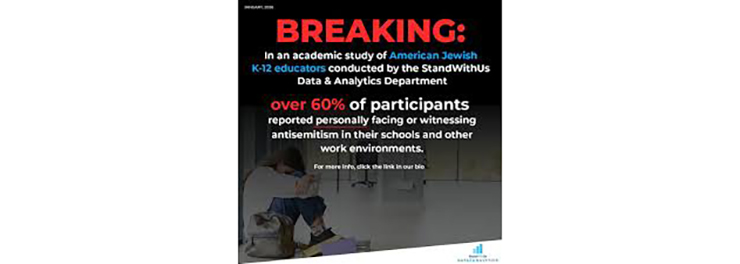
The survey, which received formal approval from the country’s leading scientific ethics committee, represents one of the first comprehensive empirical efforts to document antisemitism specifically targeting Jewish educators in American primary and secondary education. Drawing from a national sample of 584 respondents, the findings are stark. More than 61 percent of participants reported that they had either personally experienced or directly witnessed antisemitic conduct in their professional environments. Even more alarming, nearly half of respondents reported encountering antisemitism originating from teachers’ unions — organizations that are ostensibly designed to protect educators’ rights, ensure workplace safety, and advocate for professional dignity.
As The Algemeiner report detailed, this is not merely a matter of isolated incidents or interpersonal prejudice. The data points to structural dysfunction, institutional indifference, and ideological normalization of antisemitic attitudes within educational ecosystems that are legally bound by civil rights protections. School districts across the country, obligated under federal and state civil rights laws to prevent discrimination, appear to be failing at the most basic levels of prevention and response. While 65 percent of surveyed educators stated they are required to attend anti-bias or equity trainings, only 10 percent reported that antisemitism is meaningfully addressed in those programs — a staggering omission given the prevalence of reported incidents.
Dr. Alexandra Fishman, StandWithUs’ director of data and analytics, described the findings in language that underscored both their gravity and urgency. “This first-of-its-kind empirical study sought to understand antisemitism experienced by Jewish educators in K–12 education,” she stated, according to The Algemeiner report, “Over 60 percent of respondents reporting that they personally experienced or witnessed antisemitism in their profession is an astounding number.” Fishman emphasized that while the study is still undergoing formal peer-review processes, the organization felt morally compelled to release preliminary results now. “Jewish educators cannot wait for academic publishing timelines to address the discrimination they face daily in our schools,” she said.
The Algemeiner report noted that these findings align with a broader pattern observed across American educational institutions since the October 7, 2023 Hamas terror attacks against Israel and the subsequent war in Gaza. Since that moment, Jewish communities have documented a dramatic escalation in antisemitic incidents nationwide, with schools emerging as one of the most vulnerable and contested spaces. In classrooms, faculty lounges, union meetings, and professional development forums, Jewish educators increasingly report being marginalized, silenced, or targeted under the guise of political discourse, social justice activism, or “anti-Zionist” expression.
Alyson Brauning, interim chair of the National Education Association’s Jewish Affairs Caucus, captured this contradiction succinctly. “These findings, while disturbing, do not come as a shock,” she said, as cited by The Algemeiner. “They reveal a serious disconnect between stated commitments to equity and the lived realities of Jewish educators.” Her words point to a deeper paradox: institutions that publicly champion diversity, inclusion, and equity often fail to extend those principles to Jewish identity, Jewish history, or Jewish vulnerability.
Advocacy organizations have increasingly warned that antisemitism in K–12 education is being fueled not simply by ancient prejudices, but by the systematic importation of radicalized anti-Zionist ideologies into curricula, pedagogy, and school culture. As The Algemeiner has reported, this ideological shift has blurred the line between legitimate political discourse and ethnic or religious hostility, creating environments where Jewish educators are treated not as professionals, but as proxies for geopolitical conflicts.
This dynamic was starkly illustrated in New York City earlier this week. StandWithUs, alongside the North American Values Institute (NAVI), formally contacted the city’s public schools chancellor regarding the promotion of an explicitly anti-Israel event by the United Federation of Teachers (UFT). The event, organized by a group calling itself “NYC Educators for Palestine,” explicitly targeted children aged six to eighteen — a move that advocacy groups argue violates New York City’s prohibition on political indoctrination by school personnel. Screenshots included in the letter show educators advertising the event while explicitly invoking their status as public school teachers, blurring the boundary between private activism and government-associated speech.
The Algemeiner reported that the groups warned such actions risk misleading families into believing the events are sanctioned by the Department of Education itself. In their letter, they stressed that speech by public school teachers may constitute government speech depending on context — a distinction that carries profound legal and ethical implications. When educators leverage their professional authority to promote ideologically charged narratives, the classroom ceases to be a neutral learning environment and becomes a site of political socialization.
The controversy surrounding the UFT is not new. According to a report published by the Defense of Freedom Institute and cited by The Algemeiner, the union has evolved from fostering ideological sympathy for anti-Zionist narratives among students to actively seeking political influence by endorsing candidates aligned with those views. The UFT’s endorsement of NYC Mayor Zohran Mamdani — a self-described socialist who has publicly expressed support for Hamas-linked rhetoric — was widely criticized as a normalization of extremist ideology within mainstream educational institutions.
Civil rights groups warn that the consequences of this ideological shift are not abstract. They manifest in tangible harm to students, teachers, and communities. Antisemitic vandalism, harassment, and violence increasingly trace their origins to narratives introduced in educational settings. On Thursday alone, local media reported the arrest of two fifteen-year-olds in Brooklyn accused of painting nearly sixty swastikas across a neighborhood playground — a chilling reminder that hate learned in theory often becomes hate enacted in practice.
Community activist Devorah Halberstam, speaking to WABC and quoted by The Algemeiner, articulated the frustration shared by many Jewish families. “Words are not enough. Condemning is not enough,” she said. “There has to be change. Immediate change.” Her statement reflects a growing sense that performative denunciations of antisemitism have replaced substantive institutional reform.
For Jewish educators, the psychological toll is profound. Many report feeling forced into silence, compelled to conceal their identities, or pressured to conform to ideological expectations that contradict their personal beliefs or communal ties. The classroom — once a sanctuary of intellectual exchange — has become, for many, a space of emotional risk and professional vulnerability.
The Algemeiner report emphasized that this is not merely a Jewish issue; it is a democratic one. When schools abandon neutrality, when unions politicize pedagogy, and when identity-based hostility becomes normalized under ideological cover, the integrity of public education itself is endangered. The erosion of trust between educators, institutions, and communities undermines the very foundations of pluralistic democracy.
StandWithUs’ decision to release preliminary findings before peer review reflects the urgency of the moment. The organization’s leaders argue that data, while essential, must not become an excuse for delay when discrimination is ongoing and harm is active. Their study seeks not only to document antisemitism but to force institutional accountability — to compel school districts, unions, and policymakers to confront realities they have too often ignored.
As The Algemeiner continues to document, the challenge now is whether American education systems will respond with reform or retreat. Will antisemitism be recognized as a legitimate civil rights issue requiring structural intervention? Or will it remain obscured beneath ideological rhetoric and bureaucratic inertia?
For the Jewish educators standing at the front of America’s classrooms, the answer is not theoretical. It determines whether they can teach openly, live safely, and work with dignity. Their struggle is not only for professional equity, but for the moral integrity of education itself.
In an era when classrooms increasingly reflect the fractures of the broader culture, the StandWithUs survey forces an uncomfortable reckoning: antisemitism is no longer confined to history books. It is present, institutionalized, and evolving — and the silence surrounding it is no longer sustainable.
